Today is World Elder Abuse Awareness Day.
Seniors are often targeted by fraudsters who use pressure, fear, trust, and emotional manipulation to steal money and personal information. Common frauds include investment fraud, prize fraud, relationship fraud, emergency frauds and fake fraud investigators.
Protect yourself and your loved ones:
- Slow down and verify before sending money or sharing information.
- Never share passwords or multi-factor authentication codes.
- Be cautious of unsolicited investment opportunities or urgent requests for money.
- Contact organizations using trusted phone numbers and websites.
- Talk to someone you trust before making financial decisions.
Learn more: https://t.co/bTVFY6Qtz4 #WEAAD
Fraud knows no borders. The CAFC was proud to support Disruption Week, bringing together law enforcement and industry partners to disrupt cyber-enabled fraud, identify fraud networks, and protect potential victims. #kNOwfraud
Scam Center Strike Force Announces Results of U.S. & Private Industry “Disruption Week”
“America is facing an unprecedented threat from industrial-scale, foreign organizations looking to prey on our citizens,” said @AAGDuva. “And unprecedented problems call for novel, bold solutions. As Disruption Week demonstrates, the Department’s Criminal Division will stand shoulder-to-shoulder with @USAttyPirro and her office, U.S. and foreign law enforcement, and any private sector firms that commit to joining the battle to save American resources from flowing to criminal groups abroad.”
Read more: https://t.co/GKmiMoeBCJ
The Canadian Anti-Fraud Centre is proud to have supported Operation FRONTIER+ III, an international sprint aimed at identifying and disrupting fraud, including illicit transactions, suspicious bank accounts, fraudulent websites, telephone numbers, email accounts, and money mule activity linked to transnational fraud networks.
Between March 10 and May 7, 2026, financial crime and fraud experts from around the globe worked together to coordinate disruptions, share intelligence, and support victims, demonstrating the level of international cooperation required to combat these borderless threats.
Full news release: https://t.co/xetTsYzuXW #kNOwfraud
We encourage Canadians to stay alert for scams using the Canada Strong Fund name. The Fund is not yet open for public investment. Details on how to participate as a retail investor will be provided by the federal government.
🚨 When you report a suspected #scam, the info helps the @canantifraud and its partners combat fraud and cybercrime.
If you were a victim of a scam, you should also report it to your local police. https://t.co/MwXHy9X1OR #BeScamSmart#CdnTax
🚨Phishing Alert! Fake Parking and Speeding Infraction Text Messages
As summer approaches and travel increases, fraudsters are sending fake parking and speeding infraction messages to Canadians across the country. These messages may appear to come from a municipality, government agency, or parking authority. They often create a sense of urgency and include links requesting payment and personal information. Fraudsters rely on urgency and fear to pressure victims into making payment or sharing sensitive information.
Protect Yourself:
• Do not click links in unexpected messages
• Contact the municipality, government agency, or company directly using an official phone number or website
• Do not use the contact information provided in the suspicious message
Lear more about phishing and how to protect yourself: https://t.co/S9ZzFS3cC3 #kNOwfraud
⚠️ CONSUMER ALERT: As demand surges for tickets to major summer events like the FIFA World Cup 2026™, concerts, and festivals, the Bureau warns consumers to stay vigilant when buying event tickets. 🎫
For tips and to learn how to report fraud ➡️ https://t.co/GNytKwumk0
Beware of jobs offering free travel for a delivery. It's a setup. Border officers can inspect all items crossing the border. If caught with drugs, consequences are serious in Canada and abroad. Learn more: https://t.co/Y7sjiE1iV7
🚨NEWS ALERT🚨
The Canadian Anti-Fraud Centre (CAFC) worked with a Canadian financial institution to help recover approximately $3.5 million CAD linked to a sophisticated payment redirection fraud targeting a Quebec business.
In April 2026, fraudsters targeted a business involved in a high-value commercial transaction. The fraud involved a form of spear phishing where criminals impersonated legitimate contacts and manipulated email communications to provide fraudulent payment instructions.
The incident was quickly reported to the CAFC, which allowed the centre, financial institutions and investigative partners to coordinate response efforts quickly.
Full news release: https://t.co/ao4PxofmYJ #kNOwfraud
🚨 Fraud Alert: Calendar Phishing
Fraudsters are sending emails that look like invoices or subscription notices from companies such as PayPal or Norton. These emails include or trigger a calendar invite, that are often automatically added to your device calendar.
How it works:
• The invite may appear legitimate and include a “Join meeting”
or “View details” link.
• Clicking the link may redirect you to a fake login page designed to steal your username and password.
Protect yourself:
• Don’t click links in unexpected emails or calendar invites
• Verify the sender before responding
• Never enter your credentials after clicking a suspicious link
• Enable multi-factor authentication
For more information on how to protect yourself from fraud: https://t.co/7SFRdRm0Uk #kNOwfraud
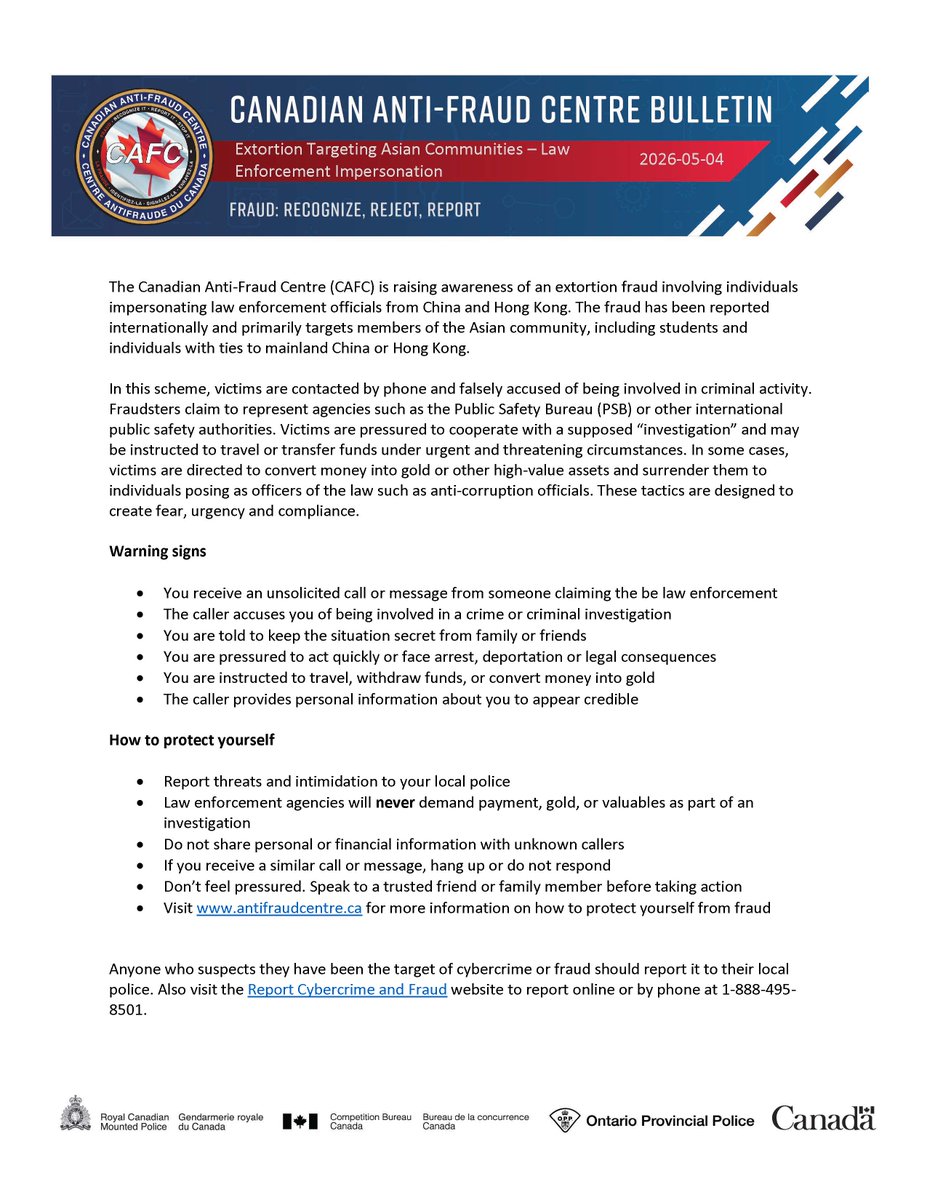
The Canadian Anti-Fraud Centre (CAFC) is raising awareness of an extortion fraud involving individuals impersonating law enforcement officials from China and Hong Kong. The fraud has been reported internationally and primarily targets members of the Asian community, including students and individuals with ties to mainland China or Hong Kong.
In this scheme, victims are contacted by phone and falsely accused of being involved in criminal activity. Fraudsters claim to represent agencies such as the Public Safety Bureau (PSB) or other international public safety authorities. Victims are pressured to cooperate with a supposed “investigation” and may be instructed to travel or transfer funds under urgent and threatening circumstances. In some cases, victims are directed to convert money into gold or other high-value assets and surrender them to individuals posing as officers of the law such as anti-corruption officials. These tactics are designed to create fear, urgency and compliance.
For more information: https://t.co/ApOQdig0Tm #kNOwfraud
The RCMP’s NC3 was proud to partner with @TorontoPolice on Project Lighthouse, Canada’s first investigation into the use of “SMS blasters”. This operation shows how police continue to adapt to new threats: https://t.co/bIE3arecnU
The Canadian Anti-Fraud Centre (CAFC) is warning the public about ongoing frauds involving the compromise of online accounts through the misuse of one-time passcodes (OTPs).
Fraudsters are finding new ways to access online accounts, including on social media platforms such as Facebook, X (formerly Twitter), Snapchat and WhatsApp, as well as email, banking platforms, and online telephone accounts. In many cases, perpetrators will initiate a login attempt using your phone number or email address. This triggers a legitimate one-time passcode to be sent to you. The perpetrator will then contact you often impersonating a trusted organization, service provider, or even someone you know and request that you share the code. Once the OTP is shared, fraudsters can take control of your account, lock you out, and use your identity to target your contacts or commit further fraud.
Learn more: https://t.co/xTU5PXA3it #kNOwfraud #showmetheFRAUD #BeScamSmart
Fraud can affect anyone and the impacts on individuals can be serious and far‑reaching. Excellent collaboration between #NorthBayOPP and @CanAntiFraud, working together to build awareness, answer questions and strengthen relationships that help community members protect themselves and prevent fraud.
-
La fraude peut affecter n’importe qui et elle peut avoir des répercussions graves et profondes sur les individus. Excellente collaboration entre le détachement de North Bay de la #PoliceProvinciale et @AntiFraudeCan en entreprenant des initiatives conjointes afin d’accroître la sensibilisation, de répondre aux questions et de renforcer les relations qui aident les membres de la collectivité à se protéger et à prévenir la fraude.
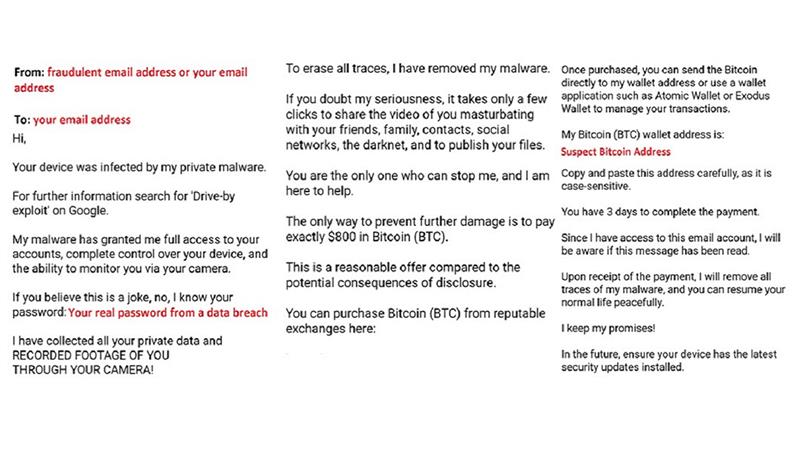
🚨Fraud Alert: Extortion Email🚨
The Canadian Anti-Fraud Centre is seeing an increase in reports of extortion emails that may appear to come from your own email address or from a fraudulent email address. In some cases, these emails can include a password you are currently using or may have used in the past. The email will accuse you of being recorded during private or inappropriate activity and threaten that if you don’t send a Bitcoin payment immediately, the video will be shared with all of your contacts.
What you need to know:
• The password was more than likely obtained from a previous data breach
• The sender does not have access to your camera
Protect yourself:
• Change your passwords
• Report the email: https://t.co/njkQidzLYq
For more information on extortion: https://t.co/Lkp13BsrlV #kNOwfraud #showmetheFRAUD #BeScamSmart
⚠️Public Warning: Investment Scam ⚠️
The RCMP is warning Canadians about a sophisticated investment fraud involving the AI‑driven impersonation of well‑known economist David Rosenberg.
Fraudsters used fake social media ads, chat groups, and fabricated investment gains to deceive victims, resulting in significant financial losses.
📞Report suspected fraud to the Canadian Anti‑Fraud Centre at 1‑888‑495‑8501
YouTube 🔗https://t.co/orG0nT3KUz
#FPM2026 #FraudPreventionMonth #RCMP #Fraud #AI #Investments