Free Android app with 37+ charts and expanding.
These are my opinions only and are not Financial or Investment advice. Consult an investment professional.
Version 1.1.5 of Canada Stats Hub for Android is now available! More than one hundred charts and the ability to create your own. You can now download data directly from StatsCan. Install now!
See link and instructions in the comments ->>>
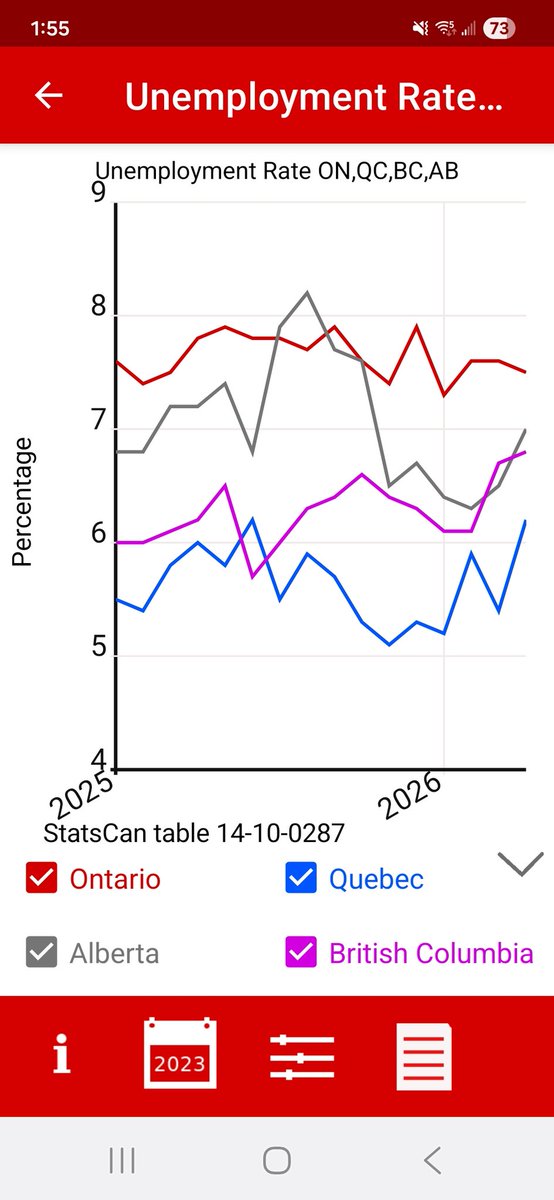
The overall unemployment rate fell to 6.6% last month. It has been around that region for 20 months now. Ontario unemployment is the worst, but slightly trending lower. BC, Alberta and Quebec are trending higher.
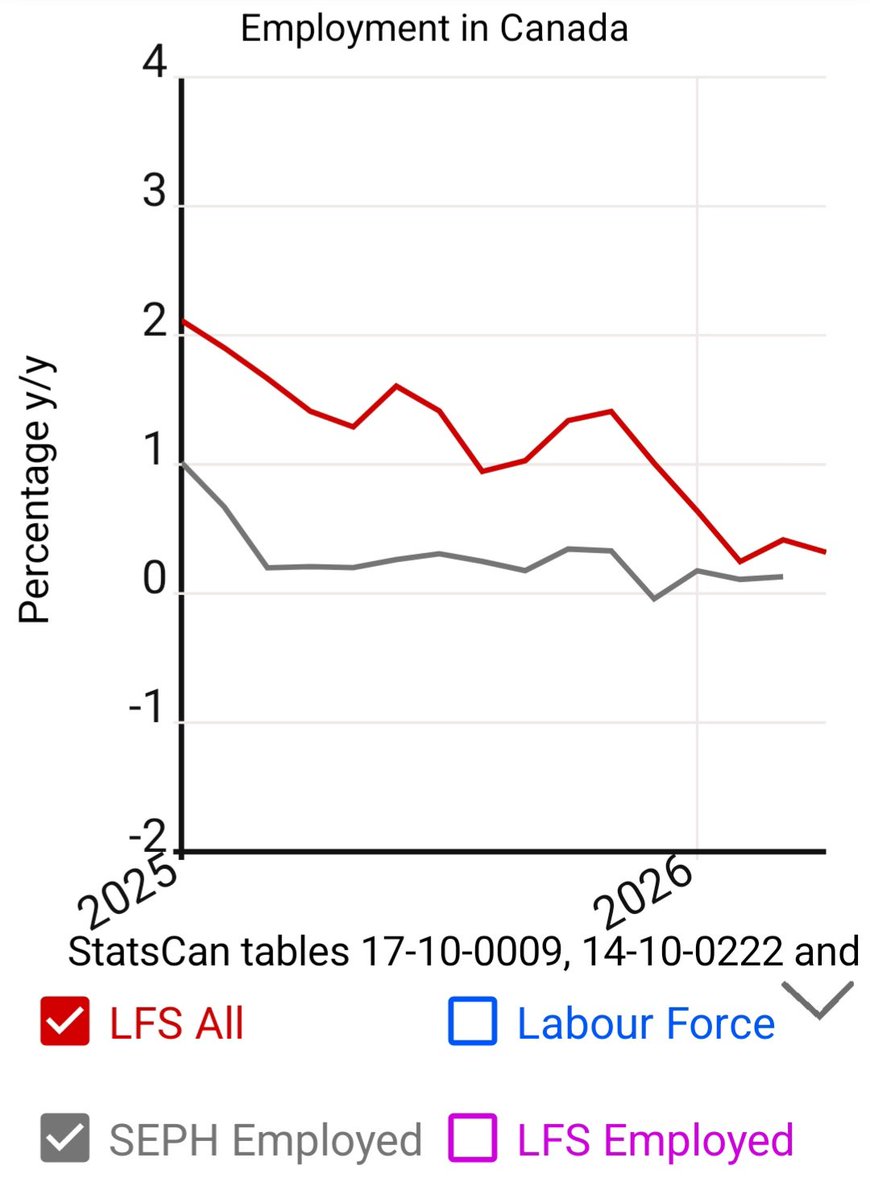
@DoeDoe1480871 I wouldn't read too much into the monthly LFS. It looks like a random number generator. I am disappointed that is going a different direction than the SEPH again...
Breaking! StatsCan just realeased the May LFS and Canada unexpectedly added 87k jobs. We are back at the LFS and SEPH data (payroll) not making sense again. Will see what the April SEPH prints in a few weeks.
StatsCan will realease the May LFS employment data tomorrow. I am expecting another bad print considering the recent trend towards no job creation over 12 months. The SEPH is already there. Having said that, monthly figures are not very reliable.
@franco_nomics@taxpayerDOTcom $1000+ in interest is just for federal debt. Other levels of government binge too, which more than doubles it. General gov interest is at $109 billion in 2025, which is $2600 per year per person. $5100 per worker. 🚀😱
Yikes. It just costed $1 trillion in AI investment to create chatbots that help hackers take over high profile accounts. In this case, hackers just ask to reset high profile Instagram accounts. This must be the the most stupid bubble ever (after the tulip one).
@canada_spends The Canadian GDP is at only 0.5% YoY. Even worse, it has not grown at all since July 2025. I will be shocked if we grow more that 0.5% by December.
Final chart on Q1's GDP: services are growing at 1% YoY, which is very slow historically. All the top sectors are mostly not discretionary purchases ( "consumer economy"). Real estate is mostly made of rents. That includes "rent to yourself" as a home owner.
2/2 The construction slow down is a very rare event over 30 years. This indicates that we are not close to a bottom. Previous events (ex pandemic) are: 1998, 2008,2016 and 2018.
The face of a recession: other that wholesale and retail trade at +1% YoY, the other top goods producing sectors are ALL in "recession". Remarkably, construction is at -1.4% negative YoY. This has only happened a few times during recessions or very slow economies (see thread).
2/2 For the incredulous folk out there, here is a chart up to 2019 showing how low 1% YoY services GDP is. Services are most of GDP, but it is mostly mandatory expenses: government, education, healthcare and rents. This shows that households are cutting duscretionary services.
Here goes another interesting look into Canada's Q1 recessionary GDP. Goods GDP is clearly in a recession, but Services is at 1% YoY. That sounds better, but it is not: we only saw such a low sustained print in 2008, 2016 (ex pandemic). 2026 seems to be worse than 2023 so far.
Canada's Q1 GDP shows that household demand for durable and semi durable goods are at recession levels (-2.9% and 0.7% respectively). Non durable good are holding up better. These levels only occurred a handful of times in the last 30 years.
The Q1 GDP shows that households are holding back on spending in good (in particular durable goods). Services recovered a bit, but a lot of it is mandatory spending: rents, healthcare, insurance and education.
Last week, Michael Harnett of BofA included this chart in his May 22 "Flow Show."
As this reposted thread below details, we have not seen the market this concentrated around a single theme in 150 years.
Follow up on Q1 GDP by expenditure: household consumption is actually fairly stable. The last four years has seen the government expenditure going to the moon (deficits). As the deficit level stabilizes, we reached a technical recession. Debt based growth has reached its limit.