@timdexterr @BBSimons I'm always fascinated by his energy, depth of knowledge, and consistency. In the future, we'll need a Bright Simons Institute to memorialize & institutionalize his works. Today, many might take what he's doing for granted but one day we'll understand the value of what he does.
God bless @pazunre and his team at Khaya! What an incredible innovation!
I was just playing around with Khaya Chat and decided to test it. Via audio, I told it that I was planning to conduct research in the Amedzofe area and needed some guidance to ensure success. The response? It immediately advised me to have a clear research question and went on to provide other useful recommendations. What impressed me even more was that although I speak Tongu Ewe, I deliberately switched to the Anglo/Ewedome variant; yet, Khaya Chat still understood my query perfectly, regardless of my accent.
Well done @pazunre
Accra flooded again yesterday. June 3. The anniversary of the 2015 disaster.
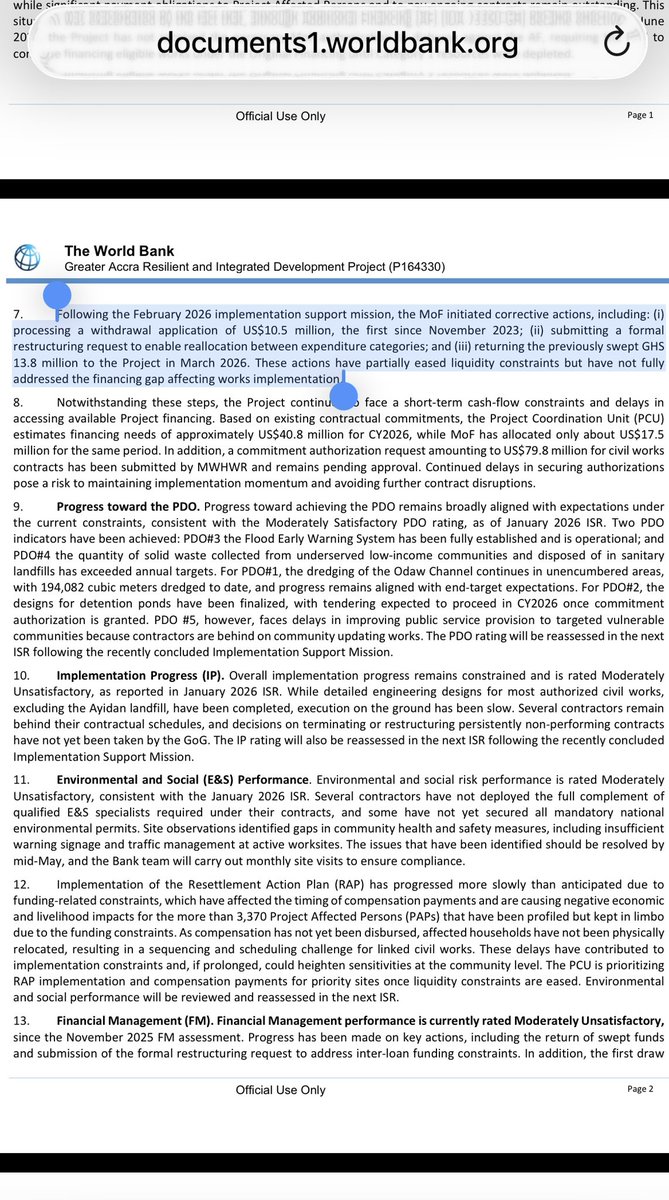
We have a $350 million World Bank project called GARID designed specifically to fix this. But somewhere between the debt default, the IMF programme, and the fiscal consolidation that followed, it became a casualty.
Ghana’s economic crisis and resulting fiscal consolidation efforts forced spending cuts. The result was 16 months without a single disbursement. For instance, government introduced a funding ceiling on project disbursement last year and swept 13.8m cedis from the project’s designated account. While Accra flooded every season, contractors demobilized and drain works stalled.
Six years in, only 40% of $350 million has been used. Detention ponds not built. The Ayidan landfill not built. Nima’s wastewater sewers not completed. Over 3,370 displaced persons profiled but not yet compensated. And the entire $150 million additional financing approved in 2023 remains completely untouched.
The World Bank has now warned Ghana formally: confirm sustained funding disbursement or the project’s continuation is at risk.
To its credit, government has begun responding. The swept funds were returned in March 2026, a withdrawal application of $10.5 million was processed, and a formal restructuring request submitted. Steps in the right direction, but the World Bank’s own assessment notes these have only partially eased the financing gap.
June 3 demands more than remembrance. It demands follow-through
@BBSimons What exactly is the reason I couldn’t see your posts for such a long time until today? I had to dig this up! I turned off my notification only to turn it back on. @BBSimons, I thought you had taken a break from social media.
The Ghana Football Association needs a surgical reset. Sacking Otto Addo may be necessary, but it is far from sufficient. We must learn from Morocco and Senegal by adopting a long-term strategy focused on recruiting and nurturing homegrown talent, investing in sports infrastructure, and building a system that supports the transition of young players into professional football.
#GFA @OttoAddo #Football #Ghana #worldcup
The difference between Manasseh Azure and others like yourself lies in the analytical framework used to understand racialized chattel slavery.
Manasseh relies on a colonial framework that begins his analysis from African merchants and works upward. The problem is that he often ends the conversation at the role of African merchants and then invites everyone to reflect.
You, on the other hand, employ a decolonial framework. Your analysis starts from the global capitalist design that gave impetus to African merchants to participate in the Transatlantic slave trade.
In fact, Azure’s approach to deconstructing racialized chattel slavery mirrors the colonial framework that historically blamed indigenous African communities for environmental degradation that did not exist prior to colonial intervention. Peasant farmers were already growing coffee and other indigenous crops, particularly in East Africa.
It was not until colonial intervention that indigenous farmers were pushed to abandon their practices. These practices were already adapted to the environment. The academic literature shows that colonizers labeled them “unscientific.” They then weaned people off these systems and imposed new techniques designed to meet global commodity demands driven by distant capitalist markets.
This is why political ecologists have long critiqued colonial frameworks. These frameworks blame environmental degradation on local people while ignoring the global commodity chains and overconsumptive Western lifestyles that actually drove ecological change. Western science was used to justify replacing sustainable indigenous systems.
So in summary, just as indigenous people were already growing coffee before colonial intervention, Africans already had systems of servitude with a completely different logic and mode of operation before the arrival of European slave merchants. However, global demand, racialized ideologies, economic logic, incentives and threats, manipulation, logistics, and ultimately the structures designed by European merchants fundamentally transformed and scaled up that system. The result was the massive, dehumanizing machinery of the Transatlantic slave trade.
Manasseh Azure needs a different conceptual framework to properly contextualize the role of European merchants. Only then would he see that what happened could not have occurred without a carefully constructed international trade system imposed on traditional African societies.
This is not to absolve African intermediaries of their agency or role in slavery. It is to properly situate that role within a broader system. That is why conversations about reparations for racialized chattel slavery disproportionately focus on European capitalists.
It seems you have read a lot on the subject matter! I hope you'll take some time off your busy schedule to argue and provide counter-arguments against reparations, including monetary reparations, in an intellectually honest manner. I would like you to steelman opponents’ views and then provide your counter-arguments. But start with a historical context, purely to enable many of us to properly ground the debate and make an informed judgment. You can add references for further reading. Thanks.
@barkervogues
For a few years now, a group of us have tried to explain that the biggest challenge in African democracies like Ghana, Nigeria, and Kenya is not really the POLITICS.
The real mess is in POLICY. We call this KATANOMICS.
But we have done most of our explaining using essays. Everyone tells us, however, that reading nowadays is hard! People are too swamped and busy.
So, we are trying our hands at using videos and photos. 😊
First video:
https://t.co/Sf5XeA8VwY
We are new to this so forgive the quality and focus on the message. But we are very welcome to all feedback. Keep them coming.
@BBSimons" wries..For a few years now, a group of us have tried to explain that the biggest challenge in African democracies like Ghana, Nigeria, and Kenya is not really the POLITICS.
The real mess is in POLICY. We call this KATANOMICS.
But we have done most of our explaining using essays. Everyone tells us, however, that reading nowadays is hard! People are too swamped and busy.
So, we are trying our hands at using videos and photos. 😊
First video:
https://t.co/zLNWcn6z15
We are new to this so forgive the quality and focus on the message. But we are very welcome to all feedback. Keep them coming. "
I said this in 2024 and I'll say it again, we must begin to think about how to institutionalize the works of @BBSimons for future generations. I don't think Ghanaians appreciate Bright enough for the thankless job he's doing for not just Ghana but Africa as a whole! The way @BBSimons explained the politics-policy dynamics on the webinar organized by NEXTIER is nothing short of insightful. God bless you @BBSimons. I really enjoyed the your presentation and the questions were insightful. Please share information about any of your next presentations with me. I want to continue to glean jewels of knowledge from your vineyard (Previous name: Coffie Jaydee. Now Dessy Nabas 😊)
@timdexterr @BBSimons I'm always fascinated by his energy, depth of knowledge, and consistency. In the future, we'll need a Bright Simons Institute to memorialize & institutionalize his works. Today, many might take what he's doing for granted but one day we'll understand the value of what he does.