Remembering a By-gone era. Hobby account; no politics, no agenda. Most images pre-1950 & #colourized. Feed by @shleyNewall. @apt613 alumni. #CdnHistory
New on my blog – the previously untold tale of Rochester's Victoria Brewery, purported to be the 1st in what would become Ottawa: https://t.co/KSaGX87vOv
1/2 Join us this weekend for #DoorsOpenOttawa!
The House of Commons and its partners will be on site to answer your questions about the Parliamentary Precinct rehabilitation.
Good morning, and welcome to June 4th.
It was on this day in 1613, that explorer Samuel De Champlain arrived in what is now Ottawa on his adventure up the Ottawa River.
His journal makes note of very specific locations, of which I will do my best to interpret below:
“On the fourth day we passed near another river coming from the north, where tribes called Algonquins live. This river falls into the great river St. Lawrence, three leagues below the Falls of St. Louis, forming a large island of nearly forty leagues? This river is not broad, but filled with a countless number of falls, very hard to pass.
Sometimes these tribes go by way of this river in order to avoid encounters with their enemies, knowing that they will not try to find them in places so hard to access”
This would seem to point to what is the Gatineau River, although it is somewhat cryptic in mention…but what he says next is not:
Champlain enters the Ottawa Area and describes the Rideau Falls which is across from the Gatineau River:
“Where this river has its debouchure is another coming from the south,’ at the mouth of which is a marvellous fall. it descends a height of twenty or twenty-five fathoms with such impetuosity that it makes an arch nearly four hundred paces broad. The savages take pleasure in passing under it, not wetting themselves, except from the spray that is thrown off.”
“When the savages desire to enter the river (The Rideau River) they ascend the mountain, carrying their canoes, and go half a league by land. The neighboring country is filled with all sorts of game, so that the savages often make a stop here.
The Iroquois also go there sometimes and surprise them while making the passage.”
Champlain continues paddling up the Ottawa River and reaches the mighty Chaudiere Falls.
“We passed a fall a league from there, which is half a league broad, and has a descent of six or seven fathoms. There are many little islands, which are, however, nothing more than rough and dangerous rocks covered with a poor sort of brushwood.
The water falls in one place with such force upon a rock that it has hollowed out in course of time a large and deep basin, in which the water has a circular motion and forms large eddies in the middle, so that the savages call it Asticou, which signifies boiler.’ This cataract produces such a noise in this basin that it is heard for more than two leagues.”
At Chaudiere Falls Champlain moves up the Ottawa River, portaging.
“Here the savages took their canoes, my Frenchmen and myself our arms, provisions, and other necessaries, and we passed over the rough rocks for the distance of about a quarter of a league, the extent of the fall.
Then we embarked, being obliged afterwards to land a second time and go about three hundred paces through copse-wood, after which we got into the water in order to get our canoes over the sharp rocks, the trouble attending which may be imagined. I took the altitude of this place, which I found to be in latitude 45° 38.”
That’s spot Champlain stood was Brebeuf Park, across from Remic Rapids.
Then Champlain moves on past Ottawa and enters the wide section past Britannia…past Dunrobin…Lac Deschenes.
“In the afternoon we entered a lake, five leagues long and two wide, in which there are very fine islands covered with vines, nut-trees, and other excellent kinds of trees. Ten or twelve leagues above we passed some islands covered with pines. The land is sandy, and there is found here a root which dyes a crimson color, with which the savages paint their faces, as also little gewgaws after their manner.
There is also a mountain range along this river, and the surrounding country seems to be very unpromising. (Gatineau Hills)
The rest of the day we passed on a very pleasant island.”
That island would have been Isle Mohr near Constance Bay.
His journey continues the following day.
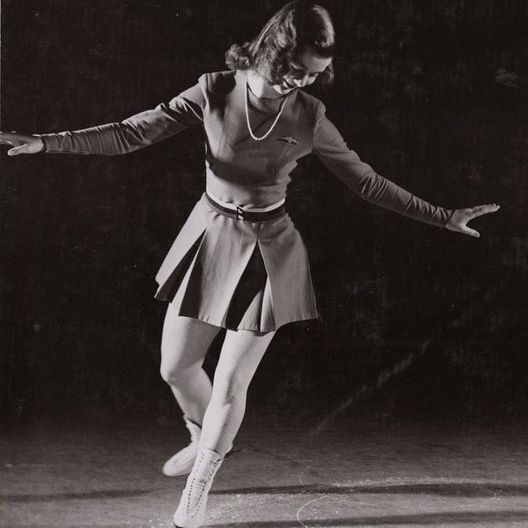
As Canada emerged from the Second World War, a figure skater captured the hearts of Canadians.
She was called Canada's Sweetheart and she took the skating world by storm.
To this day, she is beloved by many.
This is the story of Barbara Ann Scott.
📸 LAC
🧵 1/12
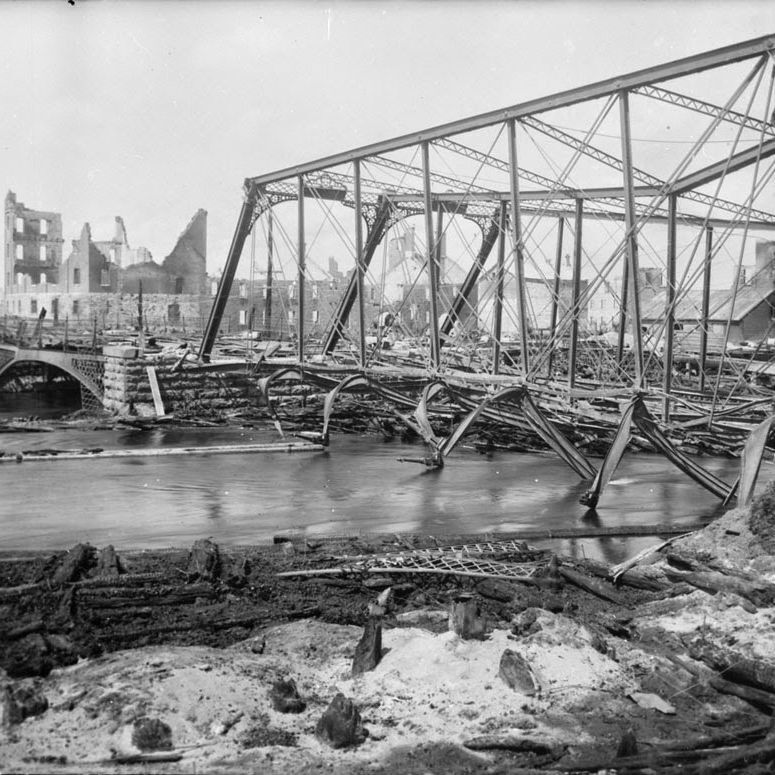
On April 26, 1900, a small fire in a defective chimney in Hull (now part of Gatineau), Quebec spread through the city. By the next day, 66% of Hull was gone, along with 20% of Ottawa.
This is the story of the Hull-Ottawa Fire.
📸 All photos courtesy of LAC
🧵 1/12
My #Sens Arenas of Yesteryear blog post has just been updated w/ all new colourizations (i.e. original colourizations upgraded, + new ones added). Covering Dey's Rinks 1, 2 & 3, Rideau Rink (feat. Lord Stanley), & the Auditorium (feat. Elvis). https://t.co/nB0Lkl3xgT
My #Sens Arenas of Yesteryear blog post has just been updated w/ all new colourizations (i.e. original colourizations upgraded, + new ones added). Covering Dey's Rinks 1, 2 & 3, Rideau Rink (feat. Lord Stanley), & the Auditorium (feat. Elvis). https://t.co/nB0Lkl3xgT
The Ann Sisson
An Ottawa River paddle wheeler steamship built in 1857 which later carried the future King.
This is my tale of finding its wrecked remains…
https://t.co/hB4mimaWnk
New on my blog: Time-Travelling Through #Ottawa History. Join me as, among other things, I partake in the Stony Monday Riot, & win the Stanley Cup!
Full (mini) photo essay here: https://t.co/boQ0b8Lfkt
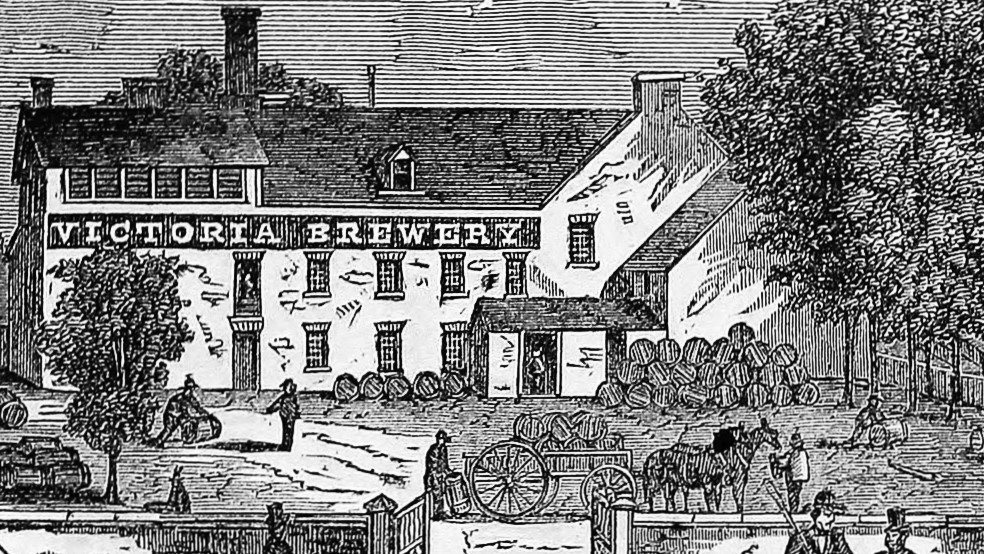
THE OLD BERRY BREWERY 🍺
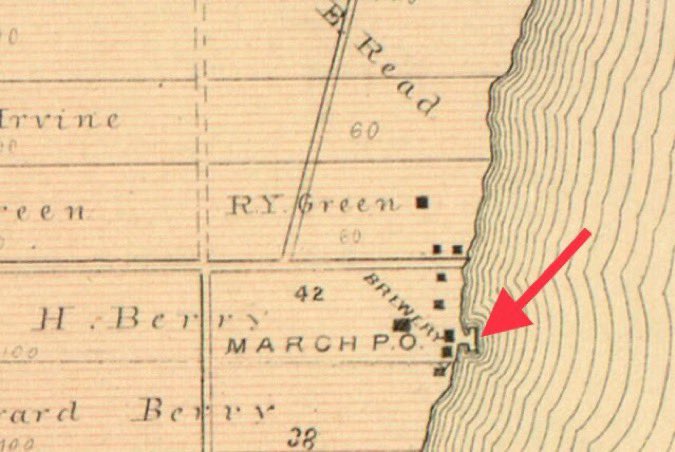
On a map from 1879, a little known brewery is shown to exist on the Ottawa River near Pinhey’s Point...
The brewery was owned/operated by W.H. Berry who was also the Reeve of March Township...this brewery had a shipping pier....
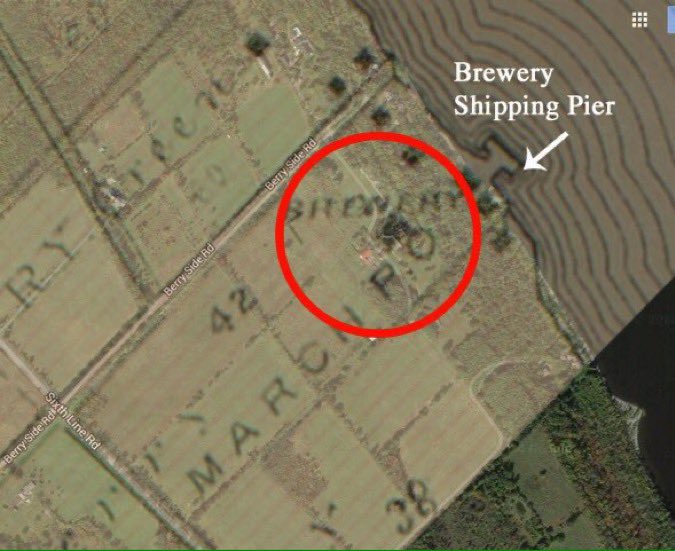
If we overlay a current map with the 1879 map, we can what is left of the brewery...
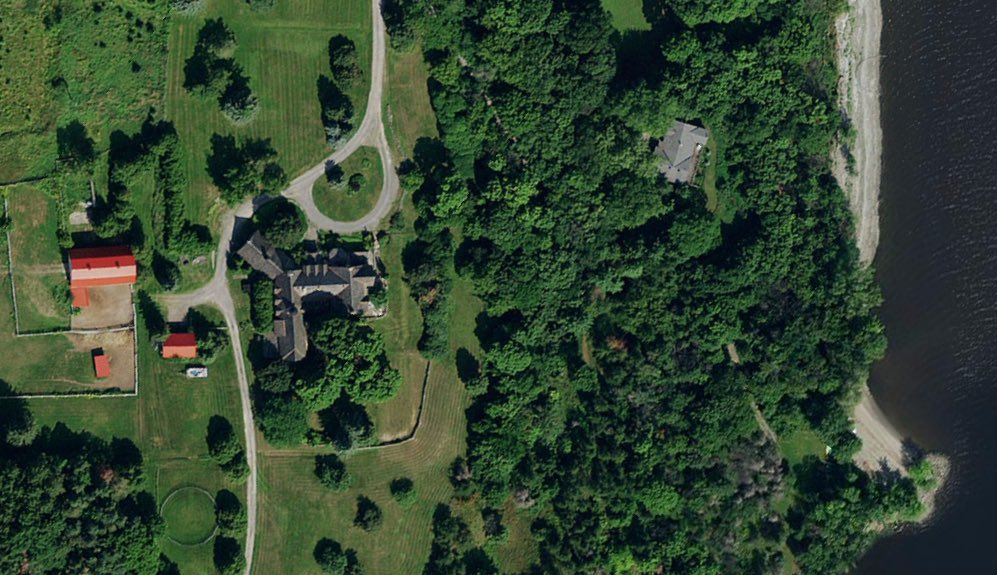
It seems this old brewery and/or residence is still there. The old pier can still be seen on the shoreline.
I wonder what beer they made? Cheers!
@twitandrewking I wonder if he was related to Godfrey Berry, who operated a brewery on Nepean Point / Kiweki Point. (Clipping from 1852.) That brewery presumed to be at Steamboat Landing, where George Stirling ultimately est. his Dominion Brewery (by 1858).
APRIL FOOLS! Alas, one of my grandfathers was a bus driver & the other a reluctant lawyer, & both lived in the GTA. (The train/tunnel pic is AI, but pretty much how I presume it looked.)
You can read my 2025 article on the Brading beer train & tunnel here: https://t.co/qmvKADW56K