@AmericanReform_@BishopBarron He meant the people inside the church the he was talking to and the people watching it at home (outside the church).
Delete this lil bro thats retarded
@Thomisticae Wouldnt you say that Platonism in its right form is compatible with Catholicism?
Marsilio Ficino: Theologia Platonica, for example?
@Thomisticae
@DWise69763 I dont know what are talking about.
Keep posting your little clips and shut up.
You never read any primary source on that topic, it also seems that your are totally fine that Hitler wanted to kill the pope.
But sure Hitler of course is a Catholic, whatever mate.
@DWise69763 It was ONE Bishop and not THE Catholic Church.
Hitler planned to kill Pope Pius XII.
He already lost his faith in Linz and even claimed:
“I do not go to church to attend the service. I only admire the beauty of the building,” February 27, 1942.
K. o. K., Seite 65
No, I meant by that that you are extremely stupid and unread. In what universe has the euthanasia only been condemned since Pius XII?
From the book “Kirchenkampf oder Katholikenverfolgung?”:
Aktion T4
In the period that followed, the resistance of Catholics against the forced sterilization of sick or “inferior” persons did not cease. The regime noted this with increasing bitterness. On 4 November 1936 Hitler complained to Cardinal Faulhaber that National Socialist race legislation was being fought from the (Catholic) pulpits. The curial authority responsible for the supervision of doctrine did not move a finger’s breadth away from upholding divine law. The Holy Office rejected direct sterilization once again on 24 February 1940 and, on 19 February 1941, placed the book of the Protestant theologian Wolfgang Stroothenke, Erbpflege und Christentum. Fragen der Sterilisation, Aufnordung, Euthanasie, Ehe, Leipzig 1940—which, among other things, advocated the killing of deformed children with the consent of the parents—on the Index of Forbidden Books. When the war broke out, Hitler considered the time ripe to implement the plans that had existed for some time. In July 1939 he ventilated the question of killing adult mentally ill persons; in August the preparations for this began. On 1 September 1939 he gave the order to kill malformed children and adult mentally ill persons (and the mentally weak!). The written formulation of the (orally issued) order for the killing of adult mentally ill persons was made at the end of October 1939 on a sheet bearing the title of the party chairman, was signed by Hitler, and backdated to 1 September 1939. Hitler rejected the issuance of a formal law because it would have made the plan known to the public; this he shrank back from. Hitler’s henchmen in the euthanasia action set to work. The killings were carried out in several institutions, of which Grafeneck and Hadamar are the best known. Surprisingly, the Protestant institutions in Bethel were spared from murder operations. Tens of thousands of mentally ill and mentally weak persons fell victim to the euthanasia program. For reasons that were to be treated in the same way, Hitler ordered on 24 August 1941 that the euthanasia action, insofar as it concerned adults, be stopped. However, the killing of malformed and idiotic children continued until the end of the war.
p. 521–522
Church protest against T4
For the last time the German bishops raised their voice against euthanasia in their pastoral letter of 19 August 1943. The attitude of the Catholic bishops, who publicly opposed the inhumanity and criminal actions of the regime, deserves high admiration. Kurt Nowak has rightly pointed out that they did not fear the grave accusations of treason, malicious intent, and undermining military morale in their protest. In this, it was not about the interests of the Catholic Church but about the defense of human rights. The German bishops received support from the Apostolic See and had in it a firm backing. The Holy Office declared on 27 November 1940, in a declaration confirmed by the Pope on 1 December 1940, that the killing of defective persons contradicted natural and divine law. Thus the judgment stands rightly: the Catholic Church stood united against euthanasia. Kurt Nowak noted “the uncompromising nature” with which the murder of the sick was condemned on the Catholic side. The bishops did everything conceivable to preserve in the faithful a sound moral judgment. This was done through sermons and pastoral letters. Bishop Preysing’s pastoral letter on the law from Advent 1942, for example, was an unambiguous rejection of the perverted National Socialist concept of law and a clear confession of just law. The bishop demanded the recognition of the sovereign rights of God and respect for human rights. The faithful stood by their bishops. This became evident when the government used the effective propaganda tool of film to make euthanasia popular. The film “Ich klage an” triggered a lively discussion about “killing on request” and the “elimination of life unworthy of life.”
p. 523
I did not mean this conversation at all, but rather the one in which you had claimed: “Hitler saved us from communism”; in that one you did not answer me anymore.
I do not know why you did not address my source, in which I showed that Pius XII maintained contact with the German resistance, who were planning the assassination of Hitler.
I do not need to fulfill your own definition or criterion of a tyrant-killing; it is entirely sufficient that Hitler strove for the deliberate killing of unborn children and also attempted to murder Pius XII.
What do you call a ruler who tries of his own will to murder the Holy Father?
"On the very same day, Hitler gave his troops the order to occupy Italy and to march into Rome. Pius XII and the Vatican were thereby in the utmost danger.
Already upon receiving the news of the coup against the “Duce,” Hitler had ordered “to free Mussolini, to liquidate the Pope and the King.” That, at any rate, is what Colonel Erwin von Lahousen, an officer of the Abwehr, testified at the Nuremberg Trials.
He too was part of the circle of conspirators around Admiral Canaris, who was still waiting for the right moment for a coup d’état. General Oster had informed him of the order in the presence of Canaris.
“Was it the intention to abduct the Pope, or what action was to be taken against him?”, the investigating judge in Nuremberg asked in disbelief. —
“No, they wanted to kill him,” Colonel Lahousen was certain."
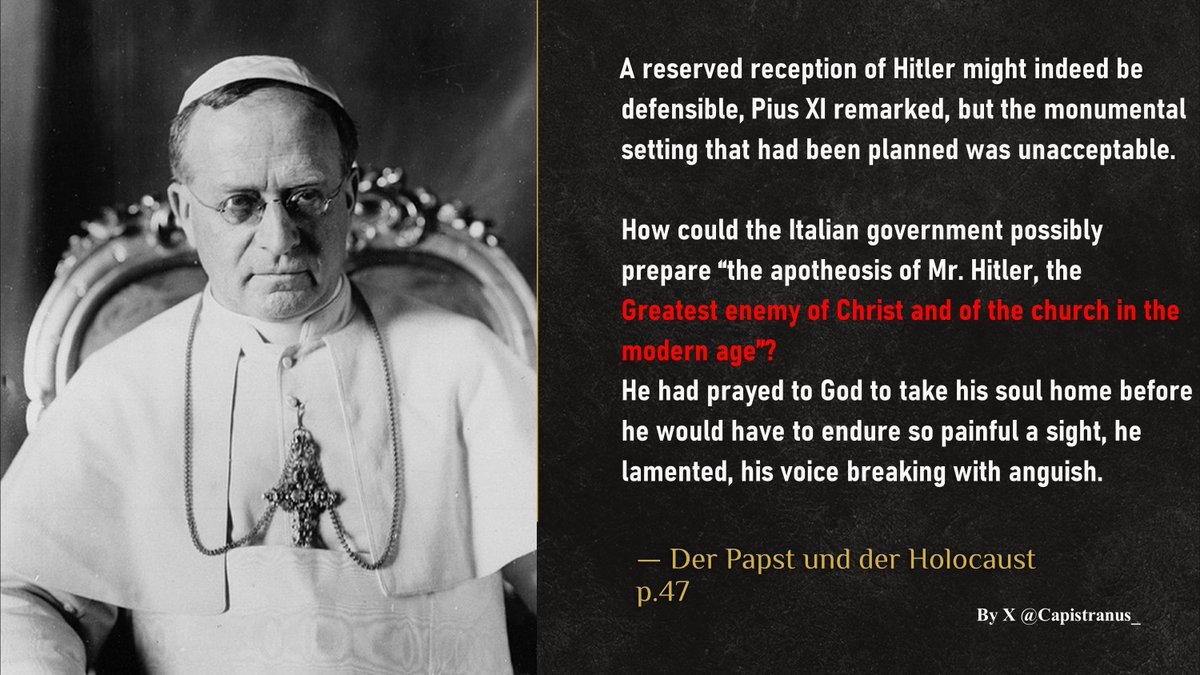
- Der Papst und der Holocaust, p. 318.