DePin landscape review: Is DePin a well-forgotten old thing? What are the prospects and challenges in this sector?
Lately, there's been a hype about something called DePin. More and more resources and influencers are starting to talk about it as a promising direction. But is it really so? Let's dive in 🧵👇
To start with, we've taken a look at the most prominent representatives of this trend (you can read more about them in the full review at the link below), which allowed us to highlight the main categories in this sector:
- Computational Networks,
- Energy,
- IOT,
- Organisation of wireless communication via wifi and different communication providers,
- Distributed real estate and car sharing capabilities.
And as it turns out, most of the projects in this sector of the crypto industry are from the 2016-2020 era. These are such projects as @iotex_io@helium@iEx_ec@golemproject@PowerLedger_io@akashnet@storj@Filecoin and many others. New projects include @Hivemapper@nosana_ci@ChirpDeWi and others. All of these projects have different life stages and degrees of development.
In addition, we examined the presence of major players in the DePin sector that offer proprietary non-public solutions, including Shell, KPMG, IBM and other niche players.
🔵 This all led us to the following conclusions: 🔵
🔹Most IOT projects are created by web2 teams who may have had little understanding of the rules of the game in web3 and failed to combine web2 development with tokenisation and incentives. In addition, the devices and protocols being developed were too niche to get any meaningful network effect in web3 and almost all projects are dead except in isolated cases. It is also worth considering that corporate players have much more resources, RnD base and technical capabilities to implement infrastructure solutions, the implementation of which can cost tens and hundreds of millions of dollars, which is not comparable to the capabilities of startups.
🔹If the implementation of blockchain technologies concerns critical infrastructure, then in such cases public solutions cannot be used, such solutions will not have tradable tokens and DAOs. These will be closed networks with proprietary settings that have nothing to do with public solutions and financial crypto-infrastructure. Especially since, for example, manipulation of tokens of an infrastructure project can create huge risks for potential disruption of critical real infrastructure in terms of economic security, for example in the case of PoS chains. And sometimes, as in the case of PowerLedger, the life of a token does not depend on the success or failure of the project at all.
🔹Single resource trading: Energy resources, and even data infrastructure (the same mobile networks), have ultimate owners and providers who are legally bound to own or maintain the infrastructure. And in the case of decentralised resource allocation, there is a very big question of ownership of these resources in relation to legal practices. Even the RWA sector, whose narrative has been churning for quite some time, has significant problems in this direction and cannot provide clear answers as to what happens if, for example, a derivative on a mortgaged property changes ownership due to hacking or theft.
🔹Energy resources tracking and certification: Certification mechanisms on blockchain have been in use for several years, but these are not public solutions. Again, this raises the question of whether public blockchain projects related to energy and resources and having their own tokens are really needed.
🔹In the case of distributed sharing the same question arises. After all, if, for example, an NFT derivative on property changes its owner, all rights are transferred to him. And what to do in this case? Issue a new NFT, which will no longer be original? Compensate huge potential losses in case the fraudster managed to realise the ownership right for example by selling the asset/closing the position? How will conflicts arising in the legal field be managed?
🔹Accordingly, DePin in the energy sector does not currently have an adequate regulatory framework and cannot be used for the real transfer of ownership and possession of resources.
🔹In the case of the decentralised computing example (except for verification of stored data, where consensus may be needed), blockchain has no application value at this stage of technology development except as a settlement layer for services provided. One of the few exceptions is the use of zk technologies and encryption to enhance privacy to sensitive areas. But again, the notional banking sector will not rely on a public solution with a tradable token that poses a risk of compromise.
🔹As originally stated - the idea of most DePin projects is very close to the web2 audience, which can serve as preconditions for the creation of deliberately fraudulent projects, taking advantage of the trust of an audience unaware of the subtleties of crypto-industry regulation and the principles of blockchain technologies.
🔹According to the token dynamics, we can conclude that the DePin narrative has indeed played out and influenced some of the projects in a positive way, but in crypto narratives change each other, and most likely, the momentum of the DePin narrative is already fading, the tokens of most of the projects are gaining back the growth. But tokens of projects related to decentralised computing are showing more or less stable dynamics.
🔹Also in the context of tokens of projects that are keeping afloat, one very important point should be highlighted: tokens of DePin projects are speculative in nature. The capitalisations of tokens are either too large in comparison with the companies' profits for them to be able to sustain the token through buybacks, or these mechanisms are not provided at all, and the token has little relation to the company itself and has no economic incentives or flywheel mechanisms.
🔵 Conclusion 🔵
Despite the fact that both in the real world a lot of startups are launched and fail, and in crypto there is a huge number of fraudulent projects on par with unicorns in all categories, DePin's sphere stands apart. The point is that DePin, especially in the energy sector, offers clear ideas that are understandable to the general public, not just web3 veterans, as is often the case with complex protocols.
Consequently, if we examine the overall landscape of DePin, we'll find that the most resilient positions are held not by projects originating from the web2 world, but those that inherently have more web3 components: decentralized data storage and decentralized cloud computing. This is because these solutions are inherently more inclined to incorporate web3 components, partly because web3 startups apply them.
It's also worth considering the fact that even the basic infrastructure at the L1 and L2 levels, along with cross-chain communication methods, is still undergoing dynamic development. Questions related to improving UI/UX in the crypto industry have only been addressed seriously in the last 2-3 years. The implementation of features like Account Abstraction is progressing at a relatively slow pace, and this could significantly enhance the interaction with products for end-users. Therefore, we are likely to witness a more extensive adoption of blockchain technologies and payment/stimulus methods through web3 as more robust and user-friendly solutions are developed in the future.
📖 Read the full article: https://t.co/K0liDhQizp
💡 For insightful updates & more, connect with us:
• Twitter: https://t.co/CGrGlas5DK
• DeBank: https://t.co/ZphYaoOJvY
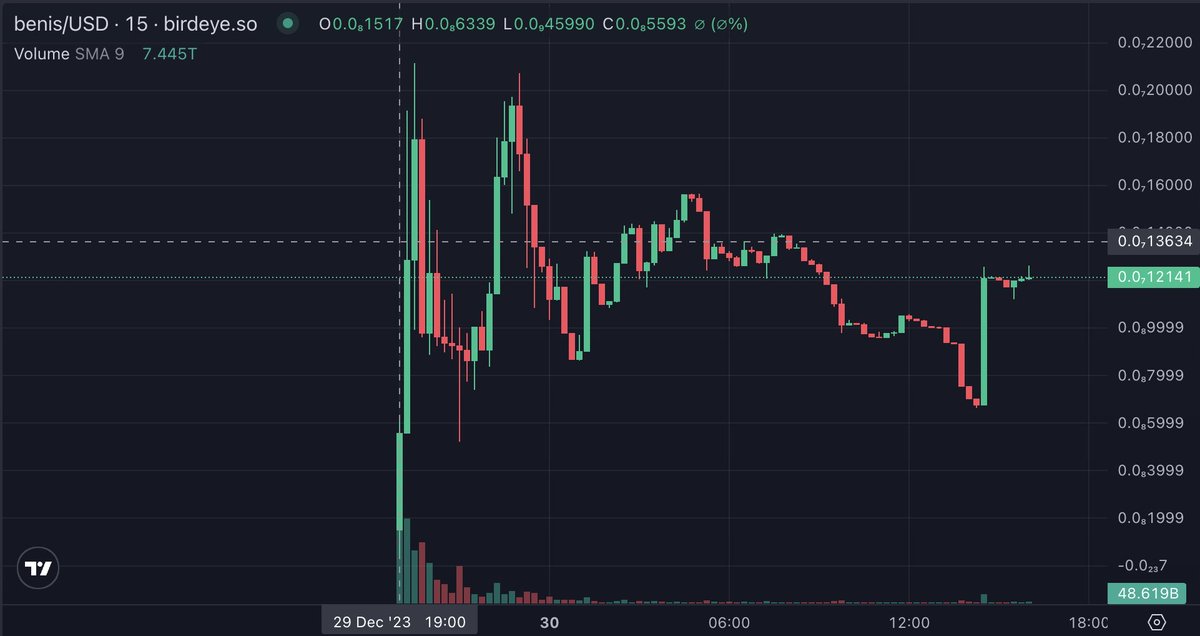
We buy $BENIS on SOL. The token has been live for a few days and is not dead like most meme tokens on Solana. In addition, it has an FDV of 96k and a nice website
Underradar GEM @benisinsol 🚀🚀🚀🌲☘️🍏
https://t.co/pQF5a8DCaW
Blueberry Explained: A New Type of Yield with Treasuries.
How Yield based on the "risk-free" Treasury bills rate with permissionless USDC yields work. 👇🧵
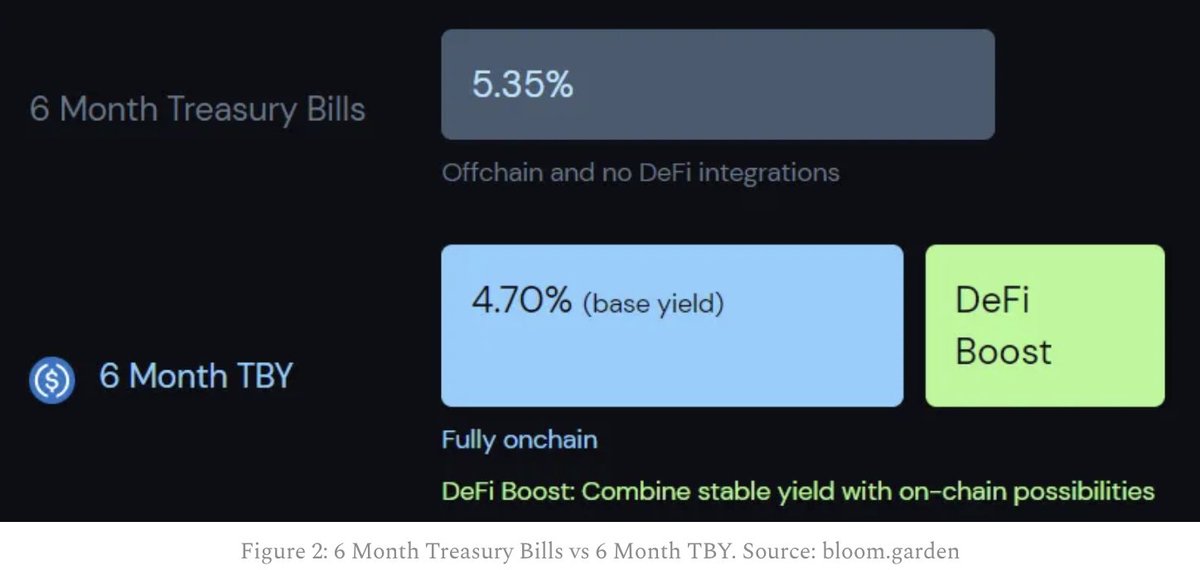
Returns in prominent DeFi money markets have reached a low point, consistently ranging from 1-3.5% APR, struggling to match the performance of conventional debt markets. When compared to treasury bill rates exceeding 5.5%, and considering the necessary risk premium for smart contracts and pooled token exposure, the noticeable decline in on-chain lending Total Value Locked (TVL) is not surprising.
Bloom Protocol from @blueberryFDN introduces yields based on the "risk-free" treasury bill rate into the DeFi landscape. These tokens are fully on-chain, freely transferable, and permissionless. Let's delve deeper into the topic.
🔵 Stablecoin Yields Nowadays 🔵
https://t.co/ZfVNkHXNxP is the driving force behind the Bloom Protocol. The protocol introduces the Term Bound Yield (TBY) token, an asset that yields commercial lending returns correlated with the risk-free treasury bill rate. These tokens, generated by the Bloom smart contract using commercial loan assets, offer yields comparable to those of 6-month treasury bills, all within the decentralized, transferable, and permissionless manner.
The origin of Bloom Protocol is rooted in a challenge within the DeFi space, specifically pertaining to the accessibility of yields linked to US treasury bills. While DeFi money markets have observed yields stabilizing in the range of 1-3.5% APR, they now face difficulties competing with traditional debt markets.
The difference is highlighted by treasury bill rates surpassing 5.5%.
However, DeFi's utilization-based rate models often fail to respond directly to external factors such as the federal funds rate, potentially impeding the competitiveness of these platforms. These models typically yield rates that rarely exceed 3-4% for most stablecoins.
🔵 New Type of Yield 🔵
Bloom is a protocol that brings yields from treasuries into the DeFi landscape. This is achieved through issuing TBYs.
https://t.co/Wk5j8yVO9m stands out as the first market opportunity to provide near treasury bill yields (approximately 5%), exclusively derived from US treasuries. Notably, it introduces a fully compliant non-KYC product, marking a significant advancement in true composability. The TBYs within the Bloom ecosystem typically yield around 5%, a compelling figure in the current low-yield environment. Furthermore, these yields can be combined or "stacked" with other DeFi protocols.
To utilize TBYs, the initial step involves minting, and the process unfolds as follows:
🔹 TBYs can be minted during a specific 3-day window occurring twice each month.
🔹 During this timeframe, the system aligns lender supply with borrower demand.
🔹 If you contribute more funds than there is demand for borrowing, your funds will be refunded at the conclusion of the 3-day period.
🔹 Alternatively, if there is sufficient demand, you will automatically receive your TBY.
The accumulation of value for TBYs commences immediately upon executing the order to acquire the underlying ib01. These ib01 tokens, supplied by Backed, may require one to two days for issuance, constituting the "order filling period," with a maximum duration of two days. Once the order is executed, interest starts accruing for TBYs until the Redeem Date.
All TBYs come with a 180-day duration from the execution time. Users can initiate redemption for the underlying USDC along with accrued interest at any point after the redeem date by using the redeem function.
🔵 Under-Collateralized Lending 🔵
Over-collateralization has always been a feature in a DeFi sector for some people and the pain point at the same time for others. Basically you have to provide more than you need to borrow, and usually the collateralization rate is somewhere between 150% and 250% due to market volatility. The prices of the underlying assets are usually not as stable as compared to shares of the equity market or fiat currencies. Therefore in case if a price of an asset drops, there has to be an over-collateralization to compensate for losses. More than that, it limits the growth of the ecosystem.
Blueberry aims to solve this problem by utilizing under-collateralized lending.This type of lending, which accounts for at least 80% of corporate debt, likely represents a market at least 4x larger than the current DeFi lending market. Most would likely agree that access to under-collateralized leverage will likely be in even higher demand as a ratio of total debt in DeFi. This will undoubtedly be an enormous market size of $80-200 billion, as the ability to access more capital is always in high demand.
Basically, Blueberry connects Lenders and Strategists allowing leverage up to 50x. More than that, Blueberry utilizes >50% of APR to buy back the token and make more liquidity available.
🔵 Tokenomics and Token Metrics 🔵
Token: $BLB, total supply 1b tokens.
🔹 $BLB: is the only liquid, tradable token in the Blueberry ecosystem. This token also usable as collateral on Blueberry when liquidity conditions met and accrues value from Make and Burn program.
🔹 $bdBLB: Blueberry introduces an innovative mechanism for a fair token distribution and launch: Bonded Blueberry ($bdBLB). Bonded Blueberry is the vesting rewards token, distributed every two weeks to those holding bTokens, the receipt token for lending on Blueberry markets. $bdBLB introduces Acceleration Fee Vesting based on the Early Unlock Penalty Ratio.
🔵 Members Behind the Project 🔵
@blueberryFDN protocol has garnered support from notable backers. Their is led by @WhiteStarCap (Dollar Shave Club, Freshly, others). Other backers include @DewhalesCapital, @chainlinklabs, @BitscaleCapital, @multisig_vc, @AshburyLegal, @AlchemixFi, @OlympusDAO, @ichifoundation, @pirata_capital, @FunFairVentures and others
🔵 Conclusion 🔵
In summary, traditional finance's interest in crypto is rising, but DeFi struggles with declining yields. Blueberry's Bloom Protocol stands out by introducing Term Bound Yield (TBY) tokens, yielding around 5% and correlated with the risk-free treasury bill rate. Blueberry's under-collateralized lending approach, enabling up to 50x leverage and using over 50% of APR to buy back tokens, addresses a significant market gap estimated between $80-200 billion. In essence, Blueberry pioneers a solution to current DeFi challenges and spearheads financial innovation in the decentralized space.
📖 Read the full article: https://t.co/qdpMrWL23c
💡 For insightful updates & more, connect with us:
• Twitter: https://t.co/CGrGlas5DK
• DeBank: https://t.co/ZphYaoOJvY
i'm fairly certain the cat wif da hat on base is going to do a thing
$CIF w 10M volume today, surpassing #Fantom chains volume for the entire month of November 🤯
We bought a cat in a hat @catwifhatbase
The Saudis are pumps on Monday
And we love kitties 😸😸🩷🩷
People say its the new $toshi
$CIF $100m mcap if FUD
GREEEEN ☘️☘️☘️🌲🌲🍏🍏
Found the next BRC20 Gem and Im giga long
$HRZN
- Wrap ERC20 assets and bridge to BRC20 using their bridge (Bridge fees to holders)
- Create any BRC20 asset in a few clicks
- Take out loans against your Bitcoin NFTs
- Arb cross chain assets through the bridge (fees to holders)
We called up the founder of Venom and he showed us beautiful towers in Dubai and told us he had connections in the government as well as Evernym super technology under the bonnet. It looked credible.
We have some of the best technical analysts in the world. This requires a very careful and pedantic approach, as there can be so many patterns and lines on the charts.