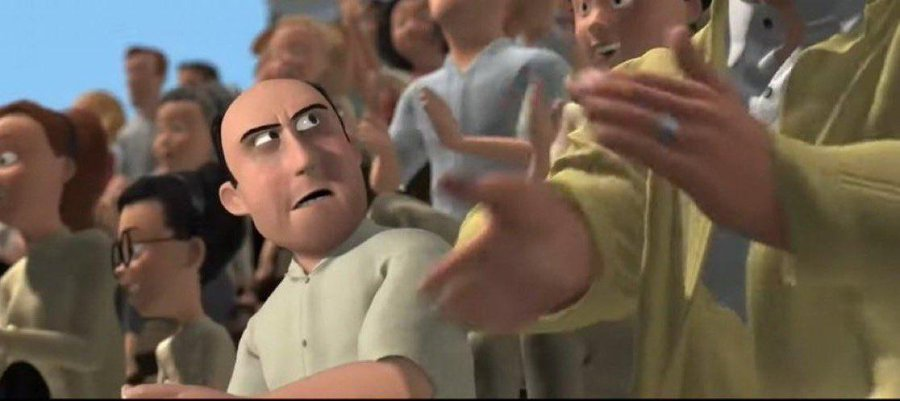
This scene is one of the most moving movie scenes I’ve ever seen. The theatre was borderline in tears, every person I’ve asked what was the best scene of the movie agreed before you would even say what the scene was. It was that powerful. Amazing scene in an amazing movie
Le fait qu'il ait appris de son erreur avec Gwen Stacy et qu'il tire pas la toile avant de l'avoir attrapée, pcq c'est sûrement la plus grande erreur de sa vie qui a tué celle qu'il aime, c'était les émotions au grand rex. Le meilleur Spider-Man à jamais
What Infantino is proposing is interesting. In principle, it makes sense to separate the commercial business of football from the regulation of the game. That is generally regarded as good governance.
The problem is that there is no independent regulator to insulate. FIFA is its 211 member associations. And those same members have been offered a share of the proceeds from the sale they are being asked to approve.
FIFA's defence is that investors will hold only a minority, non-controlling stake with no operational role. That may be true, but it misses the point. A fiduciary interest does not have to intervene to shape decisions. It constrains them. Every future decision on the calendar, competition frequency, tournament format, or even how much a safeguard is allowed to cost, will now have to account for a stakeholder whose financial interests carry legal weight. No direct interference is required.
Now consider who does not have standing. Not FIFPRO. Not the fans. Not the residents of host cities. Not even the players, who represent their countries for honour rather than as employees, cannot be transferred between nations, cannot negotiate the terms under which they play, and cannot realistically refuse selection. Yet it is their unmarketed commitment that is being valued at twenty billion dollars. This structure creates the only stakeholder in football with a legally enforceable claim on the game: American Investors.
Every other stakeholder has relied on representation rather than enforceable rights. FIFA represents its member associations, and the member associations are expected to represent the interests of the game. That chain has always been imperfect, but it was the closest thing football had to accountability.
Now that chain of representation has been priced. Forty million for a yes vote. Ten million for a no vote. The duty a federation owes its own players is placed in direct tension with a financial payment contingent on approving the transaction. That is not a conflict of interest FIFA must manage. It is one FIFA has deliberately created.
Finally, consider the sequence. The vote takes place at Congress in Morocco in March but the funding commitment must be made by September. A conflicted decision-maker is being asked to decide quickly. That should concern everyone.
🇨🇲 Au #Cameroun, Patrick Mengue a été condamné à six mois de prison pour outrage à Paul Biya.
En cause, une prière publiée sur Facebook qui, selon les autorités, constitue une offense au président de la République. On te raconte.
🇨🇲 FLASH | Paul Biya, le président du Cameroun, n’a pas été vu en public depuis 50 jours. Le pays est en "pilotage automatique", critique l’opposition.
Nigerians are so deeply fascinating. What do you mean you borrowed money from a loan app and then deleted the app from your phone?? What exactly was that supposed to do?
I do empathize with Gojo’s character a lot but one thing I can 100% get behind of is the fact that he is a huuuuge battle maniac lol that fight with Sukuna was probably lowkey the best day of his life 😔
Genuinely the first time I’ve ever seen a football club , in these touch exercises, actually serve footballs that aren’t just the same distance, same weight on the floor and serve some unpredictable variance.
Technical practices are some of the worst at clubs.
It’s so routine and formulaic based with no adaptability or random variance . Even though football is full of random variance all the time and you should always be training that.
When do you ever see the club for example, randomly bounce the awkward pass in, make a player deal with it? Pretty much never even though that stuff happens all the time in games.
Remember when Luka Modrić got angry and told Isco to shut up and pass the ball… then Isco complained to Sergio Ramos, who also told him to shut up and pass the ball. 😭
BREAKING: The wealthiest 1% of US earners now own 50.1% of US equity and mutual fund holdings.
To put this into perspective, their ownership stood at 40.1% in 1990 and 39.6% in 2001.
At the same time, the next 9% wealthiest households own 37.3%, and the middle 40% own just 11.7%.
By comparison, the bottom 50.0% of earners hold just 1.1%.
As a result, the top 10% of earners now own ~87.4% of all equity and mutual fund assets.
Asset owners are the only winners in this economy.
MCP 2026-07-28 is live and it's the largest update to the protocol since launch.
MCP is now stateless, making it easier to deploy and scale remote servers.
https://t.co/K8KqxbUh4e
This one is really dicey.
FIFA is registered as a non-profit association under Swiss law. Its 211 member associations own it. It pays no corporate tax in Switzerland. And right now, while the ink is barely dry on the 2026 World Cup final, it is in advanced discussions to sell a minority stake in its commercial operations to private investors, with JP Morgan acting as financial adviser and Thrive Capital, whose chief executive is Josh Kushner, expected to lead the investor group.
UEFA is responding. And I see reason with them. Their statement called it a crossing of a line and said the soul and governance of football are not assets to trade.
Let me explain what is actually happening here and why both positions are legally and commercially coherent at the same time.
The legal vehicle at the centre of this is called FIFA Forward Enterprise, or FFE. It is a FIFA-owned company that would consolidate all of FIFA's commercial rights, broadcasting, sponsorship, ticketing, licensing, and the operational delivery of FIFA tournaments, into a single entity.
Based on how things are proposed, FIFA would retain majority control and exclusive authority over governance, competitions, the match calendar, and all regulatory and sporting decisions.
Private investors would then hold a minority, non-controlling stake in the subsidiary, not in FIFA itself. FIFA says the proposal could deliver more than $10 billion in football development funding over the next four years.
Now here is the legal position.
Under Swiss association law, FIFA has broad autonomy over how it manages and commercialises its assets, provided it pursues its statutory purpose of promoting football and follows its internal decision-making rules.
Creating a commercial subsidiary and selling minority stakes in it to private investors is not categorically prohibited under any applicable law. FIFA already commercialises its rights aggressively through sponsorships, media deals, and licensing arrangements worth billions of dollars per cycle.
Placing some of that commercial activity into a valued vehicle and inviting outside capital is structurally an extension of what FIFA already does, not a departure from it. The proposal requires approval from the FIFA Council and the 211 member associations. That approval process is where the real legal constraints sit, not in Swiss corporate law.
What UEFA is objecting to is not the legality of the structure. They are objecting to the incentive architecture it creates once private capital is inside the tent. And again, that objection deserves to be taken seriously.
Even with formal majority control retained, private investors seeking returns will create ongoing pressure. They will request more matches, an expanded calendar. They will make decisions that prioritise revenue over player welfare or competitive balance.
Of course that pressure will not arrive through a boardroom vote. It arrives gradually, through the logic of what a return on investment requires. FIFA can retain exclusive authority over sporting decisions and still find that sporting decisions are shaped by the financial expectations of its commercial partners. Those are not mutually exclusive outcomes.
The legal permissibility of this structure is high if internal approvals are obtained. The binding constraints are member consent, political capital, and the risk that private capital incentives gradually reshape priorities even under retained formal control.
Football has watched that process play out at club level for thirty years. The question being asked right now, with genuine urgency, is whether the same dynamic should be allowed inside the institution that governs the game itself.
My name is Ajoje. I am a FIFA Licensed Agent and International Sports Lawyer. I write on the Law and Business of Football, a lot. Repost and Follow if you want to read more posts like this.
This is because the showrunners don't really know the difference between right and wrong, and can't reason through how someone fighting for evil might defect to good.
In the original, none of the good people who influence Zuko try to do so by convincing him that he and his people are evil. They influence him by cultivating and appealing to his better nature. Obviously Iroh is the most significant, and in his years of mentoring Zuko he never once tries to even sow the seed of the idea that the Fire Nation might be in the wrong. Instead he just teaches Zuko to be honorable, brave, and kind. Kind doesn't take very well, but honorable does.
Over the course of the story, these principles he has been inculcated with come more and more into conflict with his loyalties, eventually forcing a confrontation. Even that confrontation is not "honor vs blood" - that's too simplistic. His crisis is the realization it is no longer possible to be loyal to his entire family. His father's dishonor has already divided the clan.
The new Zuko isn't honorable at all, because the showrunners don't understand how a "badguy" could have great moral qualities (and even be more moral than many of the "goodguys" in certain ways) that would ultimately lead him to become a hero. That is, Zuko in AtLA is already a "hero" before switching sides, in that his behavior is heroic. He's a brave warrior who fights for his family's honor and the success of his people. At least, he thinks that's what he's fighting for. In reality what he's doing isn't best for his people. That's the crisis. That's the change.
What they want new-Zuko to do is totally reject his own identity, rather than finding its real core. The Fire Nation feels a bit too much like "white colonizers." The original's idea that the Fire Nation was a truly great people who became misguided is no longer acceptable, so all virtue has to be stripped out of it. Note that Zhao, who was fearless in the face of death originally, is made a sniveling coward in the live-action. Examining the difference between courage and stubbornness is a bit too complicated for this "more mature" adaptation aimed at "adults." The badguys are all just thieving weasels now. Zuko suffers the worst because he was the best.
I wish it was more common knowledge that almost all regulations exist because companies weren’t doing these things on their own and bad things were happening because of it.