The largest independent Spanish-language equity research house, now in English. Quality Value investing. Institutional-grade deep dives on global stocks.
Yes, certainly there are still many variables to observe, but indeed I could simply replace the existing expense, although we believe the cost will be higher, but it is something that is still to be seen. Basically, because what we believe is that the percentage of customers who go directly to the Airbnb, Booking, and Expedia apps will gradually decrease as agents will use them as a gateway.
Moncler Faces Weak Tourism Demand in Europe While Puig Accelerates Growth with Record Third-Quarter Sales
Moncler and Puig have reported sales figures for the first nine months of 2026, highlighting different trends across the luxury fashion and beauty industries.
Moncler Group generated cumulative revenue of €1.895 billion, representing growth of 6% at constant exchange rates and 3% at current exchange rates. However, during the third quarter, the core Moncler brand recorded a 1% decline in sales at constant currency, reflecting a slowdown compared with previous months.
Weakness was particularly evident in the direct-to-consumer (DTC) channel, where Moncler brand sales declined 2% during the quarter. The company attributed this performance to a challenging operating environment and persistently subdued tourism flows, particularly across Europe, the Middle East, and Africa (EMEA).
Meanwhile, Stone Island, the group’s second brand, delivered stronger performance, with 5% sales growth in the third quarter. Markets in Asia and the Americas recorded double-digit growth, partially offsetting weaker conditions in other regions.
Moncler’s Executive Chairman, Remo Ruffini, acknowledged that the industry continues to operate in an “extremely complex” environment, characterized by uncertainty surrounding demand and international consumer spending.
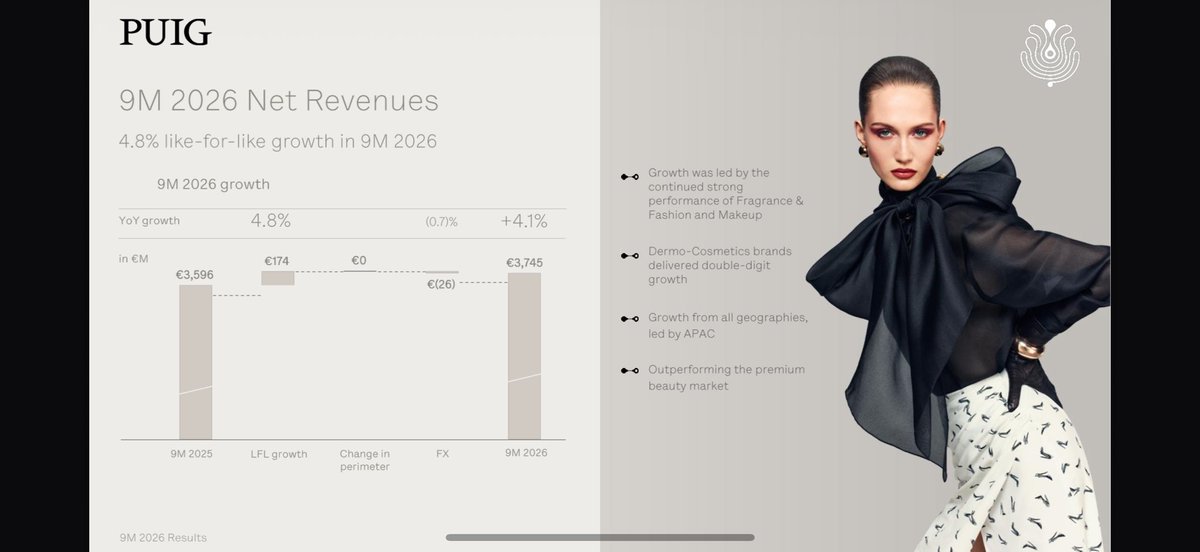
In contrast, Puig reported cumulative revenue of €3.745 billion through September, representing 4.1% year-over-year growth, supported by a record third quarter in which sales reached €1.391 billion, up 7.2%.
By category, Makeup was the fastest-growing segment, increasing 10.4% during the first nine months. This was followed by Fragrance and Fashion, up 3.2%, while the Skincare segment grew just 1%.
The company also confirmed that it will present its new strategic plan on October 28, following the unsuccessful merger discussions with Estée Lauder.
Overall, the results highlight contrasting trends between the two companies: Moncler is experiencing a slowdown in its core brand, particularly in Europe and the DTC channel, while Puig continues to grow and has accelerated quarterly sales through its beauty business.
$MONC $PUIG
Meta Ordered to Pay $25 Billion After Losing New Mexico Trial Over Misleading Privacy and Data Protection Practices
Meta Platforms has been ordered by a New Mexico judge to pay $25 billion after a jury found that the company misled consumers about its privacy policies, personal data handling practices, and platform operations.
The case stems from a lawsuit filed in 2021 by the New Mexico Attorney General following the Cambridge Analytica scandal. The British political consulting firm, linked to Donald Trump’s 2016 presidential campaign, obtained personal information from as many as 87 million Facebook users through a third-party application without their consent.
New Mexico authorities accused Meta of making misleading statements about third-party access to personal data, hate speech moderation, misinformation, and other internal policies. According to the allegations, the company was aware of the extensive access third parties had to user information and tolerated certain harmful content when doing so benefited its business interests.
On September 25, the jury determined that 26 of the 29 statements examined from Meta and its executives were misleading, identifying more than 43 million violations of New Mexico’s consumer protection laws.
State law allows penalties of up to $5,000 per violation, explaining the substantial size of the financial penalty. According to New Mexico Attorney General Raúl Torrez, the proceeds will be directed to the state’s public education system.
During an October 1 hearing, state attorney Randi McGinn requested a penalty of between $35 billion and $40 billion, arguing that the fine should be large enough to have a meaningful financial impact on Meta.
Meanwhile, Meta asked the judge to limit the penalty to $3.45 billion, arguing that a larger amount could discourage companies from doing business in the state. Meta also maintained that it does not sell user data and that New Mexico had failed to demonstrate that any consumer had actually been deceived.
This marks the second adverse jury verdict against Meta in New Mexico within six months. In March, another jury found that the company had misled users about child safety on Facebook, Instagram, and WhatsApp, resulting in a $375 million penalty. A judge subsequently ordered Meta to pay an additional $567 million into a state fund dedicated to adolescent mental health.
Despite the latest court ruling, Meta shares were trading approximately 1.8% higher during Wednesday’s session.
Source: Investing. com, October 21, 2026.
$META
Netflix is on track, but it lacks a plot twist. It posted revenue of $12,874 million, up 12 per cent, and has seen its operating margin soar to 34.6 per cent thanks to its spending schedule and a base of comparison hit by Brazil, whilst it has cut its advertising forecast from $3,000 million to $2,700 million, recorded four consecutive quarters of slowdown and announced the largest share buyback in its history, worth $4,800 million, funded partly by cash and debt. The biggest staff cut since 2022, the replacement of Bela Bajaria by Peter Rice at the helm of content, and a double-digit growth target for 2027 that the management hopes for but does not yet dare to promise.
An analysis of Netflix’s $NFLX Q3 results, the earnings call and an update to our forecasts and target price have been available on Capital Faktory Research since last night.
https://t.co/7qTdiVlghx
Los resultados de Netflix $NFLX son lo que esperabamos.
Algunas reflexiones:
- La directiva no tiene claro hacía donde irá le negocio. Es muy probable que encuentre esa dirección por su capacidad, pero de momento hay que esperar.
- La publicidad es mucho más difícil de la que se imaginaban.
- Necesitan del contenido de terceros más de lo que quisieran.
- La presencia del cine en la llamada hace pensar aún más que siguen en la busqueda de cual es el camino. Han mencionado que siguen siendo principalmente una plataforma de streaming, pero sabemos que si encuentran oportunidades no tienen problema en cambiar de opinión.
- Siguen con la recompra de acciones fuertes, pero los insiders no están comprando nada.
- El segmento que más tira en suscriptores es el peor de todos, APAC.
- UCAN está agotado en suscripciones y precio.
Entre otras...
Análisis completo en CFR.
MSCI makes peace with the consensus and steps on the commercial accelerator, but not on the margin: invoice 892 million dollars, 12.4% more, with an adjusted profit per share of 5.11 dollars that grows by 14.3% and beats forecasts, signs the best recurring net sales in its history in Analytics and private capital and takes commissions on assets to a new record with a capital in listed funds that is close to 2.9 billion; in return, the debt bill tightens, with interest expenses skyrocketing by 40% and free cash flow falling by 8.9%, Sustainability and Climate enters negative net sales, the Analytics margin deflates another four and a half points, repurchases are financed with the credit line and Henry Fernández settles the debate with a phrase that says it all: there will be no margin expansion
It is now available in Capital Faktory Research the analysis of the results + earnings call for Q3 2026 of $MSCI as well as the update of our projections and target price. In pdf and audio, in English and Spanish.
Equifax weathered the downturn in the mortgage market with drastic measures: it posted revenue of $1,693 million, up 10 per cent, beat forecasts with adjusted earnings per share of $2.26, and increased its non-FICO margin by 130 basis points thanks to artificial intelligence, but the rise in mortgage rates to 7.5 per cent has shaved $80 million off the annual forecast, the fourth quarter has slowed to 3 per cent on a non-FICO basis, and management is already forecasting that mortgage approvals will fall to the high single figures in 2027. VantageScore has seen its adoption among lenders increase sevenfold, the Government has signed contracts worth 550 million, and the spectre of the two-agency report is once again looming over the mortgage market
Full analysis of the third quarter of 2026 + Equifax’s earnings call now available in PDF and audio for LITE and PRO subscribers. An update to our forecasts and target price has also been published.
All this, as always, at https://t.co/z9KE1ee04S
$EFX
MSCI makes peace with the consensus and steps on the commercial accelerator, but not on the margin: invoice 892 million dollars, 12.4% more, with an adjusted profit per share of 5.11 dollars that grows by 14.3% and beats forecasts, signs the best recurring net sales in its history in Analytics and private capital and takes commissions on assets to a new record with a capital in listed funds that is close to 2.9 billion; in return, the debt bill tightens, with interest expenses skyrocketing by 40% and free cash flow falling by 8.9%, Sustainability and Climate enters negative net sales, the Analytics margin deflates another four and a half points, repurchases are financed with the credit line and Henry Fernández settles the debate with a phrase that says it all: there will be no margin expansion
It is now available in Capital Faktory Research the analysis of the results + earnings call for Q3 2026 of $MSCI as well as the update of our projections and target price. In pdf and audio, in English and Spanish.
Netflix to Expand Its Ad-Supported Plan to 15 Additional Countries in 2027 and Strengthen Advertising Monetization Tools
Netflix has announced plans to expand its advertising-supported subscription tier to 15 additional countries in 2027, significantly increasing its international presence in the streaming advertising market.
The expansion will begin in March 2027 and include eleven markets across Europe and Latin America: Austria, Belgium, Colombia, Denmark, Ireland, the Netherlands, Norway, Peru, Poland, Sweden, and Switzerland. Four additional Asia-Pacific markets will also be added: Indonesia, New Zealand, the Philippines, and Thailand.
Netflix’s ad-supported plan is currently available in 12 markets, meaning the expansion will increase its potential footprint to 27 countries, more than doubling the number of markets where this subscription option is offered.
In September, the company had already announced plans to launch the service in nine European countries starting on March 1, 2027. The latest additions include Colombia and Peru, along with the four new Asia-Pacific markets.
According to Telecompaper, Netflix stated during a presentation to advertisers that its ad-supported plan currently reaches more than 250 million monthly viewers, highlighting the growing scale of its advertising business.
At the same time, Netflix is introducing new tools designed to improve advertising measurement and campaign effectiveness. These include a Conversions API and a new Netflix Pixel, enabling advertisers to track more than 20 conversion events and more accurately measure the performance of their advertising investments.
The platform will also introduce The Trade Desk’s audience capabilities starting next month and expand attribution measurement through Yahoo DSP, improving campaign planning, targeting, and performance analysis across its advertising ecosystem.
The announcement comes just hours before Netflix is scheduled to release its third-quarter financial results on October 20, after the US stock market closes.
One of the main areas of investor focus will be the performance of Netflix’s advertising business, which Wedbush estimates could generate approximately $3 billion in revenue in 2026.
With this expansion, Netflix continues to increase both the geographic reach of its ad-supported subscription tier and the tools available to advertisers, strengthening advertising as an additional revenue stream alongside its traditional subscription business.
$NFLX
Ryanair Warns Airfares Could Rise by Up to 20% as Fuel Costs Surge and Airlines Cut Capacity
Michael O’Leary, CEO of Ryanair, has warned that airline ticket prices could increase by 10% to 20% over the next twelve months, driven by the sharp rise in aviation fuel costs.
Speaking in Brussels, O’Leary said the industry could experience the largest increase in airfares in its history, while acknowledging that even such price increases might not be enough to fully offset rising energy expenses.
According to estimates from the International Air Transport Association (IATA), average jet fuel prices are expected to reach approximately $152 per barrel in 2026, representing a 70% increase compared with 2025.
The association estimates that higher fuel prices will impose approximately $100 billion in additional costs on the airline industry, driven by the conflict involving Israel, the United States, and Iran, as well as disruptions to energy supplies from the Persian Gulf.
The situation is particularly challenging for airlines with limited fuel hedging coverage. Ryanair has hedged only 15% of its fuel requirements for the fiscal year beginning in April 2027.
Meanwhile, easyJet has hedged 62% of its fuel needs for the October 2026–March 2027 period, with coverage falling to 37% for the following six months. The airline has already announced plans to reduce capacity by approximately 700,000 seats next winter.
Ryanair is also adjusting capacity, planning a 4% reduction during the winter season, which the company expects will generate approximately €100 million in fuel savings.
Additionally, Ryanair has announced significant capacity reductions in Belgium following increases in aviation taxes. The airline will withdraw 1.1 million seats and six aircraft, as part of a broader reduction affecting 20 routes from Brussels-Zaventem and Charleroi airports.
The cancelled services for winter 2026–2027 include five routes between Brussels and Spain: Madrid, Barcelona, Málaga, and Valencia from Zaventem, as well as Asturias from Charleroi.
Ryanair attributes these cuts to the increase in Belgium’s aviation tax from €2 to €7 per passenger, arguing that the higher tax burden undermines the competitiveness of air travel and tourism.
Deteriorating industry conditions are also affecting other carriers. According to Expansión, Spirit Airlines has entered bankruptcy, airBaltic is restructuring its debt, and Volotea is renegotiating its financial obligations, after estimating a €150 million impact from higher fuel costs.
Overall, European airlines are facing an environment of higher energy costs, rising ticket prices, and capacity reductions, while attempting to determine how much of the additional expense can be passed on to passengers without significantly weakening demand.
Carrefour Cuts 2026 Guidance Amid French Riots as Insurers Estimate Losses of Up to €1.2 Billion
Carrefour has lowered its financial guidance for 2026 due to the impact of ongoing unrest in France, despite reporting improved sales during the third quarter.
The group’s comparable sales increased by 2.3%, reaching €22.65 billion, while sales in Spain grew 2.1% to €3.11 billion.
Carrefour CEO Alexandre Bompard warned that the company is facing an unprecedented situation in France, characterized by significant uncertainty surrounding consumer spending and the conditions under which its stores will be able to operate.
The situation is particularly challenging ahead of the crucial year-end shopping season, as household spending is already under pressure from rising energy costs.
As a result, Carrefour has reduced its expected operating margin improvement to between 0 and 15 basis points, compared with its previous target of more than 25 basis points.
The company now expects adjusted earnings per share to remain flat or increase slightly, compared with its previous forecast of high-single-digit growth. Carrefour also anticipates a modest decline in net free cash flow and plans to reduce investment in France by €100 million to €1.6 billion in 2026.
Meanwhile, analysts at Morningstar DBRS estimate that the unrest could generate insured losses of up to €1.2 billion, exceeding the €798 million in damages caused by the July 2023 riots, according to France Assureurs.
French Trade Minister Serge Papin has indicated that at least 3,000 retail businesses have suffered damage, according to preliminary estimates. Affected stores include luxury brands such as Louis Vuitton and Kenzo, while a Burberry store in Paris was also reportedly looted.
Given the scale of the damage, the French government has requested authorization from the European Union to introduce a state-backed riot insurance system, aimed at expanding protection against similar events.
Carrefour’s guidance revision represents one of the first major corporate assessments of the economic impact of the unrest on French consumer spending, particularly during a period that is crucial for retailers and luxury and beauty companies operating in the country.
Hilton Announces Transfer of Its Stock Listing From the New York Stock Exchange to Nasdaq Effective November 5
Hilton Worldwide Holdings (HLT) has announced plans to transfer its stock listing from the New York Stock Exchange (NYSE) to Nasdaq, in a move that the company says reflects its evolution into a fast-growing, technology-driven, capital-efficient hospitality business.
Hilton shares are expected to begin trading on Nasdaq on November 5, 2026, retaining their existing ticker symbol HLT. The final trading session on the NYSE will take place on November 4, and shareholders will not need to take any action in connection with the transfer.
Hilton CEO Christopher Nassetta explained that the decision aligns with the company’s growth ambitions, highlighting the importance of its asset-light business model, primarily based on hotel management and franchising, alongside its brands, commercial platforms, and technology capabilities.
Since returning to public markets in 2013, Hilton has expanded from 10 brands and approximately 4,100 hotels across 90 countries and territories to 28 brands and more than 9,400 properties across 144 markets.
Expansion has been particularly significant in the luxury and lifestyle segments, where Hilton has grown from approximately 50 hotels to 1,200 properties. Meanwhile, its Hilton Honors loyalty program now exceeds 260 million members worldwide.
Hilton also highlighted its investments in technology, including AI-powered trip planning tools, modernized digital platforms, and personalized guest communication systems. According to the company, these solutions help improve the guest experience while increasing efficiency and profitability for hotel owners.
The transfer also represents a historic change for Hilton, which became the first hotel company to list on the New York Stock Exchange in 1946 and returned to the exchange in 2013 following its period under Blackstone ownership.
The company clarified that the listing transfer does not change its business strategy, capital allocation priorities, or commitments to shareholders, hotel owners, and guests.
Source: Hilton / Business Wire, October 20, 2026. $HLT
UPS, FedEx, and USPS Lose Market Share in US Parcel Delivery as Amazon and Alternative Carriers Expand
The US parcel delivery market is undergoing a significant transformation, with the combined market share of UPS, FedEx, and USPS declining from approximately 85% of parcel volume in 2019 to just over 60% in 2025, according to a report by the US Postal Service Office of Inspector General (USPS OIG).
One of the main drivers of this shift is Amazon, which reportedly surpassed USPS in parcel volume for the first time in 2025, handling approximately 6.7 billion packages compared with USPS’s 6.6 billion, according to ShipMatrix data.
Meanwhile, alternative last-mile delivery carriers are gaining market share. Their share of total parcel volume increased from approximately 4% in 2020 to nearly 11% in 2025, reflecting the expansion of new delivery networks competing with traditional carriers.
During fiscal 2025, these alternative carriers recorded 13% growth in parcel volume, although they captured only around 6% of total market revenue. This difference reflects their greater concentration in lower-revenue deliveries.
One of their main competitive advantages is pricing. According to the report, some alternative carriers advertise rates between 10% and 40% lower than those of major delivery companies, particularly in densely populated urban areas, where higher delivery density helps reduce logistics costs.
Meanwhile, UPS and FedEx are adjusting their commercial strategies, reducing exposure to certain low-margin e-commerce shipments and prioritizing deliveries that generate higher revenue and stronger profitability.
This strategic shift is illustrated by a statement highlighted in the report regarding FedEx’s positioning: “If you’re shipping T-shirts, FedEx might not be for you.” The remark reflects the declining priority that some major carriers are placing on low-value shipments.
Overall, the report highlights the increasing fragmentation of the US parcel delivery market, with Amazon and alternative carriers capturing a growing share of shipment volumes while UPS, FedEx, and USPS lose relative market share.
Source: USPS Office of Inspector General – Evolving Last-Mile Delivery in the United States.
$UPS $FDX $AMZN
The Italian Sea Group Shares Plunge as Much as 19% Following Five Binding Offers Amid Fears of an Asset Breakup
The Italian Sea Group (TISG) suffered a sharp decline in its share price after announcing that it had received five binding offers to acquire its assets as part of the company’s ongoing restructuring process.
According to Reuters, TISG shares fell more than 14% during the morning of October 20, before trading at approximately €0.86 around midday, down nearly 19%. Meanwhile, Sanlorenzo shares declined approximately 3.9%.
The market’s main concern is the possibility that TISG could be sold in separate parts, a scenario known in Italy as “spezzatino.” All five proposals are structured as Asset Deals, meaning acquisitions of assets rather than shares in the company, although two of the offers involve the acquisition of the entire business.
This distinction is particularly important for TISG shareholders, as proceeds from asset sales would need to address the company’s obligations to creditors, meaning any remaining value for shareholders will depend on the final outcome of the restructuring.
According to estimates from Banca Akros, the La Spezia shipyard could be valued at between €20 million and €30 million, while the entire asset perimeter covered by the offers is estimated to be worth approximately €162 million.
Regarding potential buyers, Il Sole 24 Ore reportedly identifies Azimut-Benetti and SRI Global as the two bidders for the entire business, while Sanlorenzo, through Polo Nautico Carrara, and Baglietto are reportedly interested specifically in the La Spezia shipyard. The fifth bidder could be Palumbo or Safe Harbor, although its identity has not been officially confirmed.
Meanwhile, Intesa Sanpaolo maintains its Buy recommendation on Sanlorenzo, with a price target of €48.50, describing the company’s offer for the La Spezia shipyard as a prudent move.
The bank highlights that Sanlorenzo’s chosen transaction structure, limited to acquiring specific assets, reduces the financial risks associated with the deal compared with acquiring the entire company, particularly given TISG’s difficult financial situation.
Intesa expects the award and closing of the transaction to take place during the first quarter of 2027, viewing the potential acquisition as an additional opportunity beyond Sanlorenzo’s existing 2026–2029 strategic plan.
At this stage, TISG has not selected any of the five offers or officially disclosed their financial terms or the identities of the bidders. The Board of Directors continues to evaluate the proposals with support from Medi Corporate Finance and KPMG Advisory.
$TISG $SL
The weekly Capital Faktory magazine is now available
We’ve just published Capital Faktory 70: “The Perfect Storm on Your Plate: How War, Diesel, and El Niño Are Brewing a Global Food Crisis.”
Yesterday, one of the world’s most respected energy analysts—a Pulitzer Prize winner—and his team released a report worth tucking away in a drawer to reread in six months. His thesis is unsettling: the ingredients for a global food crisis are coming together one by one, and none of them are directly related to food. They have to do with a strait in the Persian Gulf, refineries that can’t export, and Pacific waters that are warming at an unprecedented rate. In this issue, we explain, from the ground up, how a gas well in Qatar ends up determining the price of a loaf of bread—and why there’s a fertilizer that almost no one talks about but is far more concerning than the famous one.
We also head out into the field, to Spanish tractors, where filling up the tank today costs more than would have seemed possible just a year ago. We’ll explain why a portion of the world’s crops ends up in an engine rather than on a plate, what a copper mine in Chile has to do with a farmer in India, and why the authors themselves acknowledge that, for a farmer in a bind, using only half the recommended amount of fertilizer isn’t necessarily crazy—even if it ends up being expensive.
And we ask ourselves the question we believe is most important: if all this is so serious, why have wheat and corn prices barely budged? The answer has to do with the agricultural calendar, and it explains why what we’re seeing at the supermarket may be just the beginning. We review the lessons from the crises of 2008, 2011, and 2022; who foots the bill—from the poorest countries all the way to your grocery cart; what’s happened on the stock market with fertilizer manufacturers; and the three scenarios we foresee for 2027.
As always, we explain everything using everyday examples, and at the end, we’ll share the indicators we’ll be monitoring in the coming months.
The report is now available in your subscriber area, exclusively for PRO subscribers.
Best regards,
The Capital Faktory Research Team
The Italian Sea Group Receives Five Binding Offers, Including Two Proposals to Acquire the Entire Business
The Italian Sea Group (TISG) has announced the completion of the second phase of its competitive process to identify potential investors, following the receipt of five binding offers as part of the company's ongoing financial restructuring.
According to the official press release issued on October 19, 2026, all five proposals are structured exclusively as Asset Deals, meaning acquisitions of assets or business units rather than direct purchases of TISG's shares.
Importantly, two of the five offers involve the acquisition of the entire business, while the remaining three relate to transactions with a narrower scope. The company has not disclosed which specific assets are included in those proposals.
The offers are currently being reviewed by TISG's Board of Directors, supported by its joint financial advisers, Medi Corporate Finance and KPMG Advisory.
Once the assessment is completed, the Board will select the proposal it considers most appropriate and communicate its decision to the market. The company intends to complete this process in line with its timetable for filing the restructuring plan with the court by the end of October.
TISG has confirmed that the identities of the five bidders and the financial terms of their respective offers will remain confidential, in order to protect the ongoing negotiations and ensure the orderly conduct of the process.
At this stage, no offer has been selected and no financial valuations have been disclosed, meaning it remains unclear which proposal will ultimately be chosen and whether the approved transaction will involve the entire business or only selected assets.
The company will continue to inform the market of any material developments related to the process, in accordance with applicable regulations governing the disclosure of inside information.
Source: Official The Italian Sea Group press release, October 19, 2026. $TISG
Sanlorenzo Submits Binding Offer to Acquire The Italian Sea Group’s La Spezia Shipyard
Sanlorenzo (SL) has announced that Polo Nautico Carrara (PNC) submitted a binding offer on October 19, 2026, as part of the competitive asset sale process involving The Italian Sea Group (TISG).
The proposal is structured as an Asset Deal and is limited exclusively to the “Cantiere di La Spezia” business unit, meaning it does not involve the acquisition of The Italian Sea Group as a whole.
Polo Nautico Carrara is an Italian company owned 50% by Sanlorenzo and 50% by Polo Nautico Viareggio S.r.l., which is also controlled by Sanlorenzo. As a result, Sanlorenzo retains control over the entity submitting the offer.
The transaction follows the process initiated on July 27, 2026, when Sanlorenzo first announced its interest in acquiring assets belonging to TISG.
However, after reviewing the available documentation and the timetable of the competitive bidding process, Sanlorenzo decided to narrow the scope of its proposal, focusing exclusively on the La Spezia shipyard and simplifying the ownership structure initially considered.
According to the company, this revised structure would help preserve the existing supply chain and maintain employment levels at the La Spezia facilities, supporting the continuity of industrial operations.
The submission of the binding offer does not mean that the acquisition has been completed. The transaction remains subject to the outcome of the competitive bidding process and the fulfillment of the conditions established in the proposal.
Sanlorenzo has stated that it will continue to inform the market of any material developments related to the process.
$SL $TISG