Ale, Sail & Fail. Not necessarily in same order. Bitter. Intellectually visceral. Recovering cynic. Traveller by fate. Wannabe Biker. Fan of Calvin & Hobbes.
A bridge can comply with visibility rules and still give the navigator the wrong view.
The CITY OF ROTTERDAM collision exposed how unconventional bridge-window geometry can distort visual judgement at the very moment it matters most.
My analysis:
https://t.co/zmoWH97sTN
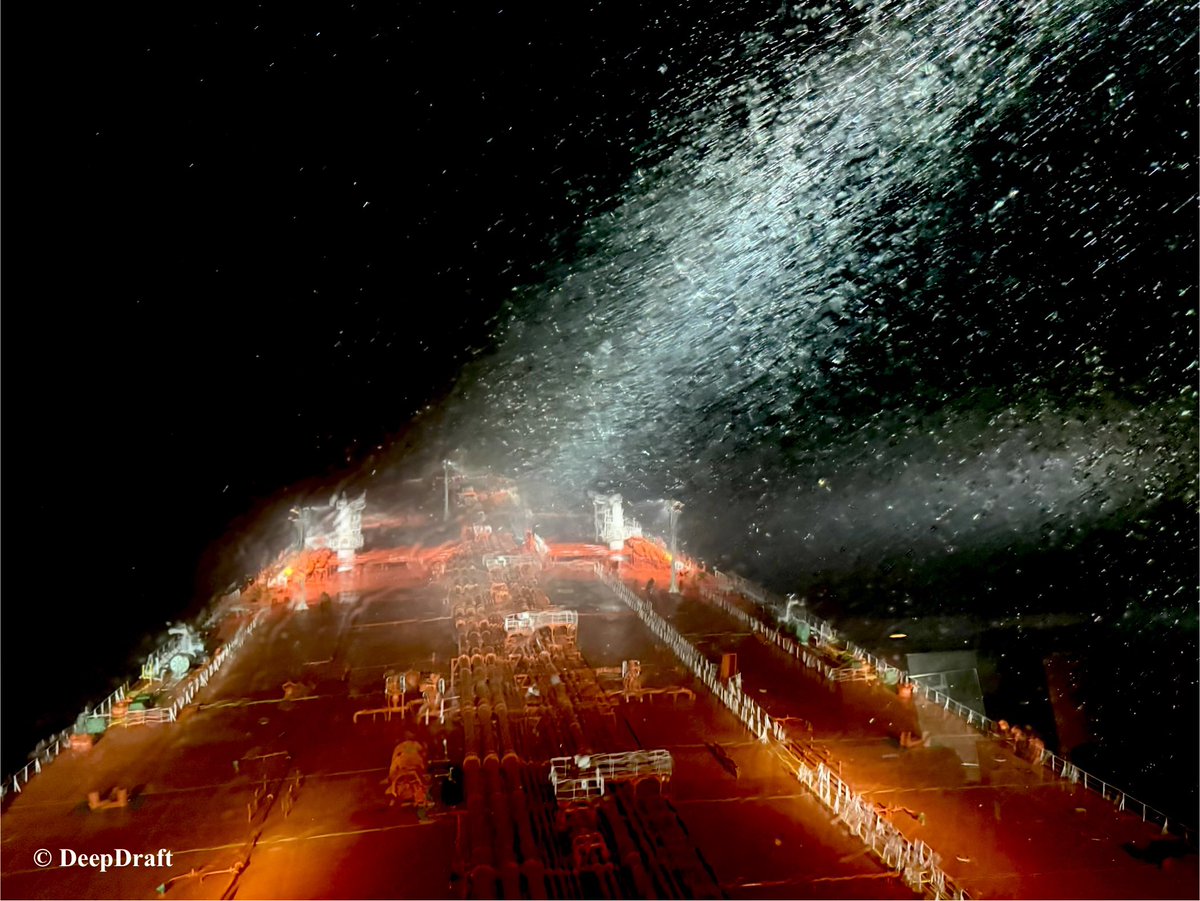
900 nautical miles from Tropical Storm Bavi.
Most people see a storm through weather systems, satellite images and forecasting apps.
This was our view from the bridge, drifting in the open ocean and waiting for Bavi to pass.
Even from that distance, the sea was carrying its presence.
U.S. Central Command (CENTCOM) forces have disabled the Curaçao-flagged tanker M/T Belma after the vessel ignored repeated warnings and continued toward Kharg Island, Iran's primary oil export terminal, in violation of the reimposed U.S. naval blockade.
According to CENTCOM, a U.S. aircraft rendered the vessel inoperable by firing AGM-114 "Hellfire" missiles into its smokestack, preventing it from reaching Iran.
The incident marks the first commercial vessel struck near Kharg Island, the first vessel disabled since the second U.S. blockade took effect on July 14, and the 10th non-compliant vessel disabled across both blockade operations. During the first 24 hours of the renewed blockade, U.S. forces also redirected two commercial vessels away from Iranian ports.
STS approach always gets attention.
But in similar-size VLCC operations, the quieter risk may begin after the vessels are already all fast.
Footage is for STS context only.
Video: Capt. Subur Sugandi
Full analysis:
https://t.co/PSJy0SDT2d
#VLCC#STSOperations#TankerSafety #MaritimeSafety
I received a good question after publishing my latest article:
Does the same similar-size VLCC STS risk apply in open sea, where neither vessel is anchored?
I have expanded on that point here, looking at swell angle, relative motion, and asynchronous rolling.
https://t.co/ItcyvgLFZ8
Photo taken at sea.
Four Flettner rotors on deck, and a modern bow form forward.
Ship efficiency is rarely one big solution. It is many smaller choices working together: hull form, wind assistance, speed, routing, maintenance, and how the ship is actually operated.
Hormuz traffic is starting to return, but the recovery is still uneven.
The EVER LOVELY route dispute, Iranian fleet movement near EOPL and falling VLCC earnings keep transit and fixture risk active.
https://t.co/tc9ushofwk
COMMAND, CONN, AND THE PILOTAGE DEBATE
I am revisiting an older maritime piece because the discussion around it never really settled.
A seafarer later shared this article on the maritime forum, where Masters, pilots, officers, and maritime professionals debated it in detail.
Some points raised there were valid. Some were less so.
But the discussion proved one thing: in pilotage waters, words like command, conduct, conn, control, and advice are not harmless.
When language becomes loose, bridge team and authority becomes confused.
Full article:
https://t.co/xR3BpMkll5
The real test of similar-size VLCC STS begins after they are all fast.
Two VLCCs may look stable alongside, but cargo transfer keeps changing the system - draft, freeboard, windage, breast-line lead, anchor cable response, fender load, and cargo hose geometry.
A 30-knot squall is not the full explanation if the bow opens, moorings part, and the hose fails.
The real question is simpler: Are the two ships still moving as one controlled system?
My latest DeepDraft analysis looks at the risk after all fast in similar-size VLCC STS.
https://t.co/PSJy0SDT2d
ARCHIVE DAY | E-CIGARETTES AT SEA
A vape onboard is not just a crew habit.
It is a battery, a charging point, a disposal item, a customs risk, and a policy gap.
https://t.co/MmXuq64tQ0
The Seafarer Is Not the Enemy.
This week’s write-up looks at how the world sees these ships, and what it often misses.
Before judging the vessel, we should understand the seafarers standing on board.
https://t.co/Ty7pDh5AWd
I do not understand the theatrics.
These are merchant ships, not pirate skiffs.
If there is lawful authority to board, hail the vessel, order her to stop, ask the crew to rig the gangway, and board professionally.
Civilian seafarers are not combatants.
The Master is not the sanctions department.
But in shadow-fleet enforcement, he may be the first person a state can physically reach.
Read: https://t.co/ePjXuzJusz
#ShadowFleet#MaritimeSanctions
THE DEBATE
Command vs “Conn”: Why the Master’s Authority Is Never Shared.
In pilotage waters, a single word can blur the line between conduct, advice, and command, and that blur can sink both safety and legal clarity.
https://t.co/9GnRugEyrQ
The operational view on Hormuz biofouling risk have now been mentioned in @Bloomberg and @gCaptain.
Good to see a practical shipboard issue entering wider maritime and energy discussion.
Original analysis: https://t.co/XmrlByFxBK
ARCHIVE REVIVAL | WHATSAPPISATION OF SHIP OPERATIONS
Fast messages are useful at sea. Operational control by chat thread is different. This DeepDraft article reopens the risk of informal messaging entering formal ship-shore command. Full article:
https://t.co/fymU6SKIbW