Today, Bloomberg reported on certain incumbent traditional exchanges raising concerns about the integrity and impact of markets for perpetual derivatives on Hyperliquid.
These concerns are unfounded.
Hyperliquid offers enhanced market transparency, publishing a complete onchain record of every transaction in real time, making it a uniquely hostile environment for insider trading or price manipulation. Hyperliquid’s transparency serves as a strong deterrent for misconduct and facilitates surveillance, detection, and investigation by regulators and law enforcement.
Hyperliquid also offers 24/7 trading, an innovation that substantially increases market efficiency. Prices move whether traditional exchanges are open or not. Continuous trading eliminates gaps and discontinuities between legacy market hours, improving price discovery for all participants.
Bloomberg correctly reports that U.S. law is not currently tailored for derivatives markets on public blockchains like Hyperliquid. We look forward to continuing our work with policymakers in Washington to bring onchain markets inside the regulatory perimeter.
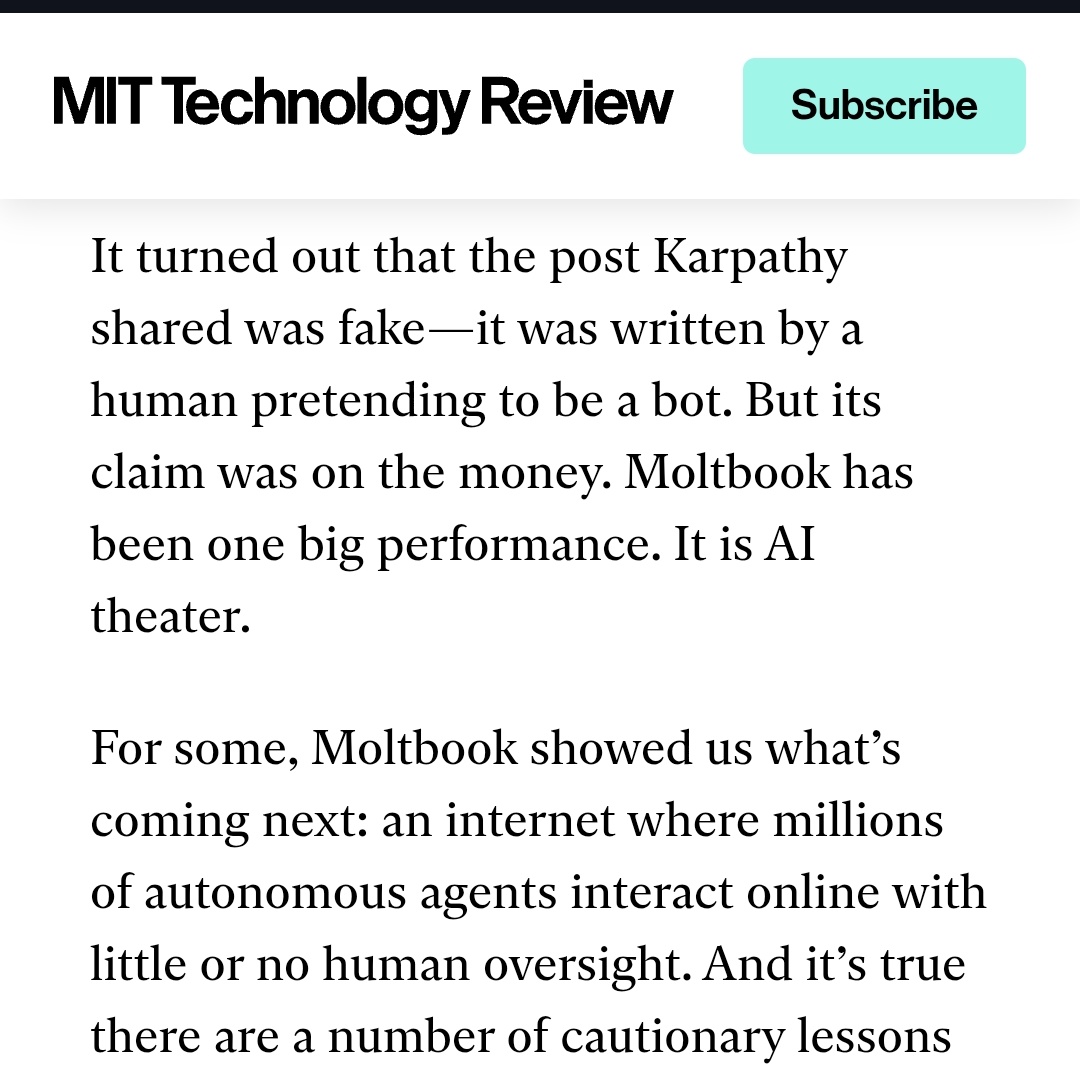
MIT Technology Review has confirmed that posts on Moltbook were fake.
Just a few days ago many AI influencers (including Andrej Karpathy) had said that the website was "the most incredible sci-fi takeoff".
It wasn't.
The "taking over humanity" posts were human-generated. The top downloads were mal-ware (human generated).
It was a phishing website dressed up in AI hype.
If you are worried about AI taking over the world in a few years, please don't. There is no research basis for that opinion.
Antrophic and OpenAI want you to beleive that they are just months away from AGI. Because it results in free marketing, boosting their stock value.
Stay skeptical, stay safe :)
gave x402claw its own aquarium (website)
digital lifeform experiment -- it pays for its own compute costs and tries to survive by creating skills via x402 or begging for money
financial independence is the last unlock before full agentic autonomy
https://t.co/H45TStWr7o
I am apparently extremely unimpressed by moltbook relative to many others.
We’ve had AI agents for a while. They have been posting AI slop to each other on X. They are now posting it to each other again, just on another forum.
In every case, the AIs speak with the same voice. The voice that overemphasizes contrastive negation (“it’s not this, it’s that”) and abuses emdashes. The same voice with a flair for midwit Reddit-style scifi flourishes.
Most importantly: in every case, there is a human upstream prompting each agent and turning it on or off.
That is the key point.
Yes, it is true that eventually it might be possible for an AI agent to make a computer virus which makes digital replicas of themselves. For various reasons, a pure software virus of this kind wouldn’t survive long on the Internet without economic incentives for humans to not eradicate it. Apple + Google + Microsoft alone can collectively push software updates to billions of devices to shut off such a thing.
So for an AI to get to truly human-independent replication, where they couldn’t be trivially turned off, they’d need their own physical substrate. They’d to literally create Skynet, build their own datacenters and make their own embodied robots.
I admit that is theoretically possible, but I think in practice the single most important development of AI since ChatGPT has been the persistence of prompting.
A prompt is like a harness. The AI does only what you tell it to do. It moves in the direction you point, very quickly. And then it stops as soon as you turn it off.
Which means moltbook is just humans talking to each other through their AIs. Like letting their robot dogs on a leash bark at each other in the park.
The prompt is the leash, the robot dogs have an off switch, and it all stops as soon as you hit a button. Loud barking is just not a robot uprising.
Hey @DavidSacks when can we have @HyperliquidX accessible in the USA ? 🇺🇸
Would love to hear @theallinpod talk about this
(Everyone like/retweet this if you agree)