My first personal data analytics project!
Built a PowerBI dashboard analyzing Nigeria's presidential elections (2015–2023).
Inspired by a challenge from @Adedamolapr. Although age and gender data weren't available, I explored voter turnout, party performance, vote-share shifts.
Let's get the internship started😁
Still grateful to have received two internship offers, and excited to begin this next chapter today.
Looking forward to gaining real-world experience, learning from professionals, and growing as a data analyst.
The data indicates that future elections may be decided more by voter turnout and swing regions than by traditional strongholds alone.
#PowerBI#DataAnalytics#ElectionAnalysis
The regional projection analysis revealed that some geopolitical zones are becoming increasingly competitive ahead of future election cycles.
Based on 2023 voting patterns:
• APC maintained narrow leads in the North Central (+1.5%) and North West (+1.4%)
My first personal data analytics project!
Built a PowerBI dashboard analyzing Nigeria's presidential elections (2015–2023).
Inspired by a challenge from @Adedamolapr. Although age and gender data weren't available, I explored voter turnout, party performance, vote-share shifts.
One major takeaway from the analysis:
Most regional lead margins were relatively small, suggesting that several zones are becoming more politically competitive rather than being completely dominated by a single party.
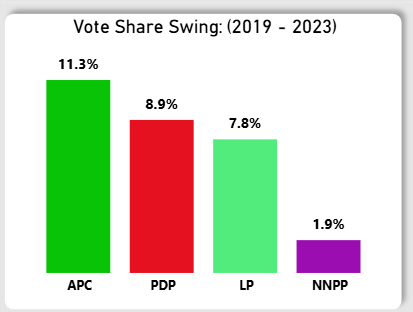
This suggests that while APC maintained stronger short-term electoral dominance, LP experienced the most significant long-term momentum growth leading into 2023.
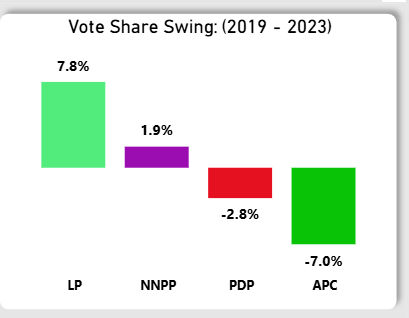
One interesting findings from the Swing Analysis of this data was the difference between short-term dominance and long-term momentum shifts.
Across the full 2015–2023 election period:
• LP recorded the largest overall positive swing (+7.8%)
• NNPP also gained slightly (+1.9%)
• PDP (-2.8%) and APC (-7.0%) experienced net declines overall.
However, when analyzed election-by-election, APC still recorded some of the strongest positive swings in individual cycles, followed by PDP.
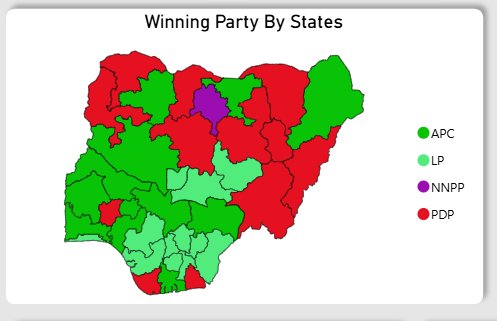
One other clearest patterns from the dashboard was how dramatically Nigeria’s political map shifted in 2023.
While APC maintained strong dominance across several Northern states, Peter Obi through LP significantly altered the electoral landscape in parts of the South East...
My first personal data analytics project!
Built a PowerBI dashboard analyzing Nigeria's presidential elections (2015–2023).
Inspired by a challenge from @Adedamolapr. Although age and gender data weren't available, I explored voter turnout, party performance, vote-share shifts.
and major urban centers in 2023.
Compared to previous election cycles, 2023 showed one of the most fragmented electoral maps in recent Nigerian political history.
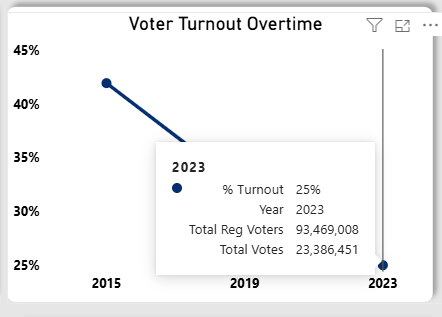
Interestingly, 2023 recorded the lowest voter turnout with highest voters registration across the 2015–2023 election cycles despite having one of the most politically active online populations.
One of the most surprising findings from my election dashboard analysis:
Despite the massive political engagement surrounding the 2023 election cycle and Peter Obi’s growing online support base, national voter turnout continued to decline.
Only 25% vote turnout (23M out of 93M)
The data suggests that higher voter registration did not translate into equivalent voter participation.
Possible contributing factors may include:
• PVC collection challenges
• election logistics issues
• voter apathy
• security concerns in some regions
My first personal data analytics project!
Built a PowerBI dashboard analyzing Nigeria's presidential elections (2015–2023).
Inspired by a challenge from @Adedamolapr. Although age and gender data weren't available, I explored voter turnout, party performance, vote-share shifts.