Nagpasya ang #KorteSuprema na ang pagkakabawi ng isang na-carnap na sasakyan ay hindi hadlang para matanggap ng may-ari ang kabuuang bayad sa ilalim ng insurance policy.
Sa Desisyon na isinulat ni Associate Justice Henri Jean Paul B. Inting, inatasan ng Ikatlong Dibisyon ng Korte Suprema ang UCPB General Insurance Co., Inc. (UCPВ) na bayaran si Wilfrido C. Wijangco (Wilfrido) para sa pagkawala ng kanyang ninakaw na sasakyan.
Tinutukan ng patalim ang anak ni Wilfrido na si Andrew sa isang paradahan ng mga armadong lalaki na tinangay ang sasakyan matapos siyang pagbantaan. Iniulat sa pulisya ang pagnanakaw at nagsampa si Wilfrido ng insurance claim sa UCPB at nagsumite ng lahat ng kinakailangang dokumento.
Sa kabila ng paulit-ulit na follow-up na ginawa ni Wilfrido, hindi inaprubahan ng UCPB ang kanyang paghahabol. Nagprotesta si Wilfrido sa pagkaantala at gumawa ng pormal na kahilingan laban sa UCPB.
Ipinaalam kalaunan ng UCPB kay Wilfrido na nabawi ang sasakyan ng Traffic Management Group (TMG) at ititigil ang kanyang claim hangga’t hindi naiisumite ang TMG clearance. Nang hindi umusad ang kanyang claim, nagsampa ng kaso si Wilfrido laban sa UCPB.
Pinagbigyan ang insurance claim ng Regional Trial Court (RTC) na nagsabing nagdulot ang pagnanakaw ng pananagutan sa UCPB kahit na nabawi pa ito. Nang binaliktad ng Court of Appeals (CA) ang desisyon, iniakyat ang kaso sa Korte Suprema.
Ibinalik ng Korte Suprema ang desisyon ng RTC. Binigyang-diin nito na may nagawa nang pagnanakaw kapag labag sa batas ang pagkuha ng sasakyan. Hindi nabubura ng pagkakabawi ng sasakyan ang mismong pagnanakaw.
Sa ilalim ng Seksyon 249 ng Insurance Code, inaatasan ang mga insurer na magbayad ng mga claim sa loob ng takdang panahan matapos matanggap ang patunay ng pagkawala. Sa sandaling lumipas ang panahong ito at bago mabawi ang insured na sasakyan, magiging pinal ang pagbabayad ng insurer para sa pagkawala at hindi maaaring pilitin ang insured na tanggapin ang nabawing sasakyan.
Sa kasong ito, inihain ni Wilfrido ang kanyang katibayan ng pagkawala noong Oktubre 10, 2006, ngunit ipinaalam sa kanya ng UCPB ang pagbawi pagkalipas ng 162 na araw – higit pa sa 90-araw na legal na palugit. Hindi rin magamit ang sasakyan dahil nawawala ang ilang bahagi at may matinding pinsala kahit pa nabawi ito.
Inatasan ng Korte Suprema ang UCPB na magbayad kay Wilfrido ng PHP 1.8 milyon na insurance proceeds, kasama ang dobleng interes sa halaga. Inatasan din ang UPCB na magbayad ng PHP 180,000 bilang attorney’s fee at PHP 200,000 bilang danyos.
Basahin ang press release sa https://t.co/b3b4lhKxp6.
Basahin ang buong Desisyon sa https://t.co/NmdXzLjRpH.
Sumunod sa Credit Attribution Policy ng SC PIO: https://t.co/F48RF1vtzZ.
#SupremeCourtPH
#SCphTranslations
What are the key differences between RA 7877 (Anti-Sexual Harassment Act) and RA 11313 (Safe Spaces Act) in how harassment is defined and who are protected? How do these laws vary in terms of accountability, legal remedies, and scope?
Listen to the latest episode of the Supreme Court Podcast with guest Judge Bernard P. Bernal, who also serves as a Professorial Lecturer at the Philippine Judicial Academy.
Supreme Court Chief Communications Officer Atty. Mike Navallo and Judge Bernal discuss RA 7877, or the Anti-Sexual Harassment Act, vis-à-vis RA 11313, or the Safe Spaces Act, highlighting what sets them apart.
This episode of the #SCphPodcast is also available on Spotify, the #SupremeCourtPH website, and YouTube.
Spotify: https://t.co/sIzCtAk4Iq
SC website: https://t.co/UwUlZd0Ils
YouTube: https://t.co/uyed8EvL2q
READ!!! READ!!! READ!!! 🚨🚨
THE ULTIMATE CALL FROM FORMER CHIEF JUSTICE REYNATO PUNO
OFFICIAL STATEMENT
PHILIPPINE CONSTITUTION ASSOCIATION (PhilConsa)
On the Supreme Court Ruling in G.R. No. 278353 “Sara Z. Duterte vs. House of Representatives, et al.”
July 30, 2025
The Philippine Constitution Association (PhilConsa) expresses its serious concern over the Supreme Court’s ruling in G.R. No. 278353, which nullified the impeachment proceedings initiated by the House of Representatives against Vice President Sara Z. Duterte. With due respect to the Honorable Court, we believe this decision overreaches constitutional boundaries, disrupts the separation of powers, and weakens Congress’ exclusive authority to hold impeachable officers accountable.
⸻
The Facts Cannot Be Ignored
Between December 2024 and February 2025, four impeachment complaints were filed against Vice President Duterte. The first three complaints, though officially docketed, were never pursued. They were neither found sufficient in form and substance nor referred for committee hearings. On February 5, 2025, a fourth complaint—this time endorsed by 215 members of the House, more than the required one-third—was transmitted as Articles of Impeachment to the Senate, in full accordance with the Constitution.
Yet on July 25, 2025, the Supreme Court ruled that the fourth complaint was barred under the one-year rule in Article XI, Section 3(5) of the Constitution, on the theory that the filing of earlier complaints—even if not acted upon—already “initiated” the impeachment process.
⸻
This Interpretation Is Constitutionally Flawed
PhilConsa respectfully but firmly disagrees with this interpretation. The one-year bar rule was designed to prevent harassment through repeated impeachment proceedings—not to protect impeachable officers from ever facing trial by allowing them to take cover behind mere filings. As the Court itself held in Francisco v. House of Representatives, impeachment is only deemed initiated after the complaint is found sufficient in form and substance and referred to the Committee on Justice. The earlier complaints never reached that stage. To treat them as having “initiated” proceedings defies both logic and constitutional intent.
This ruling invites dangerous abuse. It opens the door for impeachable officials—or their allies—to deliberately file weak or premature complaints to “consume” the one-year window and block any real effort at accountability. This is not a safeguard against harassment—it is a blueprint for evasion.
⸻
Judicial Restraint vs. Judicial Activism
This case called for judicial restraint, not judicial activism. The Constitution gave the House of Representatives the sole power to initiate impeachment and the Senate the sole power to try and decide it. These are textual, exclusive powers, and the Judiciary’s role in such matters should be limited to clear, grave abuses that nullify constitutional norms.
Instead, the Court stepped into the heart of a political process already underway—substituting its own judgment for that of a constitutional majority of the House. It interpreted the one-year bar so broadly that it now disables the very mechanism of impeachment in all but the rarest cases.
This ruling, though perhaps well-intentioned, is a clear instance of judicial activism. It turns the Judiciary from a neutral guardian of the Constitution into an arbiter of congressional timing and internal processes—matters the Constitution never assigned to the courts.
Judicial activism, if unchecked, becomes judicial supremacy. And that supremacy can, over time, paralyze the political departments that the people themselves empowered.
⸻see comment for cont. 👇🏻
The #SupremeCourtPH (SC) has clarified that being listed in a corporation’s General Information Sheet (GIS) is not enough to prove someone is a stockholder.
In a Resolution written by Associate Justice Ramon Paul L. Hernando, the SC’s First Division granted a motion for reconsideration of its earlier Decision and ruled that Ma. Christina Patricia C. Lopez (Christina) and John Rusty Lito Lopez (John Rusty) are not stockholders of LC Lopez and Conqueror, despite being listed in the companies’ GIS submitted to the Securities and Exchange Commission.
The case stemmed from special stockholders’ meetings held by the two companies to elect new board members. Christina and John Rusty sent proxies to participate, but the companies rejected them, stating that their principals were not registered stockholders. The meetings proceeded, and new directors were elected.
Christina and John Rusty challenged the elections before the Regional Trial Court (RTC), arguing that their exclusion invalidated the election due to a lack of quorum. The RTC ruled in their favor, relying on the GIS as proof of their stockholder status.
However, the Court of Appeals reversed the RTC’s decision, pointing out that their names did not appear in the companies’ stock and transfer books.
The SC initially upheld the RTC’s decision, considering the GIS and witness testimonies as sufficient evidence. Respondent board of directors, however, moved for reconsideration.
In granting the motion, the SC clarified that the stock and transfer book is the primary and official record of a corporation’s stockholders. A person must also present a stock certification issued in their name to prove ownership of shares.
Under Section 62 of the Revised Corporation Code, a transfer of shares is not valid—except between the parties—until it is properly recorded in the company's books.
The SC ruled that being listed in the GIS does not make one a stockholder, and that the stock and transfer book prevails.
Read the full text of the Press Release at https://t.co/Kn5FQ8f4Xe.
Read the full text of the Resolution at https://t.co/ok1AeJwNid.
Read the Dissenting Opinion of Associate Justice Ricardo R. Rosario at https://t.co/woDfeu9r3A.
Copying of this content is subject to the SC PIO’s Credit Attribution Policy: https://t.co/F48RF1vtzZ.
Pinagtibay ng #KorteSuprema ang awtoridad ng National Labor Relations Commission (NLRC) na ipatupad ang mga tuntunin ng Collective Bargaining Agreement (CBA) sa mga kasong may kinalaman sa unfair labor practices (ULP).
Sa isang Desisyon na isinulat ni Associate Justice Japar B. Dimaampao, kinatigan ng Ikatlong Dibisyon ng Korte Suprema ang utos ng NLRC na nag-aatas sa Guagua National Colleges (GNC) na bayaran ang mga empleyado nito ng mga napagkasunduang economic benefits pero inayos nito kung paano kukuwentahin ang mga benepisyong iyon.
Nag-ugat ang kaso mula sa mga negosasyon noong 2009 para i-renew ang limang taong CBA sa pagitan ng GNC at mga unyon nito. Bagama't sumang-ayon ang GNC na magbigay ng mga benepisyo tulad ng rice subsidy, loyalty pay, at clothing allowance, patuloy na naantala ang pagpirma sa draft ng CBA. Naghain kalaunan ang mga unyon ng notice of strike.
Nagpasya ang NLRC na may bad faith sa pakikipagkasundo ng GNC na isang unfair labor practice. Idineklara din nito ang huling draft ng CBA bilang kasunduan ng mga partido. Matapos maging pinal ang desisyon nito, inutusan ng NLRC ang GNC na bayaran ang mga empleyado nito sa mga napagkasunduang benepisyo na sumasaklaw sa 2009 hanggang sa kasalukuyang petsa na noong panahong iyon ay 2017.
Kinuwestiyon ng GNC ang kautusan na nag-uutos sa kanila na magbayad. Katwiran ng GNC, ang mga boluntaryong arbitrator lang at hindi ang NLRC ang may kapangyarihang ipatupad ang mga tuntunin ng CBA.
Sa pagpapatibay ng awtoridad ng NLRC, nilinaw ng Korte Suprema na habang karaniwang pinangangasiwaan ng mga boluntaryong arbitrator ang pagpapatupad ng CBA, pinapahintulutan ng Labor Code ang NLRC na ipatupad ang mga probisyon ng CBA kapag may kinalaman sa mga gross violation na katumbas ng ULP.
Sinabi ng Korte Suprema na nasa pinakamahusay na posisyon ang NLRC, matapos suriin ang CBA, para ipatupad ito. Ang pagpapadala ng kaso sa mga boluntaryong arbitrator para sa pagpapatupad ng CBA ay magdudulot lang ng mga pagkaantala, magpapataas ng posibilidad ng maraming demanda, at magpapahaba sa paglutas ng mga karapatan at obligasyon sa pagitan ng mga partido.
Gayunpaman, nagdesisyon ang Korte Suprema na hindi tama ang pag-compute ng mga benepisyo. Ipinagpalagay nito na ang pag-compute ay hindi dapat isama ang signing bonus at saklaw lamang ang limang taong termino ng CBA o ang mga taong 2009 hanggang 2014.
Basahin ang press release sa https://t.co/jsAexph31R.
Basahin ang Desisyon sa https://t.co/Hc9wPq0U5M
Sumunod sa Credit Attribution Policy ng SC PIO: https://t.co/F48RF1vtzZ.
#SupremeCourtPH
#SCphTranslations
The #SupremeCourtPH (SC) has affirmed the authority of the National Labor Relations Commission (NLRC) to execute the terms of a Collective Bargaining Agreement (CBA) in cases involving unfair labor practices (ULP).
In a Decision written by Associate Justice Japar B. Dimaampao, the SC’s Third Division upheld the NLRC’s order directing Guagua National Colleges (GNC) to pay its employees the agreed economic benefits, but adjusted how those benefits were computed.
The case arose from negotiations in 2009 to renew the five-year CBA between GNC and its unions. Although GNC agreed to provide benefits such as a rice subsidy, loyalty pay, and clothing allowance, it continued to delay signing the draft CBA. Frustrated, the unions filed a notice of strike.
The NLRC ruled that GNC bargained in bad faith, which is an unfair labor practice. It also declared the final CBA draft as the parties’ agreement. NLRC ordered GNC to pay its employees the agreed benefits covering 2009 up to the present date, which at that time was 2017.
GNC questioned the order directing them to pay, arguing that only voluntary arbitrators—not the NLRC—had the power to enforce the CBA terms.
Upholding the authority of the NLRC, the SC clarified that while voluntary arbitrators generally handle CBA implementation, the Labor Code authorizes the NLRC to enforce CBA provisions when gross violations amounting to ULP are involved.
The SC said that in this case, it was the NLRC which was best positioned to enforce the CBA, having reviewed it. Sending the case to voluntary arbitrators for implementation would only cause delays, increase the likelihood of multiple lawsuits, and prolong the resolution of rights and obligations between the parties.
However, the SC ruled that the computation of benefits was incorrect. It held that the computation should exclude the signing bonus and cover only the five-year CBA term, or the years 2009 to 2014.
Read the full text of the Press Release at https://t.co/jsAexph31R.
Read the full text of the Decision at https://t.co/Hc9wPq0U5M.
Copying of this content is subject to the SC PIO’s Credit Attribution Policy: https://t.co/F48RF1vtzZ.
The #SupremeCourtPH (SC) has recognized that a sudden outburst of uncontrolled emotions, triggered by years of abuse from the accused’s father, qualifies as passion or obfuscation – a mitigating circumstance that can reduce the penalty for parricide.
In a Decision written by Associate Justice Ramon Paul L. Hernando, the SC’s First Division upheld the conviction of accused Leopoldo Singcol’s (Singcol) for killing his father, but lowered the penalty due to the presence of this mitigating factor.
Case records show that during a heated argument, Singcol’s father attempted to attack him with a bolo, but the former stumbled and fell. Singcol then grabbed the bolo and stabbed his father in the chest, killing him.
Singcol thereafter encountered his sister-in-law and her two-year-old son; he fatally stabbed his sister-in-law, and injured the child.
During trial, Singcol admitted to stabbing his father, his sister-in-law, and the child. He claimed he suffered abuse from his father since childhood, and was thus not thinking clearly when he attacked the others.
While the SC agreed with the trial court and the Court of Appeals that self-defense was not applicable in this case, it ruled that passion or obfuscation should be considered as a mitigating factor or circumstance that lessens the penalty. It sentenced Singcol to two counts of reclusion perpetua or a maximum of 40 years in prison for the parricide and the murder of his sister-in-law.
Under the Revised Penal Code, the crime of parricide is committed when the accused kills their parents or child, whether legitimate or illegitimate, or any of their ascendants or descendants, or legal spouse.
On the other hand, passion or obfuscation is a state of mind present when a crime is committed due to an uncontrollable burst of emotions triggered by previous unjust or improper acts.
The SC considered the parricide a result of “a sudden surge of the accused’s bottled-up feelings caused by paternal neglect since childhood,” as shown by Singcol’s narration and his extreme, irrational acts of self-harm immediately after the killing.
Read the full text of the Press Release at https://t.co/M4PouxmBnX.
Read the full text of the Decision at https://t.co/Daa5PTKliH.
Copying of this content is subject to the SC PIO’s Credit Attribution Policy: https://t.co/F48RF1vtzZ.
Nilinaw ng #KorteSuprema na maaaring kolektahin ng korte ang suweldo ng mga pampublikong opisyal para mabayaran ang kanilang mga utang. Ang mga suweldong ito ay hindi exempted sa garnishment sa ilalim ng kasalukuyang mga batas at tuntunin.
Sa isang desisyon na isinulat ni Associate Justice Samuel H. Gaerlan, nagpasya ang Third Division ng Korte na maaaring ma-garnish o makumpiska para legal na kolektahin ang suweldo ni Atty. Fred L. Bagbagen (Bagbagen) para bayaran ang kanyang utang kay Anna May F. Perez (Perez).
Napawalang-sala ng Regional Trial Court (RTC) sa kasong estafa si Bagbagen pero napatunayan siyang may sibil na pananagutan para bayaran si Perez ng PHP 308,000. Pinayagan ng RTC ang garnishment ng kanyang sweldo na nakadeposito sa Philippine Veterans Bank.
Sinubukan ni Bagbagen na pigilan ang garnishment sa katwiran na ang kanyang mga suweldo ay pondo ng gobyerno hangga’t hindi nagagastos.
Tinanggihan ito RTC na nagsabing hindi na itinuturing na pondo ng gobyerno ang pera kapag ito ay naideposito na sa personal bank account. Sumang-ayon sa RTC ang Court of Appeals (CA).
Pinagtibay ng Korte Suprema ang Desisyon ng CA at RTC. Binigyang diin nito na walang batas na nag-i-exempt sa mga sweldo ng mga opisyal ng gobyerno sa garnishment. Sa ilalim ng Rule 39 ng Rules of Court, ang mga suweldo, parehong pampubliko at pribado, ay maaaring ma-garnish para pambayad sa utang.
May exception para sa mga manual laborer o manggagawa na ang mga sahod ay protektado para matiyak na maaari pa rin nilang suportahan ang kanilang mga pamilya. Paliwanag ng Korte, ang mga manggagawa ay karaniwang umaasa sa kikitain sa isang araw ng trabaho para suportahan ang kanilang pamilya kaya higit silang nangangailangan ng exemption. Pero hanggang apat na buwan lang na halaga ng sahod ang kasama sa exemption. Anumang halaga na higit pa rito ay maaari pa ring kolektahin para bayaran ang mga utang.
Pinapanatili ring mas mahigpit ang pamantayan pagdating sa kita at obligasyon sa pananalapi sa mga pampublikong opisyal dahil sa kanilang tungkulin sa Konstitusyon bilang tagapag-ingat ng tiwala ng publiko.
Basahin ang press release sa https://t.co/vKVV3sopnm.
Basahin ang Desisyon sa https://t.co/1BDFuDS4Tf.
Sumunod sa Credit Attribution Policy ng SC PIO: https://t.co/F48RF1vtzZ.
#SupremeCourtPH
#SCphTranslations
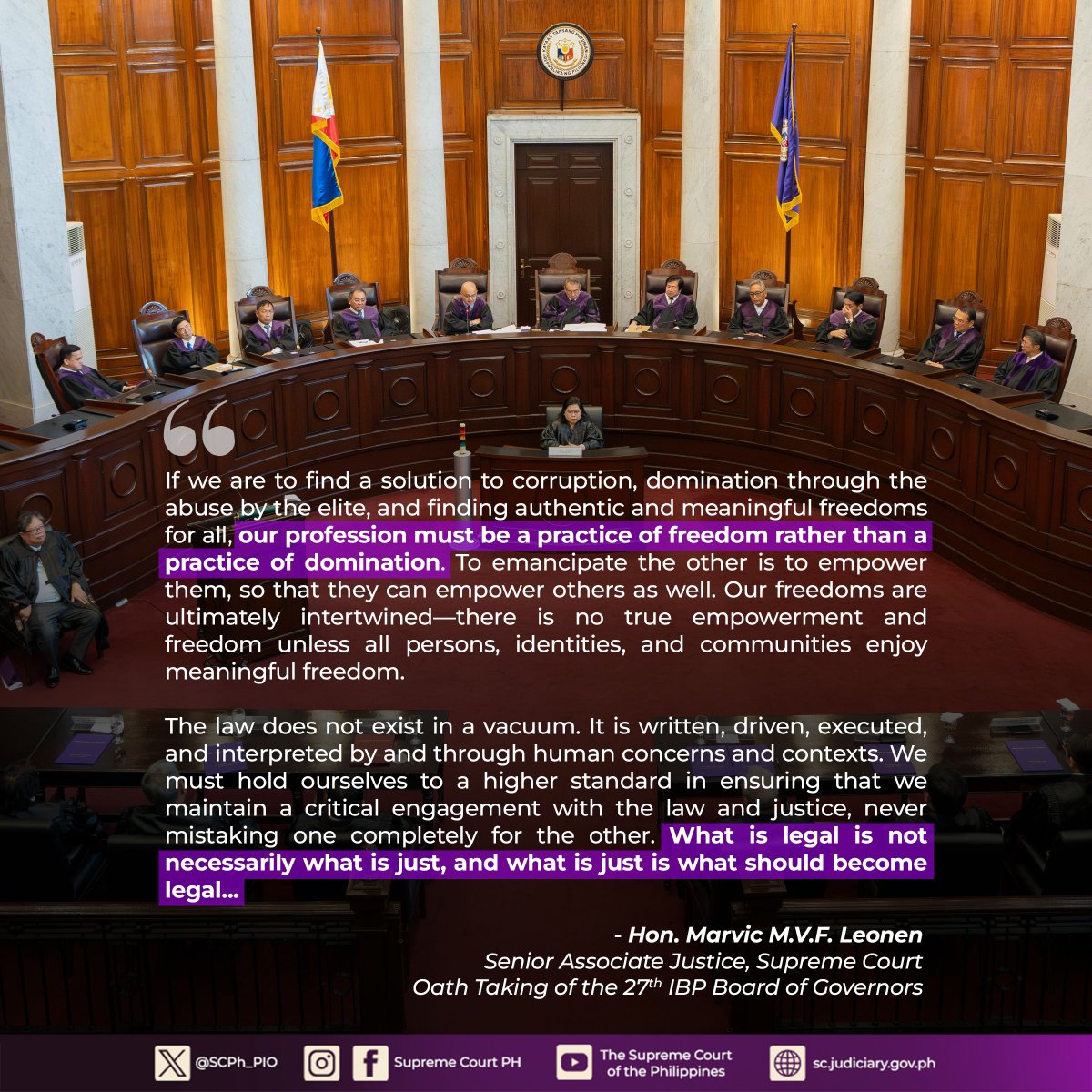
Senior Associate Justice Marvic M.V.F. Leonen challenged the newly-elected Integrated Bar of the Philippines (IBP) Board of Governors to call out acts of corruption among lawyers and abstain from corrupt practices during the Oath Taking Ceremony of the 27th IBP Board of Governors held yesterday at the #SupremeCourtPH Session Hall.
The #SupremeCourtPH (SC) En Banc, during its session today, July 1, 2025, issued a writ of kalikasan in a case which seeks to stop the construction of the Samal Island-Davao City Connector Bridge Project against the following respondents:
- Department of Public Works and Highways;
- Department of Environment and Natural Resources;
- Samal Island Protected Landscape and Seascape Protected Area Management Board; and
- China Road and Bridge Corporation
Petitioners Carmela Marie Santos, Mark Peñalver, and Sustainable Davao Movement claim that the Project will cause actual, serious, and irreversible damage to coral reefs in Paradise Reef, Samal Island, and Hizon Marine Protected Area in Davao City.
The SC required the respondents to file a verified return on the petition within 10 days from service of the writ.
The SC also referred the prayer for a temporary environmental protection order to the Court of Appeals–Cagayan de Oro station for action.
Read the Press Briefer at https://t.co/opU5LSk9mk.
Attention, lawyers. Have you created your account at the Philippine Judiciary Portal (PJP)? An active PJP account is required to electronically file petitions and pleadings before the #SupremeCourtPH through the #eCourtPH.
Please be reminded that from July 1 to September 30, 2025, initiatory petitions and pleadings, motions for extension of time, and subsequent pleadings in a previously docketed case falling due on July 1, shall not only be filed with the #SupremeCourtPH in accordance with the Rules of Court, but also through the PJP.
By October 1, 2025, the filing and service through the PJP will be mandatory for covered pleadings.
This is pursuant to A.M. No. 25-05-16-SC, or the Guidelines on the Transition to Electronic Filing in the Supreme Court, which may be accessed here: https://t.co/Hc3AwNOKAB
Watch the step-by-step guide on how to use #eCourtPH at https://t.co/y6mBabcFDy
You can also watch the instructional video on how to create an account at the PJP at https://t.co/OhRTeYHEQq
For more details, visit https://t.co/DsOvIg2oZc
The Supreme Court (SC) has ruled that a child’s rape by her adoptive uncle does not warrant a harsher penalty because they are not related, based on the prevailing law at the time of the crime. However, recent adoption laws enacted after the crime now recognize the relationship between an adoptee and their adoptive relatives and may qualify the crime.
In a Decision written by Associate Justice Japar B. Dimaampao, the SC’s Third Division found a man guilty of raping his 10-year-old adoptive niece, but ruled that his penalty cannot be increased by the qualifying circumstance of relationship.
The SC thus upheld the accused’s conviction but declared him guilty of statutory rape instead of qualified rape.
Case records show that sometime in November 2012, while the victim was asleep, her adoptive mother’s brother forcibly had sex with her.
While the Regional Trial Court and the Court of Appeals found the accused guilty of qualified rape, considering the victim’s minority and the fact that he is a relative by blood within the third civil degree, the SC disagreed.
The SC clarified that at the time the rape was committed, the existing laws on adoption did not consider the victim to be related to her adoptive parents’ family.
While R. A. No. 11642, or the Domestic Administrative Adoption and Alternative Child Care Act, which took effect in 2022, expanded the relationship to include the adopter’s parents, legitimate siblings, and legitimate descendants, it could not be applied to this case since the crime was committed in 2012.
The SC emphasized that to find the accused guilty of qualified rape would violate the constitutional prohibition against ex post facto laws, or laws that increase the penalty after the crime has been committed.
Read the full text of the Press Release at https://t.co/ZB3O9JnlwF.
Read the full text of the Decision at https://t.co/ZoKFUavyQo.
Read the Concurring Opinion of Associate Justice Alfredo Benjamin S. Caguioa at https://t.co/zoG05im0Td.
Copying of this content is subject to the SC PIO’s Credit Attribution Policy: https://t.co/F48RF1vtzZ.
The #SupremeCourtPH (SC) has ruled that a spouse’s inability to love or emotionally connect with their partner, if rooted in a genuine personality disorder, may be considered evidence of psychological incapacity and a ground to declare a marriage void.
In a Decision written by Senior Associate Justice Marvic M.V.F. Leonen, the SC’s Second Division reinstated an earlier ruling of the Regional Trial Court (RTC) which declared a couple’s marriage void from the beginning due to the husband’s psychological incapacity to fulfill his marital duties.
The couple met in 1999 and married in 2002. They did not live together immediately, as the husband worked in Saudi Arabia. They were only physically together for about five years, and their relationship was marked by frequent arguments and periods of separation.
In 2016, the husband filed a petition to nullify the marriage, supported by a psychologist’s diagnosis of his Passive-Aggressive Personality Disorder, which made it difficult for him to maintain close relationships. The RTC initially granted his petition, but reversed the same on reconsideration. The Court of Appeals denied the husband’s appeal.
The SC, however, ruled in favor of the husband, finding that he had sufficiently proven psychological incapacity.
Under Article 36 of the Family Code, a marriage is void if one or both spouses are psychologically unable to fulfill their marital duties—even if the condition becomes evident only after the wedding. The incapacity must be deeply rooted in the person’s character and must have existed before the marriage.
The SC clarified that psychological incapacity can manifest long after the wedding, so a spouse who initially appears capable may later show signs of inability. If this comes from a genuine psychological condition, the marriage can still be declared void.
In this case, the SC found that the husband’s emotional detachment stemmed from a strict and emotionally distant upbringing. While he could provide for his family financially, he struggled to meet his wife’s emotional needs, including basic companionship.
Read the full text of the Press Release at https://t.co/SwhgYNvv5V.
Read the full text of the Decision at https://t.co/94e6EEQ4CS.
Read the Dissenting Opinion of Associate Justice Jhosep Y. Lopez at https://t.co/86xEDtFrIl.
Copying of this content is subject to the SC PIO’s Credit Attribution Policy: https://t.co/F48RF1vtzZ.
The #SupremeCourtPH (SC) has ruled that a land sale made through a verbal, unwritten agreement can be considered valid and binding—as long as it has been partly or fully carried out.
In a Decision written by Associate Justice Samuel H. Gaerlan, the SC’s Third Division upheld the verbal sale of land between Marcos Batara (Batara) and his nephew Benedicto Ocampo (Ocampo). Even without a written contract, the SC found the sale valid because Ocampo had already received the land title, moved into the property, and made improvements on it.
The land was registered in the name of Batara, who passed away in 1974. His children, Noblesa and Ernesto, only learned of their father’s ownership of the property in 2007, when they received a notice to pay unpaid real estate taxes on the land and found out that the same was being occupied by their cousin, Ocampo.
Noblesa and Ernesto filed a case to reclaim the land from Ocampo, saying they were the rightful heirs. Ocampo, on the other hand, claimed he bought the land from Batara while the latter was still alive. After Batara died, Ocampo kept paying installments to Marcelo, Batara’s brother.
Ocampo admitted that the sale was not evidenced by any written document because Batara died before they could execute the necessary instruments. But Ocampo provided the owner’s copy of land title as proof, claiming Batara gave it to him after the initial payment in 1972.
Ruling in Ocampo’s favor, the SC said that under the Civil Code, a sale of land must be in writing to be enforced in court. This written document serves as proof that both parties agreed to the sale.
However, the sale is still considered valid even without a written contract if it has already been fully or partly carried out. In such cases, a verbal agreement can still be legally binding, and witnesses may be allowed to testify to prove that the sale happened.
In this case, the sale was partially executed as Ocampo had partially paid for the land, taken possession of it, received the land title, and paid real property taxes. The SC thus admitted the testimonies of Ocampo and his witnesses, which proved the sale.
The SC, however, found that Ocampo’s payments to Batara’s brother Marcelo were ineffective because he was not authorized to accept them on behalf of his brother’s heirs.
Therefore, while the sale remains valid, Ocampo must pay the remaining balance of the purchase price, with interest, to Noblesa and Ernesto.
Read the full text of the Press Release at https://t.co/dlcXQcqRDq.
Read the full text of the Decision at https://t.co/660es34NOM.
Copying of this content is subject to the SC PIO’s Credit Attribution Policy: https://t.co/F48RF1vtzZ.
The #SupremeCourtPH (SC) has reiterated that a co-owner must give written notice to the other co-owners before selling their share of a property. However, if the other co-owners already knew about the sale and failed to exercise their right to buy the share within 30 days, the written notice is no longer required.
In a Decision written by Chief Justice Alexander G. Gesmundo, the SC’s First Division denied the petition filed by siblings Antonio Azurin, Jr. (Antonio) and Rafael Azurin (Rafael) to buy back a parcel of land registered in the name of Carlito Chua (Chua).
Antonio and Rafael were in possession of a parcel of land which they co-owned with their aunt Adelaida. Adelaida later sold to Chua her portion, which was officially registered in Chua’s name after it was surveyed and divided.
Years later, Antonio and Rafael attempted to buy back the land from Chua by filing a complaint for legal redemption before the trial court. Both the trial court and the Court of Appeals denied the complaint, on the ground that the case was filed years after the sale and well beyond the 30-day period allowed by the Civil Code.
Antonio and Rafael appealed to the SC, but the SC denied their appeal.
The SC said that under the Civil Code, a co-owner intending to sell their share to a third party must notify the other co-owners in writing about the sale. The other co-owners then have 30 days from receipt of the written notice to redeem or buy back the portion sold. If they fail to do so within the period, they lose the right to redeem the sold portion.
The SC, however, added that the requirement of written notice can be waived if (1) unusual circumstances have made the co-owners aware of the sale, and (2) the co-owners did not take action or were negligent in their right to redeem the property, a situation referred to in law as laches.
In this case, the SC found that Antonio and Rafael were aware of the sale. They were in actual possession of the land and, therefore, were informed about the survey conducted on it. Additionally, they received Chua’s legal complaint to recover possession.
However, they waited more than six years before trying to redeem the property.
Read the full text of the Press Release at https://t.co/dbkNjjGINg.
Read the full text of the Decision at https://t.co/OPjSnbZBqM.
Copying of this content is subject to the SC PIO’s Credit Attribution Policy: https://t.co/F48RF1vtzZ.
Wow, behind the scenes showing it was Senator Joel Villanueva who was coaching Imee Marcos to interrupt Senator Risa as she was speaking.
“Pwede ka na magsalita para tumigil siya.”
Hiyang hiya naman ang Jesus is Lord Movement sa pagka upright mo sir.
My unsolicited legal advice to the House of Representatives:
1. The House is a co-equal of the Senate. The Senate cannot order the House around. Once the House transmits the Articles of Impeachment to the Senate—its work as a House is done. It will only need to send a delegation to act as prosecutors in the actual trial and it is its designated prosecutors that participates as prosecutors and not the House itself. In other words, while the Impeachment Tribunal can order the prosecutors to comply with reasonable and legally sound procedural requirements, it cannot order the House to re-do its processes.
2. To begin with, the act of the House enjoys the presumption of regularity. The Senate, even if it is acting as an Impeachment Court, cannot second-guess whether the House followed its own processes or that “it did not violate the Constitution.” As such, the act of remanding the Articles of Impeachment “to certify that it did not violate the Constitution,” is, ironically, what is unconstitutional because it second-guesses a categorical act of the House to transmit the Articles of Impeachment to the Senate that is the latter’s exclusive domain pursuant to the Constitution. Make no mistake: the House has the exclusive power to transmit the Articles of Impeachment and not even the Senate as an Impeachment Court can second-guess such exclusive power.
3. It has long been settled in Constitutional Law that the Journal of the House cannot be inquired upon or reviewed even by the Supreme Court. In US v. Pons (August 12, 1916, GR No. 11530), the Supreme Court held that the certification through the Journal of the House that a bill became law is CONCLUSIVE upon courts of law. Similarly, the Impeachment Court cannot also meddle with the processes of the House when it transmitted the Articles of Impeachment to the Senate. In Pons, the SC looked into the Journals to ascertain the date of adjournment but the SC refused to go beyond the recitals in the legislative Journals. Said the Supreme Court: “Said Journals are CONCLUSIVE on the Court and to inquire into the veracity of the journals of the Philippine Legislature, when they are, as the SC have said, clear and explicit, would be to violate both the letter and the spirit of the organic laws by which the Philippine Government was brought into existence, to invade a coordinate and independent department of the Government, and to interfere with the legitimate powers and functions of the Legislature.” It is clear that the Senate second-guessing the processes and records of the House showing what transpired in the House when it transmitted the Articles of Impeachment is a CLEAR INTERFERENCE in the exclusive domain of the House.
4. The remand also does not have constitutional basis. it is only a convenient excuse for the Senate to be able dribble the proceedings, despite the clear imperative by the Constitution to FORTHWITH PROCEED WITH TRIAL once the transmitted Articles of Impeachment are received by it. There is only one course of action based on the command of the Constitution: to proceed with trial.
5. The Senate is not an appellate court. It cannot “remand” the proceedings as if it is capable of reviewing the acts of the House as a constitutional body or that it is a “higher court” and the House is a “lower court.”
6. My advice to the House, therefore, is to refuse the remanding and just say that it has already done its job pursuant to the Constitution which is to transmit the Articles of Impeachment to the Senate. The ball is with the Senate to ACTUALLY commence with the trial, not to further delay the matter through contrived technical hurdles.
7. To begin with, it must be pointed out that the Senators seem to be acting like lawyers of Sara instead of behaving as IMPARTIAL JUDGES pursuant to the oath that they just made. Why are they the ones raising all of these cosmetic technical questions, instead of Sara’s defense lawyers? Abogado ba sila ni Sara Duterte?