Prof @oiioxford Director, Future of Work @oxmartinschool at Oxford University. Author of How Progress Ends (2025) & The Technology Trap (@PrincetonUPress, 2019)
In the @FT today, I argue that if AI is just another productivity tool, the productivity gains will be limited. For lasting economic expansion, AI must catalyze new industries and initiatives.
"Had the 19th century focused solely on better looms and ploughs, we would enjoy cheap cloth and abundant grain — but there would be no antibiotics, jet engines or rockets. Economic miracles stem from discovery, not repeating tasks at greater speed."
Activity is not productivity.
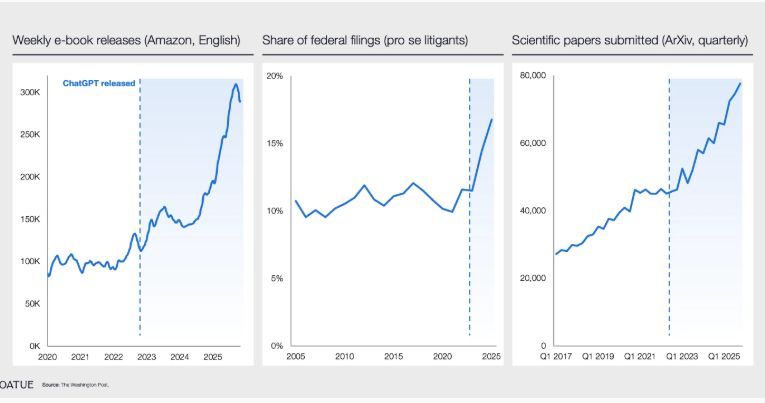
Many signs of a surge in knowledge work output post chat GPT, but no signs of any meaningful increase in the real sales per worker at the economy wide level.
I'm a huge fan of @JimPethokoukis work, and his most recent article sums up my take (though in a more erudite fashion than I could do).
AI is advancing really, really quickly. But, it takes time (sometimes a really long time) for firms to adopt and implement AI.
I don't know what Piketty, Stiglitz, and co. are smoking. Global poverty rates have never been lower. Progress on basic global health and wellbeing measures has been amazing over the past few decades. "End of the road"?!? Come again!?!
https://t.co/b5GHT6YXrN
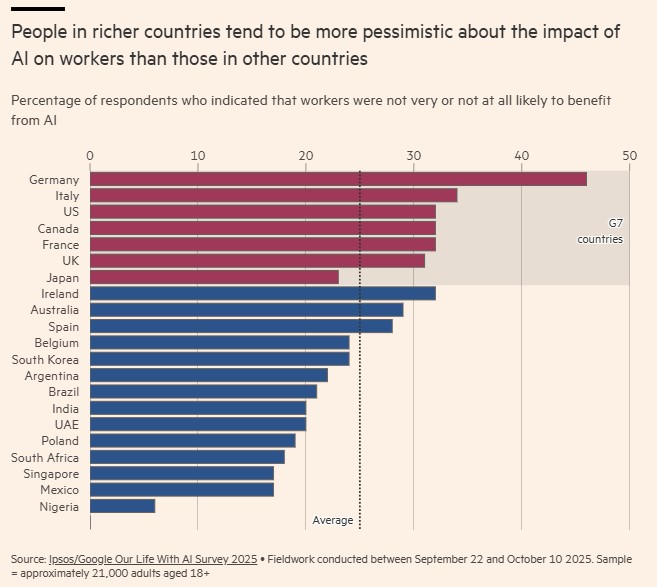
AI pessimism seems more pervasive in rich countries. Two possible reasons:
AI makes knowledge work easier to offshore to where labor is cheaper —fewer accountants in London, more in Manila.
In poorer countries, AI may expand access to services people lacked before (e.g. doctors)
I am still skeptical the smartphone explains much of recent drop in fertility. It may have contributed at the margin to the secular decline but the severe recession is a much more plausible explanation of the abrupt drop in 2008, coincidentally a year after iPhone was introduced.
Much enjoyed this session organized by .@ChathamHouse.
Many insights on #AI and its implications for companies, people, and global economy.
Huge thanks to panel speakers:
.@carlbfrey, Baroness Minouche Shafik, Blake Lweit & moderator @MyStephanomics
https://t.co/yRYoC6ahis
I really loved this article. A one-time increase in per capita growth from 2% to 2.1% for a single year, then dropping back to 2%, would permanently raises the level of GDP per capita - and because that small gain recurs and compounds every year afterward across the population, it would add up to roughly a trillion dollars in cumulative value. https://t.co/aaUHcLslRd
When people talk about pausing AI development, I can't help but think about the enormous cumulative value that would get lost over time, the higher rates of absolute poverty that would persist across the world, and the needless deaths from delayed medical advances. There may be worlds where some version of this is something to consider, but the evidentiary bar for delaying technological development should obviously be pretty high.
Anti-AI populism is on its way.
My latest column for @FT: Tech anxiety will be seized upon by politicians—echoing the anti-immigration rhetoric that has shaped public discourse over much of the past decade
https://t.co/llt1ULV9kB
#AI exposed counties lean "blue" but that doesn't mean job losses are imminent or that anxiety is driving their blueness.
It does mean blue counties are where workers have the most reason to be watching AI closely
https://t.co/aWgmpquKbi
@carlbfrey
With just one week to go, we're delighted to announce our final speaker: Professor Carl-Benedikt Frey, Dieter Schwarz Associate Professor of AI & Work at the Oxford Internet Institute, @UniofOxford. He'll be joining us at AI, work, and the future of global competitiveness, an exclusive event in partnership with LinkedIn and an official fringe event of London Tech Week.
He'll be joining our confirmed speakers, including:
▪️Stephanie Flanders, Head of Economics and Government, Bloomberg News
▪️Blake Lawit, Chief Global Affairs and Legal Officer, LinkedIn
▪️Baroness Minouche Shafik, Chief Economic Adviser to the Prime Minister
▪️Olivia O'Sullivan, Director, UK in the World Programme, Chatham House
Join us on Tuesday 9 June. Register your interest to attend 🔗 https://t.co/6RGFANvNkj
#ChathamHouse #LinkedIn #LondonTechWeek #AI #FutureOfWork #GlobalCompetitiveness #CHEvents
Commencement speakers who touted AI this graduation season were largely met with boos. But university graduates are not alone in challenging AI boosters’ bubbly narrative. In a new PS Big Picture, @carlbfrey, @RobinRivaton, and others highlight constraints on the technology’s productivity benefits.
https://t.co/N3vkMjGORO
China's comparative advantage IS industrial policy.
My latest column for @FT: Western attempts to imitate Beijing’s economic strategy are unwise.
https://t.co/ttwVfHgIMF
With insights from @carlbfrey and @gtalert
We took another look at the capability gap between open-weight and proprietary models. Since the start of the year, open-weight models have lagged the state of the art by four months.
Few things encapsulate the self-defeating European scarcity mindset (and quasi-religious belief in self-castigation) than the war on AC... when the evidence is very clear: Cognitive performance plumets beyond 16-18 degrees.
1/8
I just finished reading Chris Miller's excellent book on the collapse of the Soviet Economy. Some people might think that the topic is interesting, but largely irrelevant to global economic conditions today. They would be mistaken. This is a very relevant book.
@crmiller1