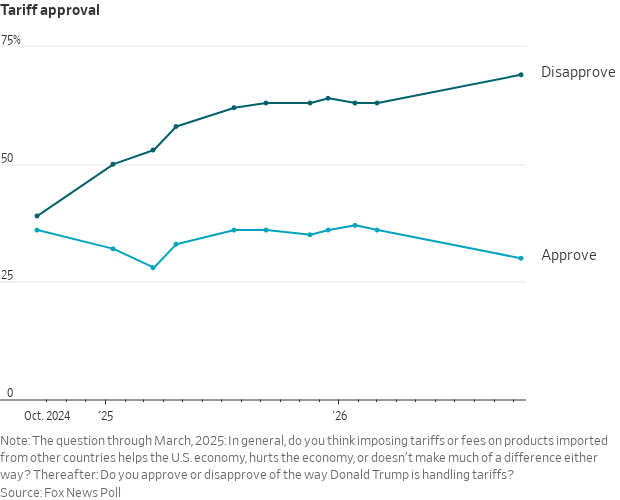
1/ Trump called “tariff” the most beautiful word in the dictionary. He somehow made it the most hated word in politics. He has thus endangered would could have been a legacy-defining shift in American trade policy. My column: https://t.co/g7VmfNeWX1
@TPCarney The irony is Trump may have found a bipartisan majority in Congress to raise some tariffs, esp. on China. But he would have surrendered the ability to toggle tariffs any time on anyone for any reason, which is one reason they became so unpopular.
“‘We should repeal the tariffs and banish [Trump’s] cronyist industrial policy to the footnotes of history,’ said Jake Auchincloss, a moderate Democrat running for re-election in Massachusetts. ‘Embrace free trade with free people,’ he said, meaning with allies but not China or Russia.”
https://t.co/mU45c0Z3AL
Trump's support for tariffs was always based on a basic economic error: he believes that a nation-to-nation accounting deficit means that other countries owe us money. Makes no sense but there it is. This policy and his Iran war have ruined his second term.
President Trump once called “tariff” the most beautiful word in the dictionary. He has somehow made it one of the most hated words in politics, writes @greg_ip https://t.co/4iVYCDwMTX via @WSJ
American workers want elected officials to prioritize making goods, services, and housing more affordable.
Tariffs do the opposite.
In our survey highlighted by @greg_ip today @wsj, they tell us they've had enough.
Check out the full results here: https://t.co/q6WFNJpxwr
Great piece from @greg_ip, and I hope this means I'm wrong that the broad tariffs are likely to be a lasting part of American economic policy going forward. https://t.co/F5ipJ6BnyZ
"How Tariffs Became the Most Hated Word in Politics" https://t.co/6GtlKuR9Bi
"Trump’s trade agenda collided with the public’s cost of living agenda, and trade lost."
Great piece from @greg_ip on the politics of tariffs. But campaigning against tariffs may look different than reality of repealing them. Ip points out what I argued in the Times over the summer:
"Repeal might also get harder by 2028 when domestic industries have gotten used to protection, some of the promised investment has materialized and tariffs are supplying almost $200 billion a year in federal revenue."
https://t.co/Ez4CBugfyI
@InnovateEconomy@scottlincicome 5/ Democrats shouldn't be smug. The same thing happened to their climate agenda: biden pushed it when people were worried about the cost of energy, and the other side made political hay of it.
1/ Trump called “tariff” the most beautiful word in the dictionary. He somehow made it the most hated word in politics. He has thus endangered would could have been a legacy-defining shift in American trade policy. My column: https://t.co/g7VmfNeWX1
@InnovateEconomy 4/ And because of the capricious way Trump deployed tariffs he personalized them, turning Democrats and independents off, @scottlincicome tells me. Ds may have supported some of the tariff agenda; they are now on record wanting to reverse it.
When my book came out, everyone asked if Trump was going to change the direction of US trade policy. "Too soon to say" I'd say because of status quo bias. Now Trump made "tariff" one of the most hated words in politics, says @greg_ip https://t.co/FcvJkfpYJ9 via @WSJ (1/2)
Any sense of how many levered investors are just playing the market outright v doing so on a RV (hedged) basis ... ultimately the world has to be long treasuries, and thus any RV player is relying on someone else's demand for synthesis duration (for example lifers getting duration v swaps after going into private credit for yield and volatility laundering)
Looking at today's dramatic decline in Treasury yields, worth remembering that the growing role of price-sensitive investors is two sided: it can explain large moves up, and down. Many of those investors are hedge funds arbitraging the curve or between cash and derivatives and dislocation could come either by liquidating shorts (yields fall) or longs (yields rise).