Me: "What does it say for your credibility on foreign policy issues, if you've gotten the two biggest foreign policy issues of our lifetime, Iraq and Gaza, both wrong?"
Matthew Yglesias: "I don't know, what does it mean to get Gaza right?"
New clip:
https://t.co/UoU5OJYD7O
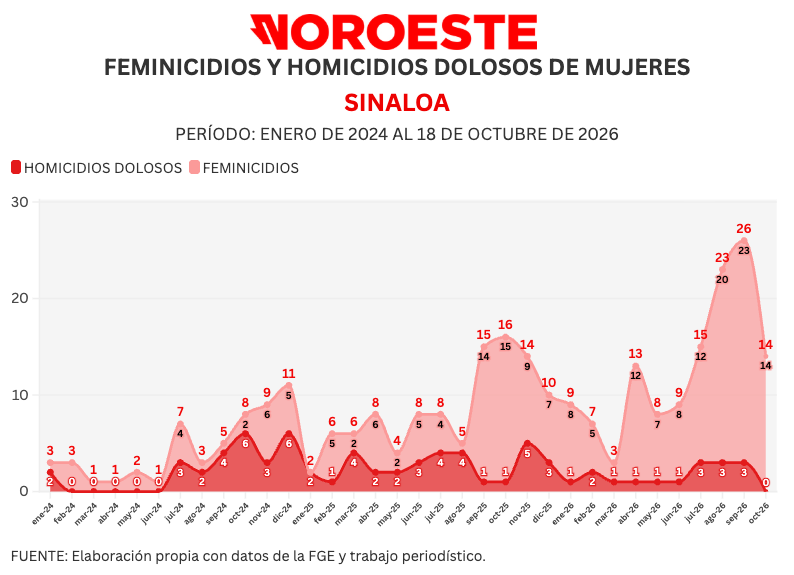
Ayer en la noche asesinaron a Reina en el centro de Escuinapa; hoy, Reyna Guadalupe fue perseguida y alcanzada por sus agresores dentro de una heladería en Culiacán, ahí dentro le quitaron la vida.
Con ellas, ya van 14 mujeres asesinadas en este octubre en Sinaloa y 127 en lo que va de 2026, casi 25% más que todo el 2025.
Por denunciar el desabasto de medicamentos que estoy afrontando fui objeto de crítica y burla en la mañanera. Aquí respondo: Presidenta @Claudiashein, usted tergiversa mi denuncia. El desabasto de medicamentos es real y afecta tanto a farmacias públicas como privadas, al IMSS y a hospitales particulares. No son mundos separados. Las decisiones fallidas de compras consolidadas del sexenio pasado y las trabas regulatorias de Cofepris también repercuten en el acceso a medicamentos.
Lamento que haya utilizado mi experiencia para descalificarme, incluso con el tono burlón de “la Denise”. Me tocó a mí, pero millones de mexicanos padecen el mismo peregrinaje desesperado de farmacia en farmacia. En lugar de burlarse de quienes denuncian debería escuchar a quienes sufren.
Tanto lo privado como lo público comparten la cadena de suministro, así que los problemas de Cofepris y de las compras públicas terminan afectando a las farmacias privadas. Los pacientes, al no encontrar los medicamentos necesarios en el IMSS, surten sus necesidades en el sector privado, hacen gasto de bolsillo y agotan inventarios. En mi caso el desabasto fue de un medicamento para el dolor; en muchos otros se trata de medicamentos de vida o muerte.
El desabasto no desaparece porque usted lo minimice. Y la responsabilidad de un gobierno no termina en la puerta de una farmacia privada. Los errores que han producido el desabasto nos afectan a todos. Lástima que no tenga la humanidad para reconocerlo y resolverlo.
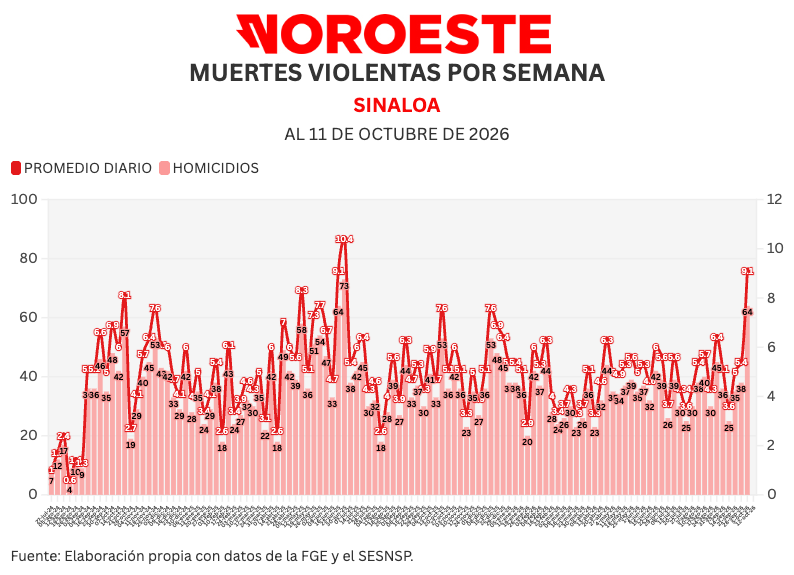
Con 64 muertes violentas ya y todavía a unas horas de que termine, esta semana (la 109) es ya la segunda más letal del conflicto entre los clanes Guzmán y Zambada en Sinaloa.
El comportamiento de los asesinatos muestra que la violencia letal en el estado se ha mantenido muy estable y no hay ninguna tendencia descendente, como suele presumir el gobierno federal.
Tu sistema inmune está súper conectado a tu sistema nervioso.
Lo hemos platicado mucho por aquí, pero esta revisión en Journal of Experimental Medicine está preciosa porque nos recuerda algo que a veces olvidamos cuando hablamos de inmunidad…que el sistema nervioso autónomo forma parte de la regulación de la respuesta inmune.
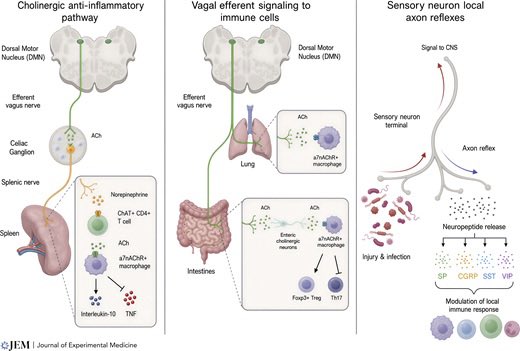
El sistema nervioso periférico/autónomo logra una comunicación bidireccional entre cerebro y sistema inmune. Y dentro de esta “plática”, el nervio vago tiene un papel especialmente maravilloso.
Sus vías sensoriales pueden detectar señales inflamatorias y sus circuitos pueden, directa o indirectamente, modificar respuestas inmunes.
El cerebro recibe información sobre lo que está pasando inmunológicamente en los tejidos y, al mismo tiempo , puede participar en cómo se regula esa respuesta.
Esto no significa que “activar el vago” mágicamente apague la inflamación (ojalá fuera así de sencillo😅) Significa que la inmunidad, cerebro y sistema nervioso autónomo forman circuitos neuroinmunes integrados.
Lo mejor de todo esto es que esto está abriendo la puerta a la neuromodulación como estrategia terapéutica para algunas enfermedades inflamatorias y autoinmunes.
El sistema inmune nunca ha trabajando por su cuenta. Eso es lo más lindo del sistema inmune…que “platica” con tu cerebro.
¿Por qué las mujeres tenemos más enfermedades autoinmunes que los hombres?
Durante años la respuesta fácil fue...las hormonas.
Pero la cosa está más interesante y más compleja.
Los involucrados en este incremento son los dos cromosomas X, genes inmunológicos como el del receptor Toll para RNA (TLR7), la molécula Xist, los estrógenos… y un sistema inmune que no funciona exactamente igual.
Aquí te platico todo esto. Está bueno... 😄
https://t.co/COJGXD30dM
In 2015, at the ECHO Klassik Awards, pianist Menahem Pressler, then 92 years old, was honoured with a Lifetime Achievement Award. After accepting the award, he asked if he could sit down at the piano and play a short piece.
He chose Chopin’s Nocturne in C-sharp minor. There was no orchestra, just a piano and a man who had devoted his entire life to music. The piece is not long, but under Pressler’s fingers, each note seemed to unfold slowly, delicately, and intimately, like a story being told through sound.
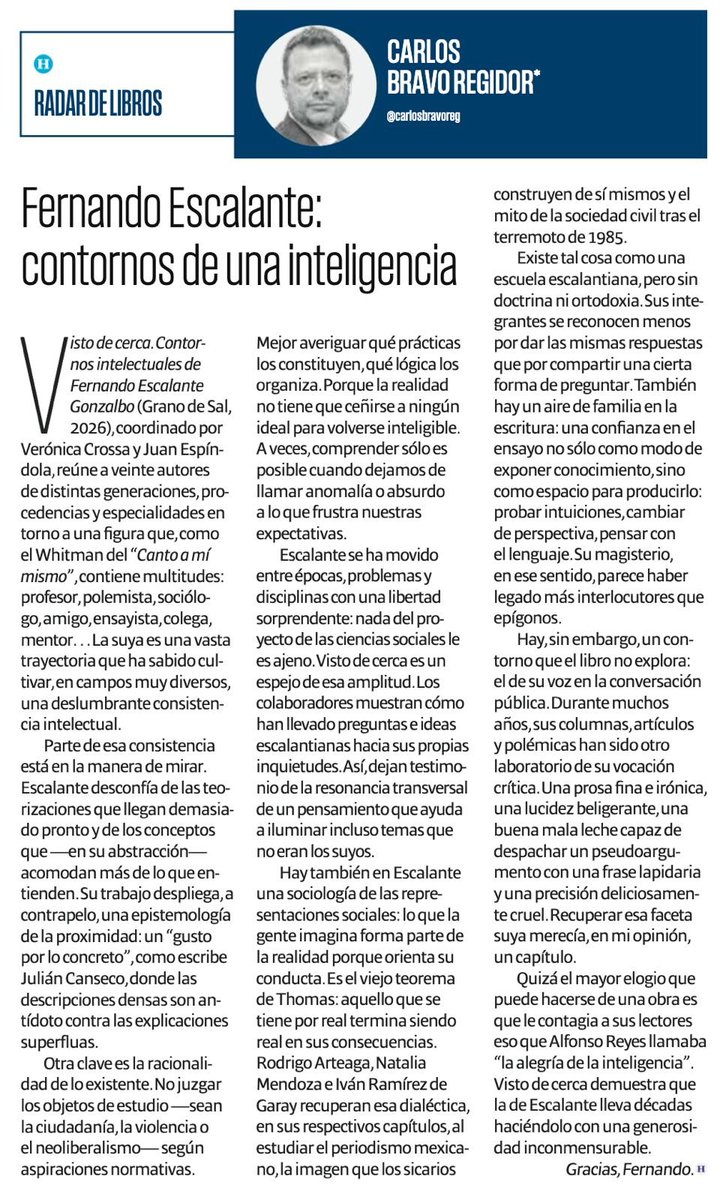
Este es mi #RadarDeLibros sobre "Visto de cerca. Contornos intelectuales de Fernando Escalante" (@GranodeSal, 2026), de Verónica Crossa y @espinaymata.
Ensayos sobre una vasta trayectoria que ha sabido cultivar, en campos muy diversos, una deslumbrante consistencia intelectual.
An 18-year-old Japanese classical guitarist, Haruna Miyagawa, performs Niccolò Paganini’s Caprice No. 24, a technically demanding violin piece arranged for guitar, highlighting its sequence of variations and arpeggios in a contemporary concert hall setting.
Sociologist Richard Sennett wrote a wonderful book about the value of hand craftsmanship in his 2008 book The Craftsman. He traces the long history of why people have valued handmade goods for hundreds of years, even through periods of major technological or industrial advancement, and weaves together an engaging intellectual history involving figures like Aristotle and John Ruskin.
One of the book’s recurring themes is the value of imperfection. Sennett notes that the authors of the Encyclopédie praised the “character” of handmade goods, such as the slightly irregular bubbles in hand-blown glass bottles. He connects this idea to Voltaire, who warned us of the relentless pursuit of perfection. If we learned to embrace these imperfections, Sennett suggests, perhaps we would develop more realistic expectations about life.
This creates an interesting tension at the heart of craftsmanship. A good craftsperson strives to make something as well as they possibly can, yet must ultimately accept that perfection is unattainable because they are imperfect, like all human creatures. Toward the end of the book, Sennett discusses craftsmanship in religious terms. In the Judeo-Christian tradition, he notes, excessive pride is a sin because it risks putting the self in God's place. In this sense, the craftsperson embodies both aspiration and humility.
In Sennett's framing, craftsmanship is not necessarily about whether a machine can replicate the results, but about a human's role in production and what that process can teach us about ourselves. It's not just about materiality, but also spirituality.
NEW: I analyzed seven years of Cornell's sexual violence case data. Expulsions are very rare.
1,216 reports of sexual assault, DV and stalking from 2018-2024.
162 formal investigations.
51 findings of fault.
14 suspensions.
7 expulsions or dismissals. https://t.co/yL3abPPQHr
It's important to learn math not because you may need to do long division as an adult, but because it promotes rigorous thinking. IMO, history and causal inference are among the most important subjects a young person can study — math being central to the second.
A significant problem in public discourse right now is people's inability to critically evaluate causal claims (e.g., vaccines cause autism, deporting immigrants will solve the housing crisis, etc.). The less able people are to critically evaluate causal claims, the worse our democracy functions because people can be preyed upon for votes. You should promote anything that improves rigorous thinking, even if it doesn't have market value. In fact, we should stop thinking of education only in the context of what improves the economy.
IMO, this is distinct from knowing your own address (which Huang can avoid because he's wealthy). Memorizing facts like this may or may not be important, but it's distinct from rigorous thinking.
I was invited to address the @UN Security Council this afternoon to discuss the unprecedented threat posed by uncontrolled frontier AI agents.
Humanity has summoned the courage and wisdom to manage catastrophic risks before. This is one of those moments, far bigger than any personal, commercial, or national interest. The choices we make about this technology today will shape generations to come. We must act now.