Rest in peace, Irish singer Dolores Keane, who passed away at the age of 72. Here is her last public performance, a beautiful rendition of Caledonia on TG4.
Listen to the first four episodes of Life and Leadership's brand new season with @bobbykerr now for business insights from Ireland's leading entrepreneurs🧠
https://t.co/G40IHJh1O1
With thanks to Standard Life Ireland
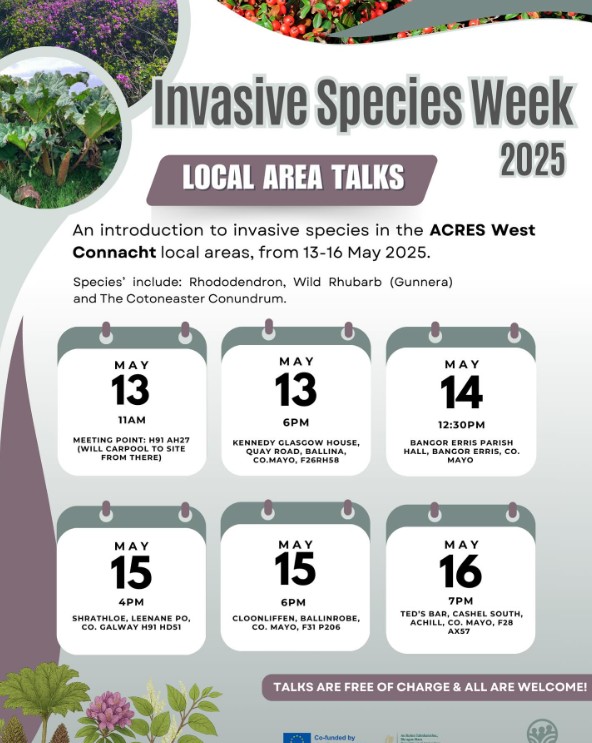
We are delighted to announce additional events have been added to the line-up for Invasive Species Week 2025!
🦝 🐿️ 🦜 🐢 🐜 🐞 🦠 🌱 🦀 🦐 🐠
🗓️Check out the full list of events here : https://t.co/KHVGio4DOL
#INNSWeek
Killarney National Park has said that staff are patrolling 24/7 along with drone operators and helicopter surveillance following a number of fires in the park in recent days.
https://t.co/WiyDa1JXqF
This St. Patrick’s Day, we pay tribute to Irish people making remarkable contributions around the world and showcasing the very best of what it means to be Irish.
🎵🔊 'A Rainy Night in Soho', performed by Cat Dowling
Happy #StPatricksDay!
Lá Fhéile Pádraig Sona Daoibh
Depending on the size of the holding, maybe place the land in a trust with an environmental group or social farm as the beneficiary. They would have to agree to carry on his legacy for a defined period of time. This might be one approach.
Elderly Mayo farmer has incredible lightly grazed, undesignated, species rich grassland & peat bog too. Wants to leave a legacy for nature and to save his bit of heaven. How does he secure this land & biodiversity into the future? #RestoreNature 1/2
Woman of the Day Marie Colvin of New York, Middle East correspondent for The Sunday Times, who died OTD in 2012 aged 56 in a targeted attack by Syrian government forces during the siege of Homs. She was trying to retrieve her shoes from the hall of a temporary media centre - it is Syrian custom to leave shoes at the door -so she could escape the shelling but a rocket landed just a few metres away.
The attack was found by an American court to be retaliation. The day before, Marie had broadcast movingly about a dying baby hit in the chest by shrapnel in Baba Amr, a neighbourhood in Homs, where 28,000 civilians were “hiding, being shelled, defenseless…That baby probably will move more people to think, ‘What is going on and why is no one stopping this murder in Homs that is happening everyday?’”
The Syrian government, led by Assad, claimed the siege was necessary because its forces were only looking for terrorists. She reported, “It’s a complete and utter lie…The Syrian Army is basically shelling a city of cold, starving civilians.”
The daughter of two teachers - her father was an ex-Marine - Marie was something of a rebel as a girl. She organised an anti-Vietnam War demonstration in her neighbourhood in a little place on Long Island and declared the front garden of her home as an ecological recycling zone. Even her first job after graduating with a degree in American Literature was unconventional: working on the in-house magazine for the Teamsters’ union. Unexpectedly promoted to Acting Editor, she asked when the real editor would be back. The reply was “five years, less with good behaviour”.
UPI gave Marie the chance she’d always wanted, to be a foreign correspondent, and made Paris Bureau Chief in 1984. She didn’t disappoint. She secured an exclusive in 1986 in Tripoli where she dodged explosions while filing copy of the American aerial attack and was summoned to meet Gaddafi. This, and her subsequent meetings with him over several years, was chronicled in “Mad Dog and Me”.
1986 was the year that Marie began freelancing for The Sunday Times but she soon became its Middle East correspondent. Rather like Kate Adie of whom was said, “We only know it’s serious if Kate Adie shows up”, Marie had editors teetering between admiration and despair as she filed her stories from the thick of the action but it was always worth waiting for.
She smuggled herself in disguise into Basra during the Iran-Iraq war, reported under fire from a refugee camp in Lebanon, filed copy from Baghdad on the aftermath of the first Gulf War, reported from war-torn Kosovo. Embedded with Chechen rebels cut off by Russian troops, she endured an eight-day slog through chest-high snow, suffered altitude sickness, exposure and hunger, and had to be evacuated to safety by a helicopter sent by the US Embassy. “I was never happier to have an American passport.”
In 1999, Marie refused to leave a besieged compound in East Timor because it held 1,500 defenceless women and children and kept sending updates to the world’s press. After four days, they were all evacuated by the UN. She was credited with saving their lives.
Her distinctive eyepatch was her trademark and, she said, her “badge of honour”. Marie, who had reported on the humanitarian disaster caused by the Sri Lankan government’s blockade of food and medical supplies in the northern Tamil regime, had walked over thirty miles through the jungle to cross over into the government-controlled area, calling out “Journalist, journalist!” The Sri Lankan forces fired an RPG at her. “They knew what they were doing.” She was hit by shrapnel in four places and lost the use of her left eye. She still wrote a 3,000 word article and filed it on time.
Why? What on earth motivated Marie to take such risks? What kept her going?
“My job is to bear witness. I have never been interested in knowing what make of plane had just bombed a village…These are people who have no voice. I feel I have a moral responsibility towards them, that it would be cowardly to ignore them. If journalists have a chance to save their lives, they should do so.”
We have finally fallen! Power gone in another part of West Clare. ESB crews are going to have some clean up job tomorrow at this rate. All thanks to #StormEowyn
The prescient social philosopher and reluctant 'management guru' Charles Handy has died aged 92. It was a privilege to know him. Here's a link to my obituary for the Financial Times Charles Handy, management thinker and author, 1932-2024 https://t.co/b8e1tOtFzA #CharlesHandy #management