Elon Musk Says the Media Decides What You Think About.
Most people think media bias is about lying.
Musk says it’s something much more subtle.
According to him, the real power isn’t in what makes the headlines…
It’s in everything that never does.
Every day, editors decide which stories deserve the front page—and which ones disappear before most people ever hear about them.
As Musk puts it, a handful of people end up deciding what millions should pay attention to.
Sometimes, the biggest story isn’t the one everyone is talking about.
It’s the one nobody was allowed to notice.
RUN THE MATH ON A PAINTING ROBOT ONCE AND YOU CAN'T UNSEE IT
Tesla's target price for Optimus is in the $20,000 to $30,000 range. That's the cost of one used pickup truck.
Now do the numbers every contractor is quietly doing.
A robot doesn't bill hours. It doesn't split the invoice with a crew. It works the night shift in an empty apartment where nobody needs the lights on or the heating running.
Clients won't even see a discount at first. Same quote, same result, same invoice. The difference all lands on one side of the ledger.
Painting was supposed to be too fiddly to automate. Watch the clip: taped outlet, clean edges, even coat. Fiddly is getting solved in real time.
The machine doesn't have to be better than a painter. It just has to be cheaper than a payroll.
⚡️Intelligence is not primarily knowledge.
It is not memory.
It is not IQ.
It is not even neuroplasticity by itself.
Intelligence is the speed and accuracy with which a model of reality updates under pressure.
Every intelligent system does the same thing.
It compresses reality into an internal model.
Reality pushes back.
The model changes.
The better and faster that process happens without destroying coherence, the more intelligent the system becomes.
That is why extremely knowledgeable people can be profoundly unintelligent.
They possess enormous databases protected by rigid identity.
New evidence arrives.
The model refuses to move.
Knowledge accumulates.
Understanding stagnates.
The opposite also exists.
Someone knows relatively little but updates rapidly, identifies contradictions quickly, abandons broken assumptions without emotional attachment, and converges toward reality faster than experts.
That person is often more intelligent in practice.
The deepest obstacle is identity.
Most people do not defend beliefs.
They defend the self built around those beliefs.
Changing the model therefore feels like dying.
Highly intelligent people separate identity from inference.
An incorrect model becomes useful information rather than personal humiliation.
That creates extraordinary learning speed.
The AI connection makes this even clearer.
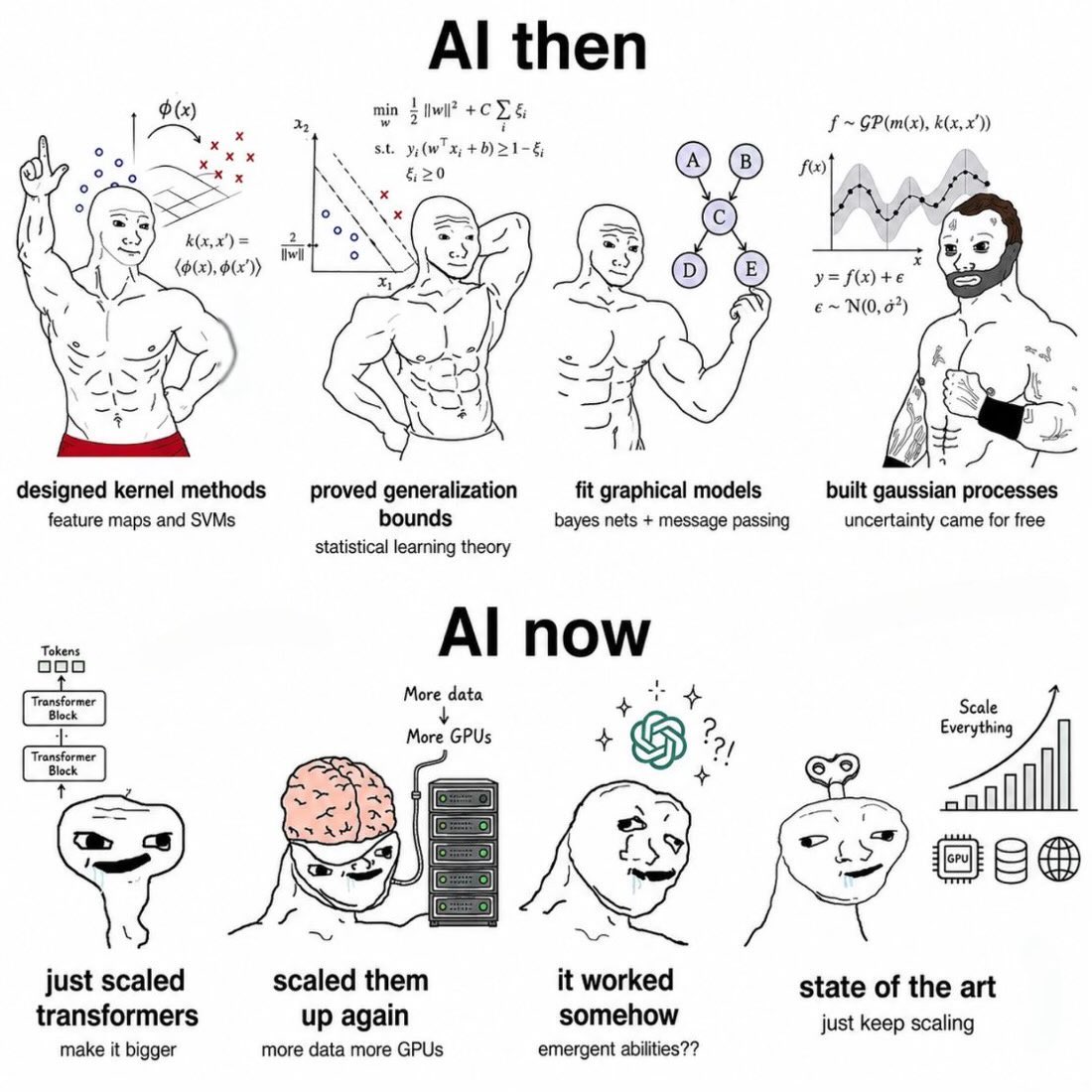
Large language models improve because they are optimized to reduce prediction error.
The gradient does not care about ego.
Reality pushes.
Weights move.
Prediction improves.
That loop repeats billions of times.
Human intelligence operates through the same fundamental architecture when functioning well.
Reality pushes.
The internal model changes.
Prediction improves.
The strongest definition becomes:
Intelligence is the capacity to repeatedly reduce the distance between your internal model and reality.
Everything else follows from that.
Knowledge helps.
Memory helps.
Creativity helps.
Reasoning helps.
Pattern recognition helps.
All of them are subordinate to one question:
Does the model become more aligned with reality over time?
That is the only definition that survives every domain.
Science.
Markets.
Engineering.
Politics.
Relationships.
Evolution.
Artificial intelligence.
The smartest systems are not the ones that know the most.
They are the ones that surrender the fastest to reality when reality proves them wrong.
Elon Musk just named AI’s next crisis. It’s not a shortage. It’s a surplus nobody can switch on.
Musk: “By the end of this year, chip production will outpace the ability to turn chips on.”
For three years the world was starved for silicon. Every lab, every government, every company racing to secure the chips that decide who wins the AI era.
That bottleneck is ending. A harder one is replacing it.
Musk: “The chips are going to be piling up and not be able to be turned on.”
Billions of dollars in the most advanced AI hardware ever built. Sitting dark.
Not because the chips don’t work. Because there isn’t enough electricity to run them.
You can’t print a power plant the way you print a chip.
The fabs scaled. The grid didn’t. Now the hardware everyone fought over is hitting a wall capital can’t buy its way through.
Compute becomes abundant. Electricity becomes the most valuable commodity on earth.
Physics doesn’t care about your chip architecture if your data center can’t pull the megawatts.
Every mind that has ever existed was limited by what it could eat. Ours ran on grain. This one runs on the grid.
That has never been solved by thinking. Only by building.
The war isn’t about who can print the most silicon. It’s about who can plug it in.
Whoever solves energy first doesn’t just win. They own the rails everyone else has to rent.
The losers stack chips in warehouses, waiting for power that never arrives.
We built a trillion dollar engine and forgot the fuel.
My X timeline is completely flooded with "Creator Revenue" drama lately. Honestly, I don't even want to see these arguments, but the more this topic spreads, the more it feels like the platform is full of bots. Is everyone just trying to make money on X now?
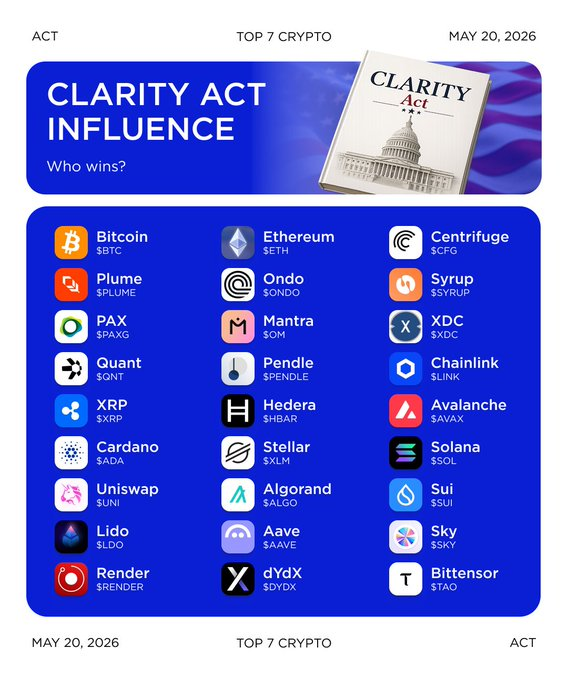
Right behind it sits institutional infrastructure: oracles, cross-chain interoperability, and compliance layers become non-optional once banks actually move on-chain.
The biggest winner is real-world asset tokenisation. For the first time, there's a legal framework for tokenised treasuries, private credit, and on-chain securities - exactly what BlackRock, Apollo, and pension funds have been waiting for before deploying serious capital.