This afternoon, I read through 39 years of NSS assessments of 🇨🇳 in order to verify a claim that I published with @AtlanticCouncil: This NSS is the first since 1988 to neither denounce China's authoritarianism nor express an intent to promote democratic reform in China (1/17)
A major evolution in how Washington frames its competition with Beijing
It is striking that this NSS frames China as more of a potential economic partner than an adversary, pledging to pursue “a genuinely mutually advantageous economic relationship with Beijing.” The previous NSS described China as a values-based adversary seeking to “create more permissive conditions for its own authoritarian model.”
Why is China an adversary? There are, broadly speaking, two answers to this question: because China’s rise challenges US economic and security interests, and because Beijing is replacing the rules-based international system with one that favors its authoritarian model. This NSS makes it clear that the Trump administration views the US-China rivalry as an interest-based competition, not a clash of values.
The NSS neither denounces nor even mentions China’s authoritarianism. It also prioritizes deterring conflict over Taiwan for strategic and economic reasons, not to preserve its democracy. This represents a major evolution in how Washington frames its competition with Beijing. This is the first time since the 1988 NSS—published during a period of optimism toward China’s reform and opening to the world—that the NSS has neither condemned China’s governance system nor expressed an intent to promote democratic reform in China.
— Caroline Costello (@Ke_Luolin) is an assistant director with the Atlantic Council’s @ACGlobalChina Hub.
President Trump has a unique opportunity to free our colleague @RayhanAsat's brother, Ekpar, from detention in Xinjiang. Rayhan's new @washingtonpost op-ed explores how Trump could accomplish what his predecessor could not: https://t.co/aVc9391yof
I covered China’s new five-year plan with my @AtlanticCouncil colleagues Melanie Hart and Samantha Wong.
Special thanks to @niubi and the folks who have been translating the plan on Google Drive while we wait for the official English version: https://t.co/oIHLi47KoC
We read the PRC's new five-year plan so that you don't have to. In a piece by GCH Senior Director Melanie Hart and Assistant Directors @Caroline_Costel and Samantha Wong, we outline five key takeaways. Here's what you need to know 🧵https://t.co/OGxT5dmc8G
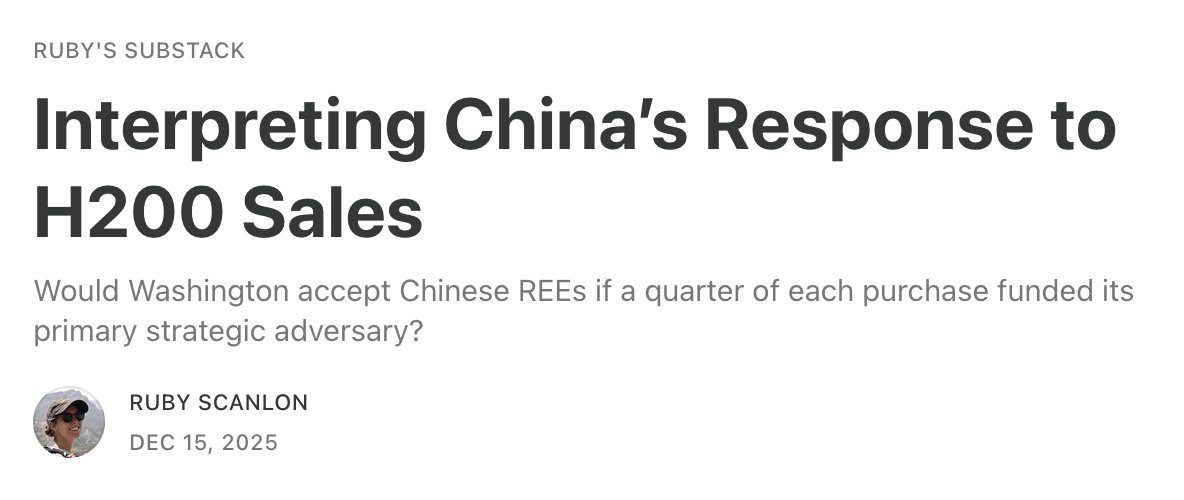
My first Substack essay is about China's response to H200 sales
Drawing on Chinese media, I look at whether floated restrictions are due to industrial policy, kill switch concerns, confidence in the Ascend 910C, or a secret fourth thing?
Link below 🔗
West Africa loses billions yearly to illegal mining, fishing, and logging.
New research by @Joshua_Eisenman and @Ke_Luolin looks at corruption, Chinese demand, and whether reform is still possible.
Full Episode - https://t.co/04tL46CABR
“US policymakers need to understand exactly how the China model is working in 2025 if the United States is going to compete effectively with it,” writes @ACGlobalChina’s Melanie Hart.
https://t.co/AmbswQzsh7
Congress began mandating publicly-released NSS in 1986. The first two NSS, published by the Reagan Admin in 1987 and 1988, did not criticize 🇨🇳 authoritarian model. Instead, the Reagan Admin took a "quiet diplomacy" approach of private engagement with the PRC on sensitive issues.
This afternoon, I read through 39 years of NSS assessments of 🇨🇳 in order to verify a claim that I published with @AtlanticCouncil: This NSS is the first since 1988 to neither denounce China's authoritarianism nor express an intent to promote democratic reform in China (1/17)
A major evolution in how Washington frames its competition with Beijing
It is striking that this NSS frames China as more of a potential economic partner than an adversary, pledging to pursue “a genuinely mutually advantageous economic relationship with Beijing.” The previous NSS described China as a values-based adversary seeking to “create more permissive conditions for its own authoritarian model.”
Why is China an adversary? There are, broadly speaking, two answers to this question: because China’s rise challenges US economic and security interests, and because Beijing is replacing the rules-based international system with one that favors its authoritarian model. This NSS makes it clear that the Trump administration views the US-China rivalry as an interest-based competition, not a clash of values.
The NSS neither denounces nor even mentions China’s authoritarianism. It also prioritizes deterring conflict over Taiwan for strategic and economic reasons, not to preserve its democracy. This represents a major evolution in how Washington frames its competition with Beijing. This is the first time since the 1988 NSS—published during a period of optimism toward China’s reform and opening to the world—that the NSS has neither condemned China’s governance system nor expressed an intent to promote democratic reform in China.
— Caroline Costello (@Ke_Luolin) is an assistant director with the Atlantic Council’s @ACGlobalChina Hub.