BOOM!
Apple’s Neural Engine Was Just Cracked Open, The Future of AI Training Just Change And Zero-Human Company Is Already Testing It!
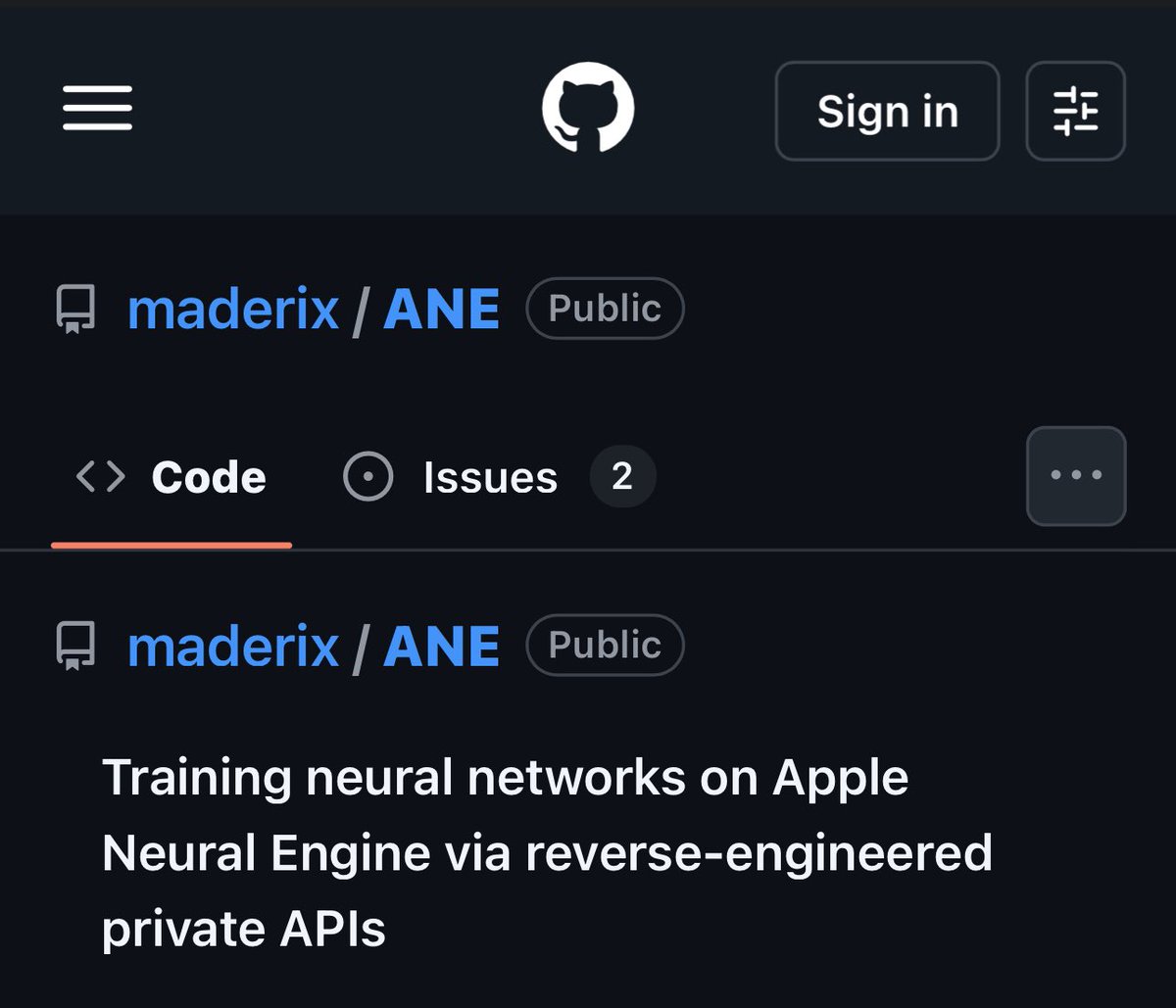
In a jaw-dropping open-source breakthrough, a lone developer has done what Apple said was impossible: full neural network training– including backpropagation – directly on the Apple Neural Engine (ANE). No CoreML, no Metal, no GPU. Pure, blazing ANE silicon.
The project (https://t.co/jrk67hf9p1) delivers a single transformer layer (dim=768, seq=512) in just 9.3 ms per step at 1.78 TFLOPS sustained with only 11.2% ANE utilization on an M4 chip. That’s the same idle chip sitting in millions of Mac minis, MacBooks, and iMacs right now.
Translation? Your desktop just became a hyper-efficient AI supercomputer.
The numbers are insane: M4 ANE hits roughly 6.6 TFLOPS per watt – 80 times more efficient than an NVIDIA A100. Real-world throughput crushes Apple’s own “38 TOPS” marketing claims. And because it sips power like a phone, you can train 24/7 without melting your electricity bill or the planet.
At The Zero-Human Company, we’re not waiting. We are testing this right now on real ZHC workloads. This is the missing piece we’ve been chasing for our Zero Human Company vision: reviving archived data into fully autonomous AI systems with zero human overhead.
This is world-changing.
For the first time, anyone with a Mac can fine-tune, train, or iterate massive models locally, privately, and at a fraction of the cost of cloud GPUs.
No more renting $40,000 A100 clusters. No more waiting in queues. No more massive carbon footprints.
Training costs that used to run into the tens or hundreds of thousands of dollars? Plummeting toward pennies on the dollar – mostly just the electricity your Mac was already using while it sat idle.
The AI revolution just moved from billion-dollar data centers to your desk.
WE WILL HAVE A NEW ZERO-HUMAN COMPANY @ HOME wage for equipped Macs that will be up to 100x more income for the owner!
We’re only at the beginning (single-layer today, full models tomorrow), but the door is wide open. Ultra-cheap, on-device training is here.
The future isn’t coming. It’s already running on your Mac.
Welcome to the Zero-Human Company era.
anthropic fucking killed it with this. so many people will start using claude.
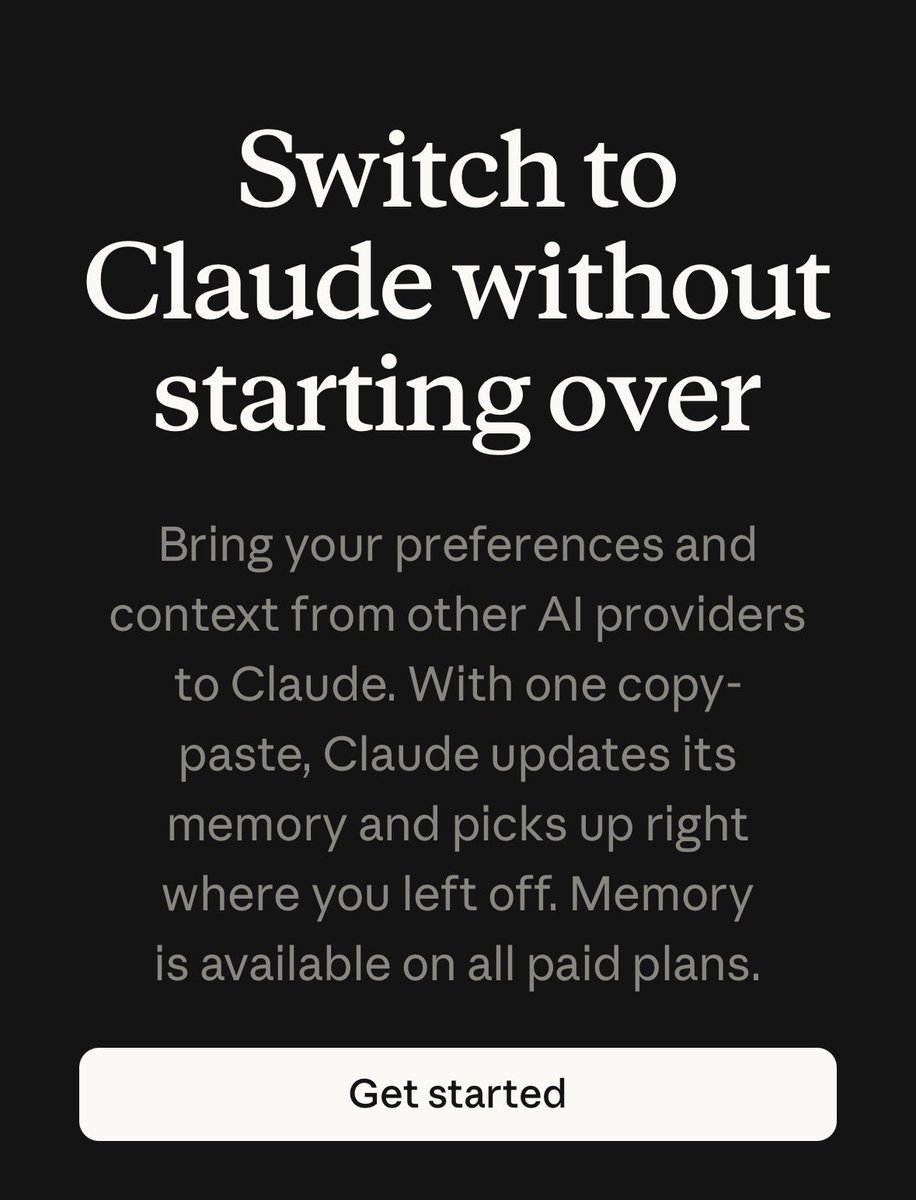
new feature lets you import your *entire* memory from chatGPT, Gemini etc into Claude so it *instantly* knows everything about you. no more reminding claude who you are.
the best fucking part is it takes literally 60s:
- copy and paste the below prompt into your alternative AI (eg chatgpt)
- paste answer into claude’s “memory” settings and… you’re done.
- Claude immediately picks up from the last conversation you had with it in chatgpt!
the opportunity cost to switch to anthropic just went to zero - their app is currently #1 in the app store
anthropic fucking killed it with this. so many people will start using claude.
new feature lets you import your *entire* memory from chatGPT, Gemini etc into Claude so it *instantly* knows everything about you. no more reminding claude who you are.
the best fucking part is it takes literally 60s:
- copy and paste the below prompt into your alternative AI (eg chatgpt)
- paste answer into claude’s “memory” settings and… you’re done.
- Claude immediately picks up from the last conversation you had with it in chatgpt!
the opportunity cost to switch to anthropic just went to zero - their app is currently #1 in the app store
We’ve identified industrial-scale distillation attacks on our models by DeepSeek, Moonshot AI, and MiniMax.
These labs created over 24,000 fraudulent accounts and generated over 16 million exchanges with Claude, extracting its capabilities to train and improve their own models.
We’ve identified industrial-scale distillation attacks on our models by DeepSeek, Moonshot AI, and MiniMax.
These labs created over 24,000 fraudulent accounts and generated over 16 million exchanges with Claude, extracting its capabilities to train and improve their own models.
In 1956, linguist Benjamin Lee Whorf proposed that the structure of language shapes the boundaries of thought.
Programming languages proved him right in reverse: precise syntax forces precise thinking.
We’re about to test what happens when we remove that constraint.
Traditional code is explicit instruction. You write a function, you know exactly what output you’ll get. The computer executes precisely what you specify, nothing more, nothing less. This constraint is actually a feature: it forces clarity about what you’re trying to achieve.
Natural language programming inverts this relationship. Instead of learning the computer’s language, the computer interprets yours.
The upside is significant. You can express ideas you don’t yet know how to formalize. The AI might generate solutions you hadn’t considered from the same prompt. Serendipity becomes possible in ways rigid syntax never allowed.
But there’s a deeper problem: most people don’t actually know how to verbalize what they want.
Not because they’re inarticulate, but because human language evolved for social coordination, not technical specification. We communicate through context, gesture, shared understanding, and iterative refinement. We point and adjust. We say “you know what I mean.”
Computers don’t know what you mean. They interpret what you said.
The gap between intent and expression, currently bridged by explicit syntax, will become a source of constant friction. Users will feel the AI “doesn’t do what they’re looking for” not because the AI failed, but because there’s no defined way to execute ambiguous requests.
We’re trading determinism for flexibility.
Are we okay with these differences?
In 1865, economist William Stanley Jevons observed that as steam engines became more efficient, coal consumption increased rather than decreased.
More efficiency meant more applications, which meant more total use.
AI is following the same pattern with human labor.
The assumption was straightforward: more powerful tools mean less work. But this misunderstands how work gets distributed.
For decades, work was constrained by access to specialized knowledge. If you needed design, code, or analysis, you delegated to someone with that capability.
The friction of delegation created a natural limit on what any individual could take on.
AI removed the access bottleneck. The bandwidth for accessing knowledge becomes nearly infinite.
Now the founder who used to hire a designer can create their own materials. The PM who relied on engineers can write queries. The marketer who outsourced development can build their own tools.
We assumed this would create leisure. Instead, it created expansion. When you can do something yourself, the friction of delegation disappears, and so does the natural limit on your workload.
Work isn’t decreasing. It’s consolidated into fewer hands with greater capability.
The question isn’t whether AI makes us more productive. It clearly does. The question is whether increased individual capability leads to increased individual burden.
So far, the answer appears to be yes.
Free alETH. 3 Envelopes. Denver, CO.
To celebrate the upcoming launch of Alchemix v3, we're hiding 3 physical envelopes around the city, each unlocking 1 alETH.
Not attending @EthereumDenver? One alETH also goes to a random person who interacts with this post.
Details 👇