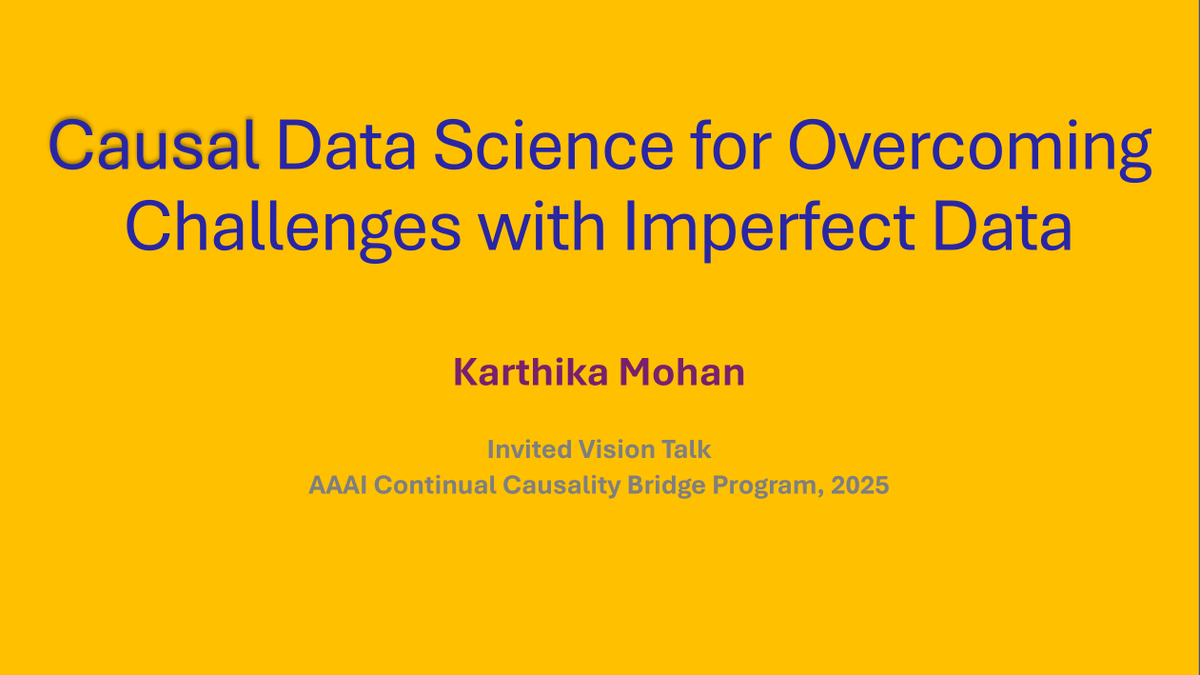
🚀 Excited to be at AAAI! 🚀 Join me on Tuesday, 25th Feb to explore the fascinating ways causality brings clarity to messy datasets. See you in Philadelphia! 👋#AAAI2025#CausalDataScience#MissingData#noniidData
Honored to speak on causality at #IBC2024 in Atlanta! 🎉 Humbled to hear my work on missing data has helped improve outcomes for children. 🙏✨ Huge shout-out to the researchers at Murdoch Children's Research Institute! 👏🌟 @yudapearl@_MargaritaMB@JiaxinZhang96 @ghazalehdashti
Challenging the IID assumption is key to advancing AI/ML, as real-world data often violates IID. We are excited to present our paper that explores this frontier.
Do Finetti: On Causal Effects for Exchangeable Data.
#NeurIPS2024
Oral Session 5B: Fri 13 Dec 10 a.m. — 11 a.m. PST
Poster: West Ballroom A-D #5000
Fri 13 Dec 11 a.m. — 2 p.m. PST
joint work with @zcccucla@Carthica@fhuszar@bschoelkopf
New preprint: Do Finetti w/@zcccucla, @Carthica, @fhuszar, @bschoelkopf and me.
https://t.co/SAUs8pwEgM
Do Finetti provides a do-calculus foundation for exchangeable data following the independent causal mechanism (ICM) principle + a causal Pólya urn model to show how interventions propagate effects in exchangeable settings. [1/n]
🧵👇
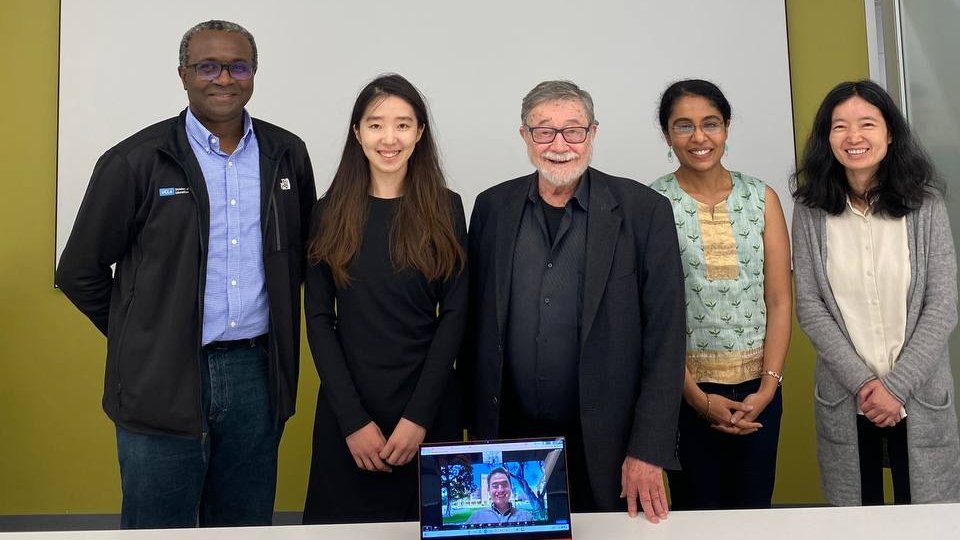
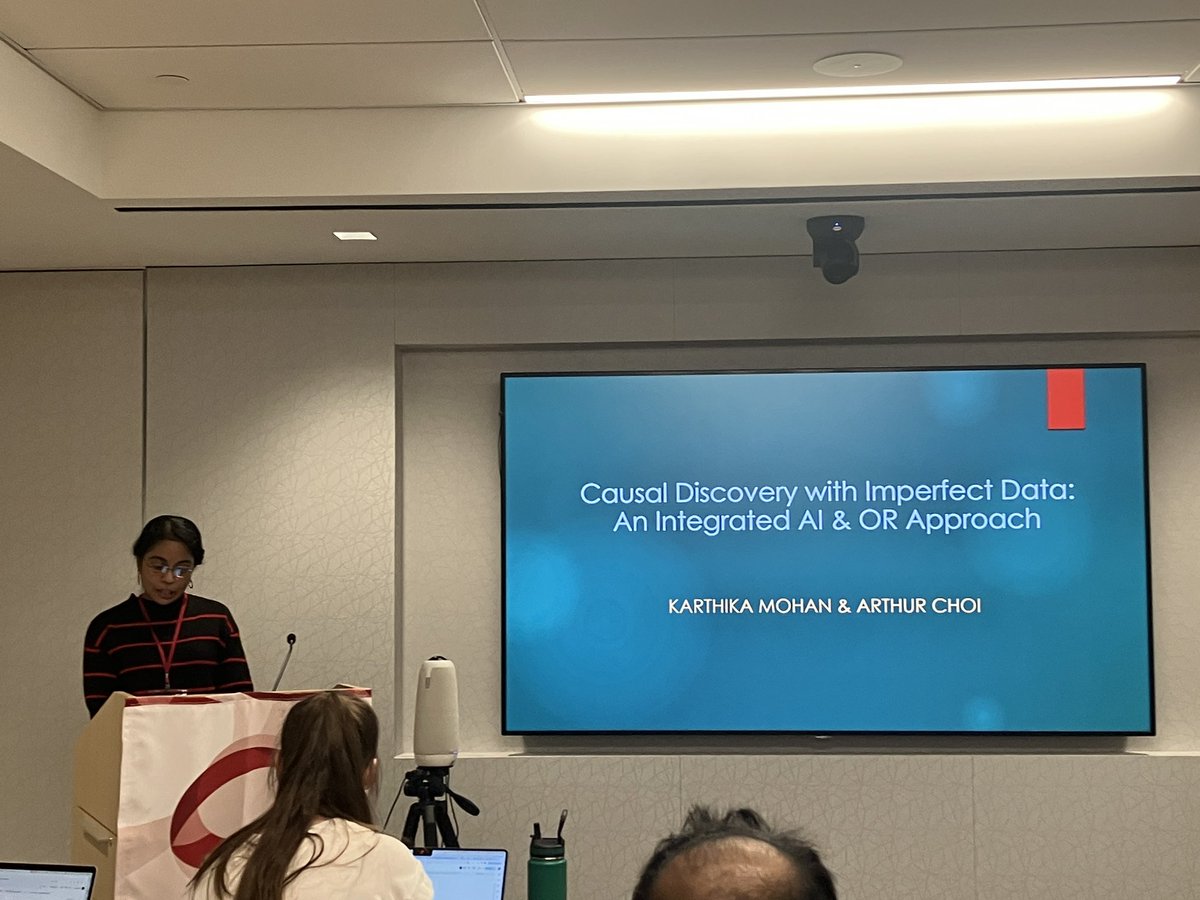
I discussed the application of Operations Research methods to the challenge of Causal Discovery with Imperfect Data at the Computing Community Consortium (CCC) AI/OR Workshop in Washington DC. Grateful for the opportunity and huge thanks to the fantastic organizers!
In the third technical presentation of the AI / OR workshop, Karthika Mohan talks about how to use integer programming for causal inference over incomplete data #orms#monarchsofmip
Enjoying every page of this book! Delighted by the dedicated chapter on causality, thrilled with the missing data section, and grateful for the shoutout to my work with @yudapearl . A must-read for AI students.
https://t.co/lU5A9AhY85
Remember PO's slogan "causal inference is a missing-data problem"? Well, here @Carthica shows the opposite: "missing-data is a causal problem": https://t.co/6qemKlVZQH. Her gentle introduction through simple and meaningful examples should convince everyone, including the staunchest statistician.
Congratulations to Dr. Chi Zhang (@zcccucla) on defending her PhD thesis! Her work on interference pushes research boundaries and highlights the perils of blindly assuming IID. Well done, Dr. Zhang! It's been a delightful journey collaborating with you. 🥳🎉🍾
@yudapearl @oacarah
@AngeloDalli@yudapearl O and Ro are parents of O*. You can model the scenario by adding two edges, one between U & O and the other between U & Ro.
@raziehnabi@analisereal@noah_greifer@stephenjwild @r0ntu Agree! However, recoverability is query dependent. In X-->Y<-->Rx, P(X) is recoverable (despite Y being a collider between X and Rx) but P(Y,X) is not. Reference Mohan & Pearl, Neurips-14, https://t.co/XSYy3D4maJ
@yudapearl do you understand the analogy to a right angled triangle that Don Rubin makes in his interview:
https://t.co/vjf6AGXi4e,
on pages 88 and 89 ??? I am bewildered.






![syguoML's tweet photo. New preprint: Do Finetti w/@zcccucla, @Carthica, @fhuszar, @bschoelkopf and me.
https://t.co/SAUs8pwEgM
Do Finetti provides a do-calculus foundation for exchangeable data following the independent causal mechanism (ICM) principle + a causal Pólya urn model to show how interventions propagate effects in exchangeable settings. [1/n]
🧵👇](https://pbs.twimg.com/media/GPJRbWzWIAAcsgt.png)