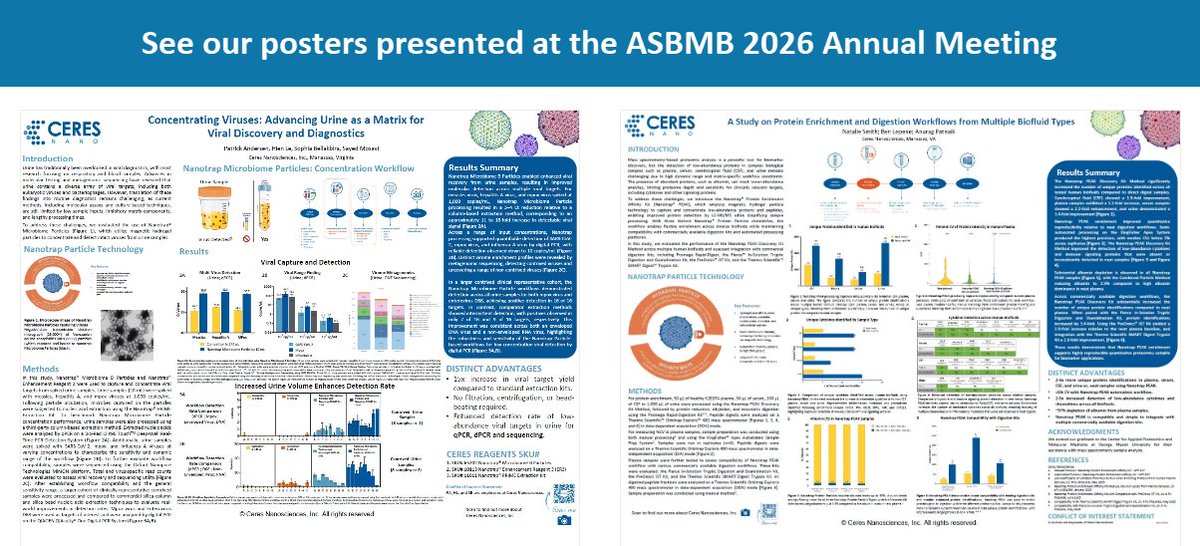
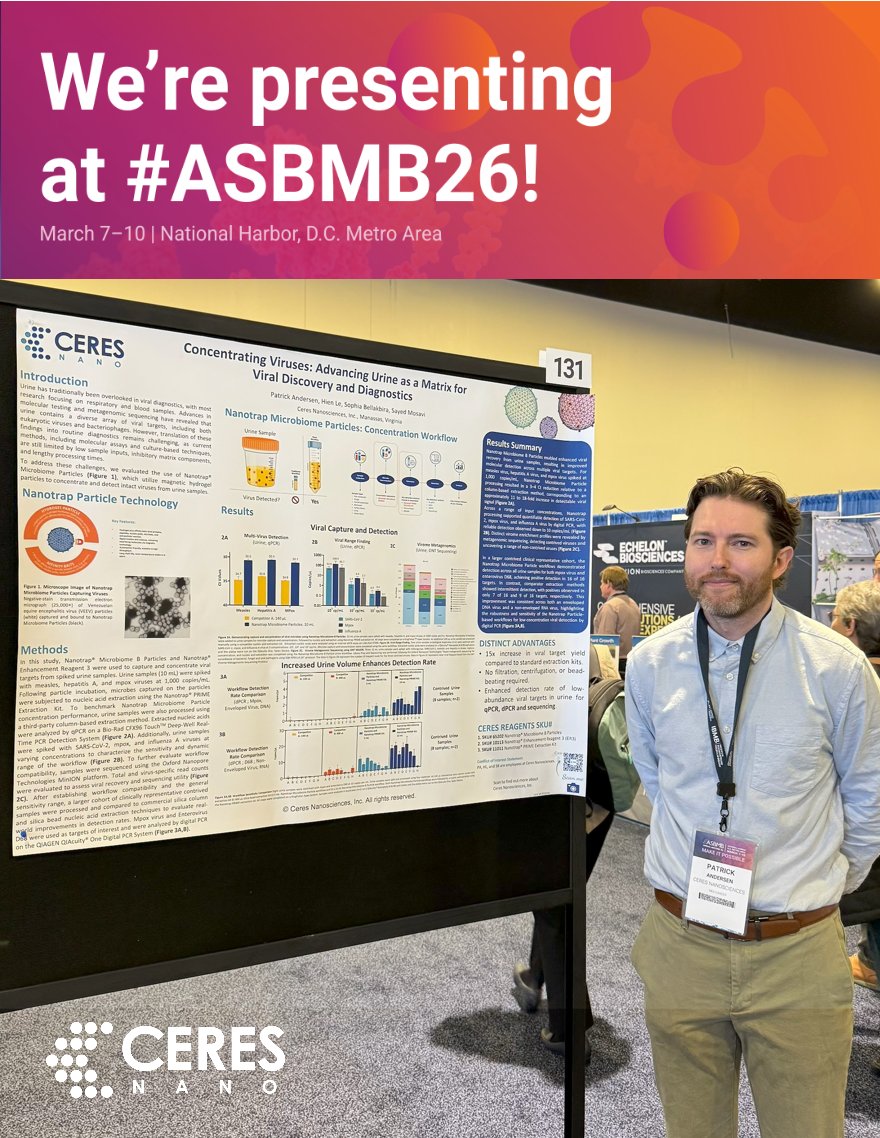
ASBMB 2026 was a great week full of science and discussion — thank you to everyone who connected with us during the poster sessions. If you missed it, both posters are now available for download:
🔬 A Study on Protein Enrichment and Digestion Workflows from Multiple Biofluid Types by Natalie Smith, Applications Scientist
Download the poster here: https://t.co/hKvQM7WSrB
🦠 Concentrating Viruses: Advancing Urine as a Matrix for Viral Discovery and Diagnostics by Patrick Andersen, Applications Scientist
Download the poster here: https://t.co/vwSMtpODkY
Our team of scientists is available to walk through the data, discuss workflow integration, and answer your questions. Reach out to schedule a discussion at [email protected]
#ASBMB2026 #Proteomics #ViralDiscovery #MassSpectrometry #TranslationalResearch
🥧 Pi Day is almost here!
At Ceres, celebrating π also means celebrating the scrumptious treat. Our teams put their creativity — and baking skills — on display in our annual Pi/Pie Day Contest.
Take a look at the π-inspired creations and drop a comment to vote for your favorite!
#PiDay #Funatwork
We had a great time connecting with the proteomics community at the US HUPO 2026.
Thank you to everyone who stopped by our booth and attended our poster presentations. For those who were unable to join the session, our poster—“Optimizing Plasma Proteome Enrichment: Achieving Depth, Reproducibility, and Cost Efficiency”—is now available online.
The data highlight strategies to:
• Obtain broad proteome coverage at the lowest cost per sample
• Ensure high reproducibility (Average CV < 8.5%) with reduced albumin dominance
• Provide a distinct protein recovery profile with strengths in low-abundance and membrane-associated targets
Access the poster here: https://t.co/477Wkbq6AR.
If you would like to discuss how this workflow could support your proteomics studies, please contact our team at [email protected]
#USHUPO2026 #Proteomics #PlasmaProteomics #Nanotrap
Join us today at ASBMB 2026 to explore the latest enrichment innovations in proteomics across multiple matrices.
If you’ve been on the fence about enriching your samples, this is your sign — stop by and talk with our team. We’re sharing practical strategies to improve depth, reproducibility, and performance without adding unnecessary complexity to your workflow.
Poster #276: A Study on Protein Enrichment and Digestion Workflows from Multiple Biofluid Types
🗓 Tuesday, March 10, 2026
Presenter: Natalie Smith, Applications Scientist
#ASBMB2026 #Proteomics #MassSpectrometry #ViralDiscovery #Biofluids #LCMS #Nanotrap
Join us today at ASBMB 2026 for Poster #131: “Concentrating Viruses: Advancing Urine as a Matrix for Viral Discovery and Diagnostics.”
Stop by to learn how Nanotrap® Technology is making urine workflows simpler, more efficient, and more powerful for downstream detection.
If you’ve experienced challenges with large sample volumes but need greater sensitivity in your workflow, this is the perfect opportunity to connect. We’re sharing practical strategies to streamline your workflow while maximizing the richness of your sample.
Come talk with our expert, Patrick Andersen, and explore how smarter concentration can unlock better results.
#ASBMB2026 #nanotrap #infectiousdisease #urine #clinicalresearch
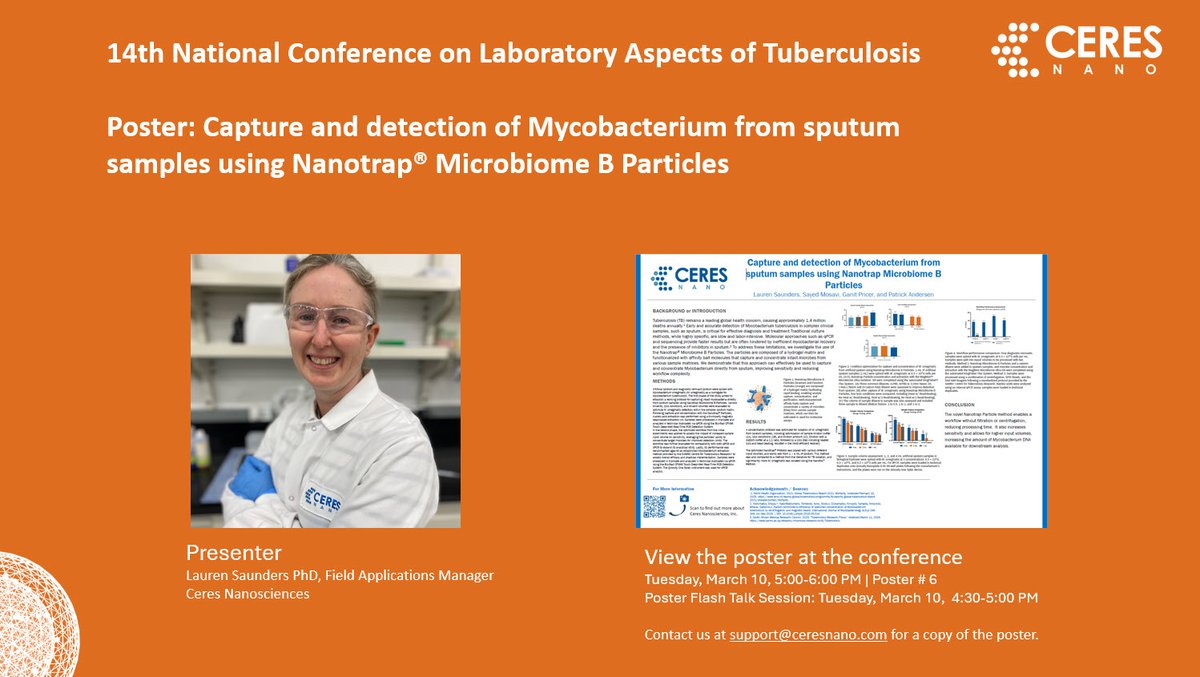
We’re excited to share that Lauren Saunders, Ph.D., Field Application Scientist Manager, will be presenting at the 14th National Conference on Laboratory Aspects of Tuberculosis next week in Atlanta, Georgia.
Stop by to learn how our technology is supporting improved detection and research workflows in tuberculosis clinical studies. We look forward to connecting with you there.
🗓 Tuesday, March 10
🕟 4:30 PM – Flash Talk
🕔 5:00–6:00 PM – Poster Session
#TB #Tuberculosis #Nanotrap #InfectiousDisease #APHL
Heading to ASBMB 2026 in the DC Metro area? Add these poster sessions to your agenda and connect with the Ceres Nanosciences team.
🔬 Poster #131 - Concentrating Viruses: Advancing Urine as a Matrix for Viral Discovery and Diagnostics
📅 Monday, March 9, 2026
🧪 Poster #276 - A Study on Protein Enrichment and Digestion Workflows from Multiple Biofluid Types
📅 Tuesday, March 10, 2026
Meet up with our team—Natalie Smith, Patrick Anderson and Mark Cafazzo—to discuss data, workflows, and how Nanotrap® Technologies are enabling new possibilities across biofluids.
📧 Email us, [email protected], to preschedule a time with the team. We look forward to seeing you at ASBMB.
#ASBMB26 #nanotrap #proteomics #infectiousdisease
On the road to BloodPAC!
Lauren Saunders, Ph.D., Leader, Field Application Scientists, is heading to the BloodPAC Conference and looking forward to connecting with the community. If you’re attending, don’t miss the chance to meet up with Lauren to talk about how we can improve the accuracy of your liquid biopsy results.
🔗 Learn more about the conference: https://t.co/tjDCFGsaDp and contact us if you would like to meet with Lauren at the conference: [email protected].
See you at BloodPac!
#nanotrap #liquidbiopsy
When real-time wastewater and environmental surveillance (WES) data triggers coordinated, multi-agency interventions, it demonstrates the critical role WES plays in mass-gathering preparedness and broader global health security frameworks.
Here, the Uganda Ministry of Health and the Association of Public Health Laboratories (APHL) Global Health team leveraged WES to monitor risk and translate data into actionable public health responses.
We are proud that Nanotrap® Technology played a vital role in enabling this workflow and supporting impactful, data-driven decision-making.
Read more: https://t.co/vdkR8dLYQs
Interested in implementing a similar approach? Contact [email protected]. #APHL #MOH-Uganda #Nanotrap
The Ceres Nanosciences team is on site at the #USHUPO 2026 Conference and ready to connect.
If you’re attending this week, swing by��Booth #11 to meet our Field Applications Scientists and see how Nanotrap® Technology can:
-Improve proteome coverage
-Increase reproducibility
-Reduce per-sample cost
Let’s talk science—see you there! #Proteomics #Nanotrap
We’re heading to the HUPO US Conference—and we’d love to see you there!
👉 Visit us at Booth #11 to learn how Ceres Nanosciences is enabling deeper, more reproducible proteomics enrichment results.
📊 Don’t miss our poster presentation by Pat Acer, Field Applications Scientist, highlighting real-world data and practical insights you can apply in your lab.
Stop by, ask questions, and see how our Nanotrap® Technologies can elevate your proteomics research. #HUPOUS #Proteomics #MassSpec #Nanotrap
Today, we celebrate the International Day of Women and Girls in Science 2026.
This year’s theme, “From Vision to Impact: Redefining STEM by Closing the Gender Gap,” reminds us that representation alone isn’t enough—we must reshape systems so women and girls can lead and drive scientific innovation.
To all the women and girls advancing discovery and breaking barriers—we see you, we celebrate you, and we stand with you.
#WomenInScience #GirlsInSTEM #IDWGIS2026 #STEMinclusion #UNESCO
https://t.co/qg6qB8LWCH
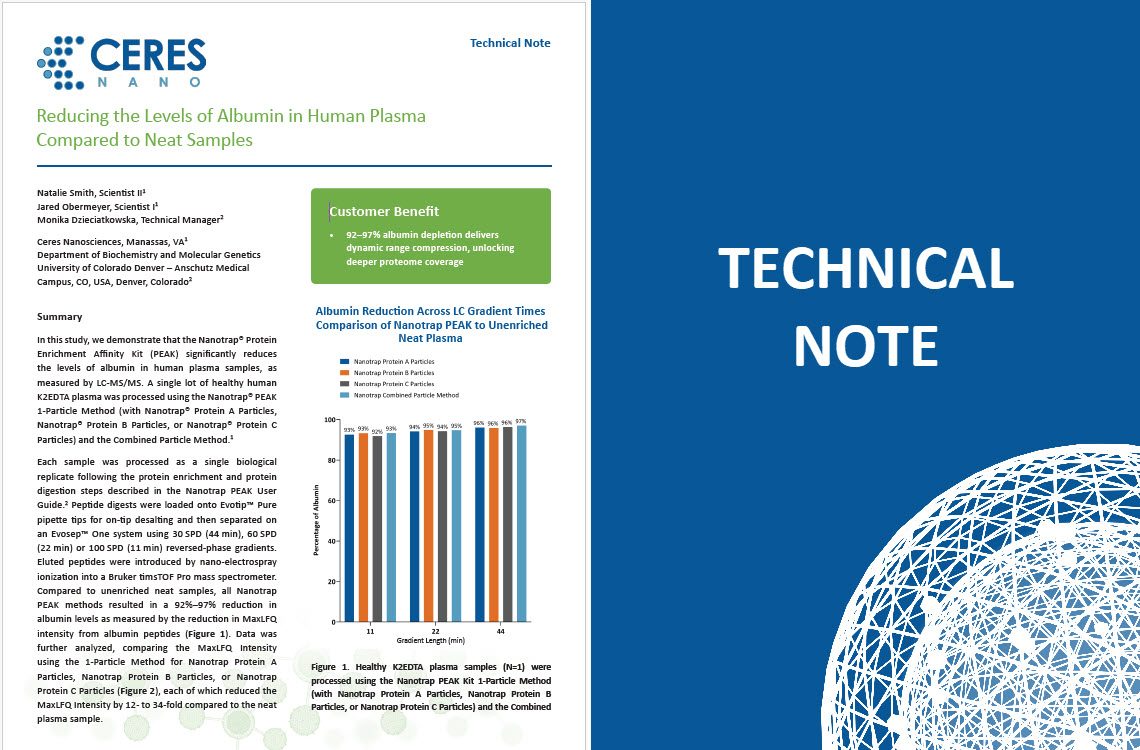
Unlock deeper proteome coverage with 92–97% albumin depletion and true dynamic range compression.
In this newly published technical note, see how the Nanotrap® PEAK Proteomics Workflow compares to a standard NEAT workflow—demonstrating improved access to low-abundance proteins and enhanced analytical depth.
Published in collaboration with the Department of Biochemistry and Molecular Genetics, University of Colorado Denver – Anschutz Medical Campus, this work highlights how Nanotrap-enabled sample prep can elevate plasma proteomics performance.
Read the tech note to see the data. https://t.co/pAWK7ndVEI
#nanotrap #proteomics
📢 New Insight from the Frontlines of Public Health Surveillance!
A study in Kampala, Uganda, shows that wastewater-based surveillance (WBS) can detect SARS-CoV-2 transmission 2–5 weeks before clinical cases, with the strongest signal at ~4 weeks.
Analyzing 244 samples across four facilities, they found high detection rates and episodic viral surges—demonstrating WBS as a cost-effective, population-level tool for outbreak preparedness, especially in resource-limited settings.
Beyond COVID-19, WBS can support multi-disease surveillance and smarter public health response.
Read the full article: https://t.co/8LcX9DYbM4
#nanotrap #WastewaterEpidemiology #SARSCoV2 #PublicHealth #GlobalHealth #EarlyWarning #InfectiousDisease
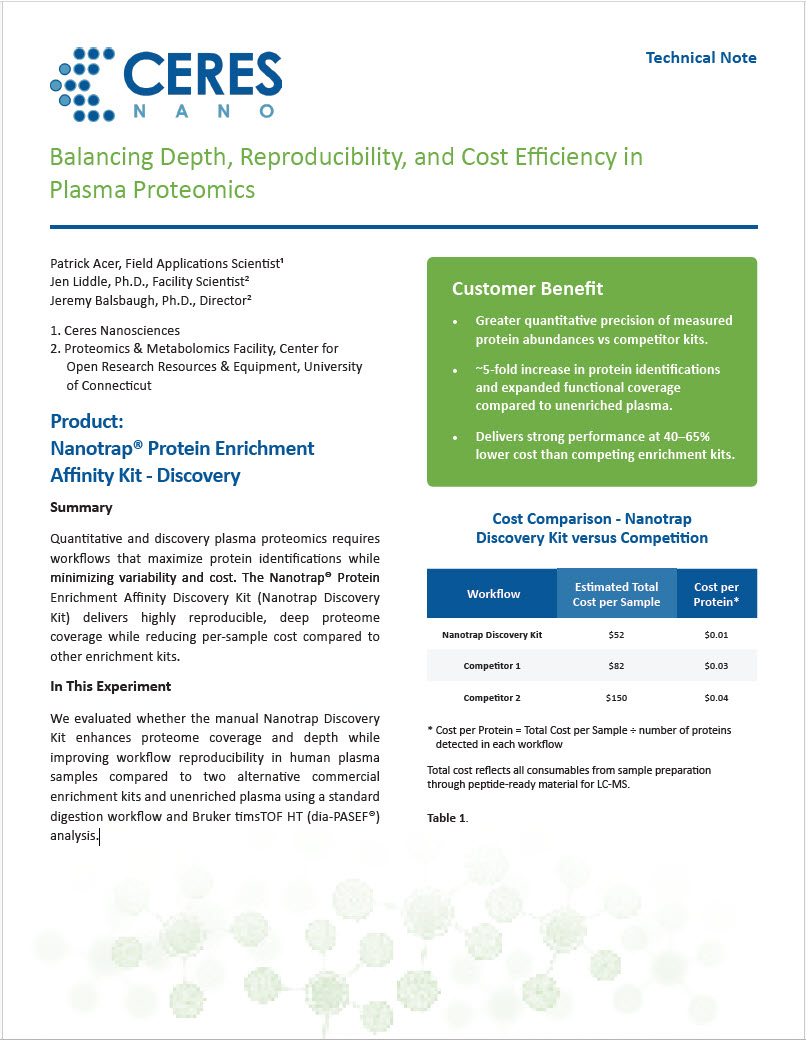
Deep proteome coverage. Improved reproducibility. Greater cost efficiency.
In this co-authored tech note with the University of Connecticut Proteomics & Metabolomics Facility, we benchmark plasma proteomics workflows and share practical, data-driven insights to help optimize your lab’s performance.
Read and download here: https://t.co/kPj6xOUEeN
Curious to know more? Contact us: [email protected]. We're happy to help!
#proteomics #Nanotrap #UConnResearch
Deep proteome coverage. Improved reproducibility. Greater cost efficiency.
In this co-authored tech note with the University of Connecticut Proteomics & Metabolomics Facility, we benchmark plasma proteomics workflows and share practical, data-driven insights to help optimize your lab’s performance.
Read and download here: https://t.co/kPj6xOU6pf
Curious to know more? Contact us: [email protected]. We're happy to help!
#proteomics #Nanotrap #UConnResearch
New Application Note: Capture of Small DNA Fragments for Transplant Analysis
Transplant-derived cfDNA is often smaller (80–120 bp) and can be missed by conventional extraction methods. This app note evaluates extraction performance for small DNA fragments using transplant patient samples—highlighting implications for more sensitive, non-invasive monitoring.
📄 Read the app note: https://t.co/gNeYOqciIL
📩 Want to learn more?
Contact [email protected] to discuss how this approach could improve your transplant cfDNA workflow.
Did you miss us at the Microbes in Wastewater Conference hosted by Zymo Corporation last week? You can still explore our latest research poster: “Evaluating Saturation and Competitive Binding Effects in Nanotrap® Microbiome Particles.”
📄 View the poster now: https://t.co/N8EWpQLs7m
Have questions or want to discuss the data with our team? Contact us — we’re happy to connect!
#nanotrap #wastewater #zymo-research-corp
Our new technical note, “Enhanced Respiratory Pathogen Detection in Wastewater Using Nanotrap Technology,” highlights how Nanotrap® Microbiome Particles significantly improve recovery and detection sensitivity for respiratory pathogens in complex wastewater samples compared to conventional methods.
Read the full tech note and get detailed insights — download now: 👉 https://t.co/E2do2Svg1Q
Have questions or want to discuss how this workflow can integrate into your surveillance program? Contact us today. #nanotrap #wastewater #UMASS