@MyKenyaLaw In this case Court found that the employee was constructively dismissed after the employer created a toxic working
environment and pressured him into signing the separation agreement.
LINK;https://t.co/nbF2Txmhhg
#EmploymentLaw#LabourLaw#ConstructiveDismissal#Kenya
A SIGNATURE DOES'T MAKE A “MUTUAL” SEPARATION TRULY MUTUAL. An employer cannot use a “mutual separation” agreement to escape liability for an unlawful termination.
READ; Mosongo v Pathologists Lancet Kenya [2024]KEELRC 13313
@JudiciaryUG@ug_lawsociety@Uganda_LII 📍Case link
https://t.co/sCOWYciU73
📍Gazonja Andrew v Registered Trustees of Tororo Diocese (Civil Application No. 793 of 2026)
#AffidavitOfService#ECCMIS
Do not assume that a notification/matter appearing on ECCMIS automatically means effective service has been achieved. Monitor ECCMIS, but also scrutinise the record, notifications and affidavits of service...
@JudiciaryUG@ug_lawsociety@Uganda_LII Court reinstated the appeal dismissed for non-appearance, holding that an ECCMIS hearing date was insufficient where the Appellant’s advocates received no email notification. Notice was served on the Respondent’s former & current advocates, rather than the Appellant’s counsel.
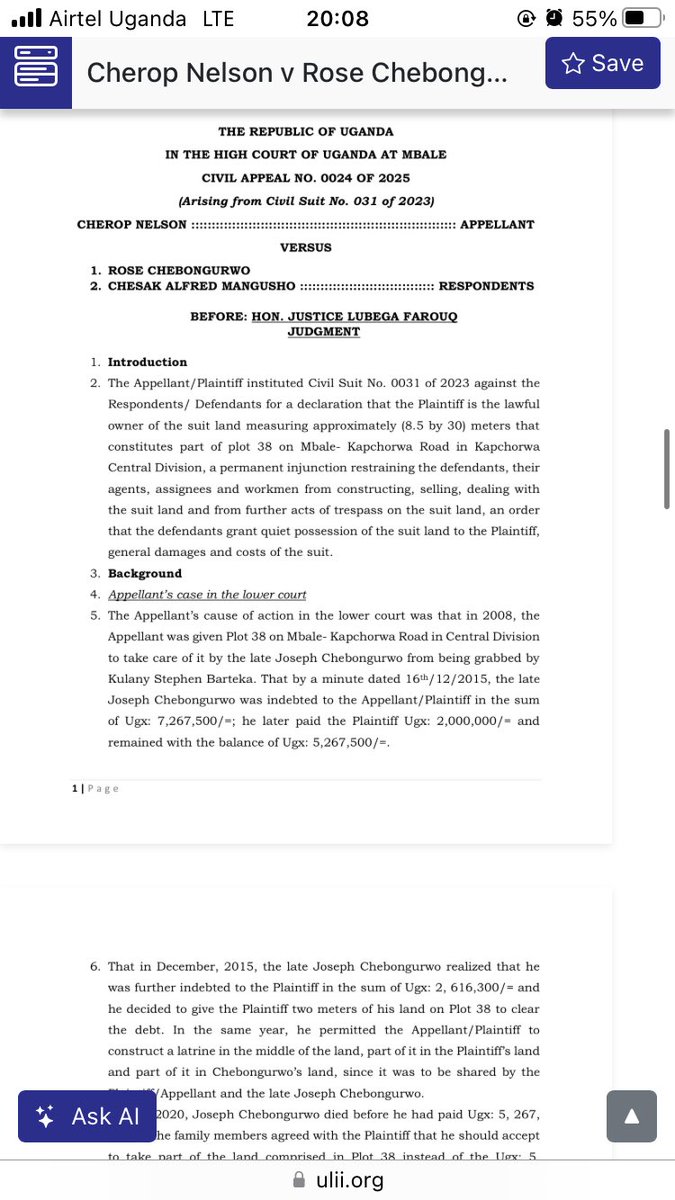
A crucial decision. A debt owed by a deceased person does not, by itself, confer authority to dispose of estate property. Legal title and the authority to administer and deal with estate assets must be properly established through the succession process.
A Sale of Estate Property Without Letters of Administration: What Cherop Nelson v Chebongurwo Tells Us
In Cherop Nelson v Rose Chebongurwo & Another, Civil Appeal No. 0024 of 2025 [2026] UGHC 899, the High Court at Mbale delivered an important reminder on dealing with property belonging to a deceased person.
The Appellant claimed an interest in the land based, among other things, on an alleged debt and a subsequent arrangement with members of the deceased’s family. The Respondents also claimed title through a sale by family members.
The Court rejected both transactions not because the underlying dealings were necessarily devoid of evidence, but because the deceased’s estate had never been administered through letters of administration.
The Court’s crucial finding was that family members cannot simply assume the legal authority of an administrator and dispose of estate property before obtaining the necessary grant. The land remained property of the estate, and the Court declined to give effect to an unlawful transaction.
What makes the decision particularly interesting is the Court’s qualification: beneficiaries may, in appropriate circumstances, deal with estate property even before letters of administration—but only within their respective interests and subject to the circumstances recognised by law. Here, the Court found it unclear whether all beneficiaries had consented to the sale.
The practical implication is significant:
possession of family land, a family meeting, payment of money, or even a signed agreement does not automatically confer authority to sell property forming part of an unadministered estate.
For purchasers, the message is simple: before buying property from heirs, establish who has legal authority to deal with the estate.
For practitioners, the case is another reminder that succession law is not a technical afterthought in land transactions, it can determine whether the transaction exists at all.
The appeal was ultimately dismissed, with each party bearing its own costs.
Court also ordered X Corp. to disclose information capable of identifying the anonymous account holder and awarded substantial damages.
Esther Agboola v. X Corp. & Anor, Suit No. IKD/21207MFHR/2026,
https://t.co/dbwzjGki0q
#DataProtection#Privacy#DigitalRights#Nigeria🇳🇬
Manipulating and republishing a person’s social-media post in a manner that makes their personal data false or misleading can amount to unlawful processing and violate the constitutional right to privacy.
In Esther Agboola v. X Corp. & Anor, Court considered the manipulation & republication of personal data on X and held that altering & republishing personal data in a manner that makes it false or misleading can amount to unlawful processing & violate the right to privacy.
The legal framework governing the registration of NGO's in Uganda does not accord preferential treatment to any particular incorporation vehicle. Rather, it establishes a uniform registration process for all organisations seeking recognition under the NGO Act.
Trust or Company Limited by Guarantee(CLG):
Which corporate vehicle is best suited for establishing an NGO?
Vote first, then share with us what influenced your decision. Is it governance, compliance, flexibility, or something else?
#SuccessionLaw#Inheritance#FamilyLaw#LegalInsights
𝘾𝙖𝙣 𝙖 𝙬𝙤𝙢𝙖𝙣 𝙞𝙣 𝙖𝙣 𝙞𝙣𝙫𝙖𝙡𝙞𝙙 𝙢𝙖𝙧𝙧𝙞𝙖𝙜𝙚 𝙞𝙣𝙝𝙚𝙧𝙞𝙩 𝙝𝙚𝙧 𝙝𝙪𝙨𝙗𝙖𝙣𝙙'�� 𝙚𝙨𝙩𝙖𝙩𝙚
The High Court of Kenya has answered yes—at least for purposes of succession.
https://t.co/641TuvGY4w
The decision serves as a timely reminder that corporate restructuring, deregistration, or dissolution cannot be used as a mechanism to evade legal obligations. Outstanding debts survive and creditors retain remedies, including restoration of the company to the register.
𝐂𝐚𝐧 𝐚 𝐜𝐨𝐦𝐩𝐚𝐧𝐲 𝐞𝐬𝐜𝐚𝐩𝐞 𝐢𝐭𝐬 𝐥𝐢𝐚𝐛𝐢𝐥𝐢𝐭𝐢𝐞���� 𝐛𝐲 𝐬𝐢𝐦𝐩𝐥𝐲 𝐬𝐭𝐫𝐢𝐤𝐢𝐧𝐠 𝐢𝐭𝐬𝐞𝐥𝐟 𝐨𝐟𝐟 𝐭𝐡𝐞 𝐫𝐞𝐠𝐢𝐬𝐭𝐞𝐫?
The High Court of Kenya recently answered that question with a firm 𝗡𝗼
https://t.co/Ti4RsR2MoM
The decision echoes two important principles:
✔️ Dissolution does not extinguish valid debts and liabilities.
✔️ Creditors are entitled to notice and an opportunity to protect their interests before a company is struck off.
#SuccessionLaw
𝗪𝗵𝗲𝗻 𝘄𝗶𝗹𝗹 𝗖𝗼𝘂𝗿𝘁 𝗴𝗿𝗮���𝘁 𝗟𝗲𝘁𝘁𝗲𝗿𝘀 𝗼𝗳 𝗔𝗱𝗺𝗶𝗻𝗶𝘀𝘁𝗿𝗮𝘁𝗶𝗼𝗻 𝗣𝗲𝗻𝗱𝗲𝗻𝘁𝗲 𝗟𝗶𝘁𝗲?
Court in Kyagaba George William v Kivubuka Achileo & Anor, has clarified the limited scope of grants issued under S.214 of the Succession Act⬇️
The decision affirms that administration pendente lite is a limited protective remedy, available only where the statutory conditions under Section 214 are satisfied. It cannot be used merely to facilitate execution of a judgment or continuation of litigation.