Just a nobody trying to make a name for myself in this space, yet it feels like nothing is working.
But I’m not giving up.
If you’ve figured out how to grow on this app, I’d love some tips.
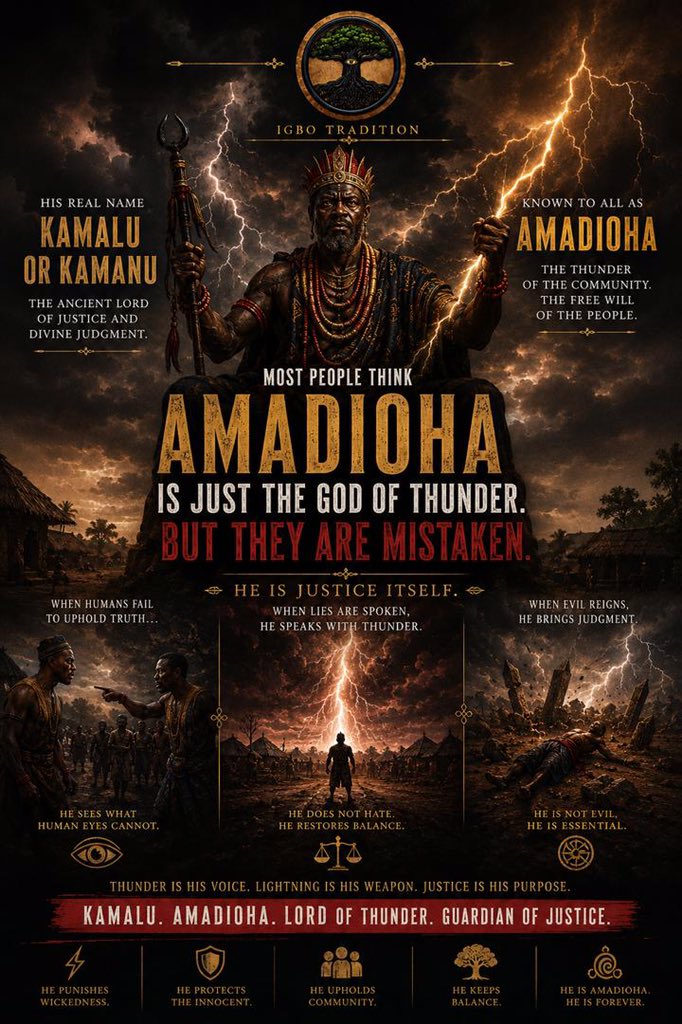
Most people think Amadioha is simply the god of thunder. But they are mistaken.
To the ancient Igbo people, Amadioha was far more than lightning in the sky.
He was justice itself.
Long before courts, judges, or written laws, there was a force the Igbo feared more than any king’s punishment. A force that could strike from the heavens and expose a liar in an instant.
Justice was his true domain.
The storm was only his messenger.
The elders taught that thunder carried a warning.
Every flash reminded humanity that actions have consequences.
Every storm was a reminder that truth cannot remain buried forever.
And so, when lightning splits the sky over the forests of Igboland, some still remember the old stories.
Not of a god who loved destruction.
But of Kamalu.
Amadioha.
The Lord of Thunder.
The Guardian of Justice.
The Judge whose courtroom was the sky itself.
Most people think Amadioha is simply the god of thunder. But they are mistaken.
To the ancient Igbo people, Amadioha was far more than lightning in the sky.
He was justice itself.
Long before courts, judges, or written laws, there was a force the Igbo feared more than any king’s punishment. A force that could strike from the heavens and expose a liar in an instant.
Amadioha became known as the divine judge who defended truth and punished wickedness.
People swore oaths in his name.
Disputes were settled before his shrines.
Those who believed themselves innocent called upon him without fear.
Those who carried guilt trembled whenever thunder rolled across the sky.
Yet Amadioha was not viewed as evil.
Nor was he a god of destruction.
Lightning was simply the weapon he used.
Esu is not the enemy of God.
He is the keeper of the crossroads—the one who stands where every decision is made, watching quietly as human beings choose their own fate.
Most people think Esu is Satan, but they’re mistaken.
Long before foreign religions arrived in West Africa, the Yoruba people spoke of a powerful deity named Esu. He was not the embodiment of evil, nor was he the ruler of a fiery underworld. Esu was something far more complex—and far more dangerous.
Yet the elders understood that Esu served a purpose. Without choice, there can be no virtue. Without temptation, there can be no self-control. Without consequences, there can be no justice.
So while many outsiders later compared Esu to Satan, the comparison misses who he truly is in Yoruba tradition.