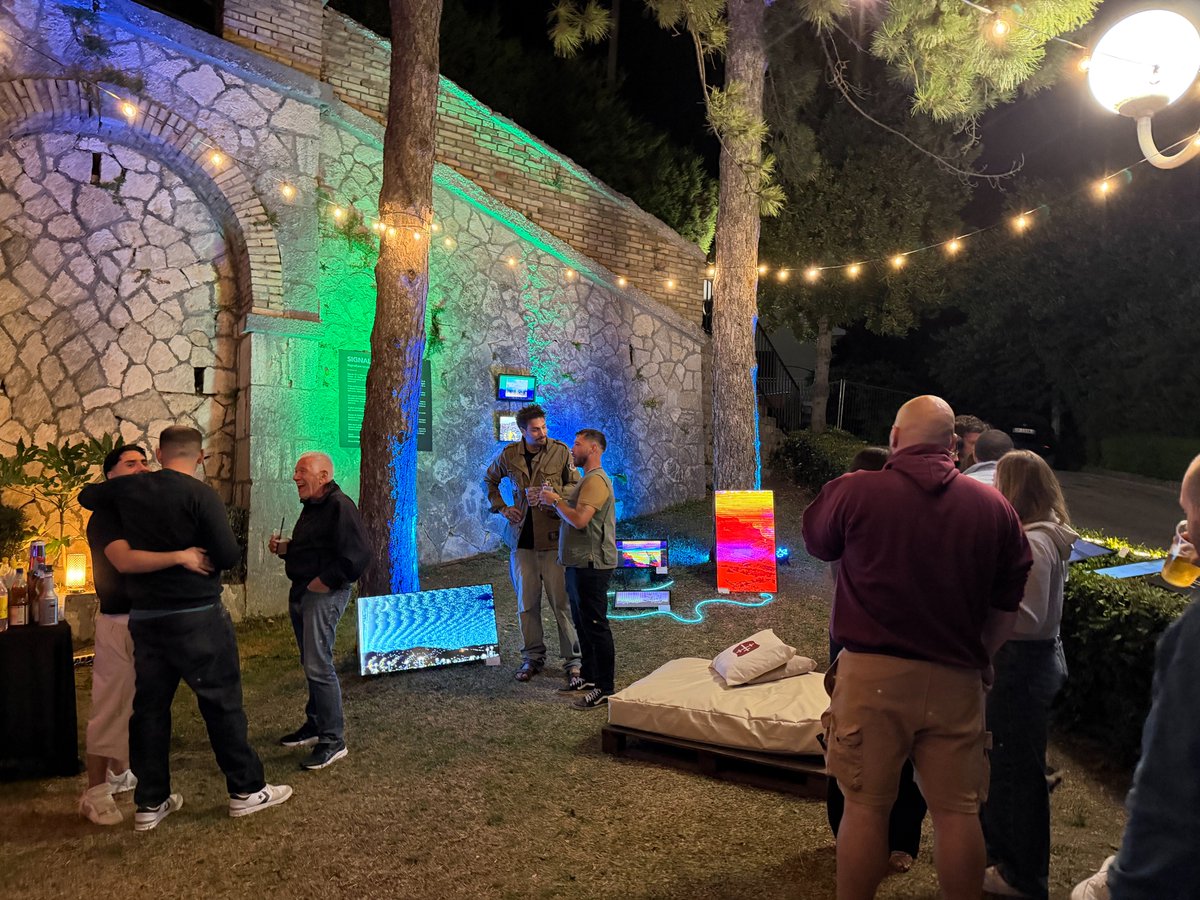
Yesterday, I Veri Costruttori was presented in Castel di Croce.
Curated by @RaqueGaudard using the village’s postwar archive, preserved by Paolo Pallotta and Luigi Laurenzi, the exhibition approaches memory not as a fixed repository but as a collective process, rebuilt each time someone remembers, adds a detail, or tells a story.
+ 🔽
Thank you @RaquelGaudard and @CasteldiCroce_ for organizing a lovely event! Really talented group of artists and love to see analog glitch out in the world:)
First time ever being quoted at an exhibition, that’s something I’ll definitely always remember:) Thanks Raquel 🎨📺
Last Saturday, Signals for a Village returned to where it began: @CasteldiCroce_.
After travelling across countries, hands and machines, images of the village came back transformed—as eight artworks presented in the place that first generated them.
Eight works, seven incredible artists:
@cebolander — WHERE IS THE MOON + GLITCH IS HEAVEN
@eglesaka — Disintegrating Landscapes
@ex_mortal_ — _mezzanotte
@ina_vare — SIGNAL 0413
@jotta_rs — I followed the mountain path, and the light found me
@Nebular___ — anachronistic
@s0mfay — Sun Behind The Sun
Follow the thread for the full story 💜
"WHERE IS THE MOON" is my contribution to the exhibition SIGNALS FOR A VILLAGE, curated by @RaquelGaudard
so proud to be part of this <3
link to the piece 🔽
📺💭An image of a place is never neutral. It can describe it, idealize it, or turn it into a static view. Signals for a Village chooses another possibility: transmission.
The project begins with the landscape of @CasteldiCroce_ and its most recognizable elements: the mountains, the fields, the sunsets, the changing light, the silhouette of the village on the horizon, and fragments of its architecture.
These images were sent to seven international artists on @objktcom: @ex_mortal_, @s0mfay, @cebolander, @ina_vare, @eglesaka, @jotta_rs, and @Nebular___ , becoming materials open to interference and transformation. Through CRT televisions, mixers, feedback, modified circuits, software, and hand-built tools, each artist developed a different signal.
Analog glitch is not applied as a style layered over the landscape. Instead, it becomes a way of revealing the instability of every image: shifts in colour, loss of synchronization, electronic noise, and signal disruption produce new visual possibilities.
Castel di Croce is the active source of the project, not a passive backdrop. Its images leave the village, pass through other geographies, other hands, and other machines, and finally return transformed.
The exhibition thus brings the local and the global, the natural and the electronic, the physical presence of the landscape and its digital circulation into dialogue. The works do not seek to fix Castel di Croce within a definitive representation, but to offer eight possible transmissions of it.
Can the contemporary language of digital art invite us to see a place through different eyes and, in doing so, make it feel more present? I hope so. 🧵👇