Congratulations to @XRAssociation on an impressive seven-year run bringing XR into the mainstream, and thank you for being such a great partner to @ITIFdc. We’re proud to help carry this work forward and look forward to continuing to advance policy for immersive technologies.
1/5: After seven remarkable years of advancing immersive technology, the XR Association has announced the organization’s decision to wind down operations at the end of 2026.
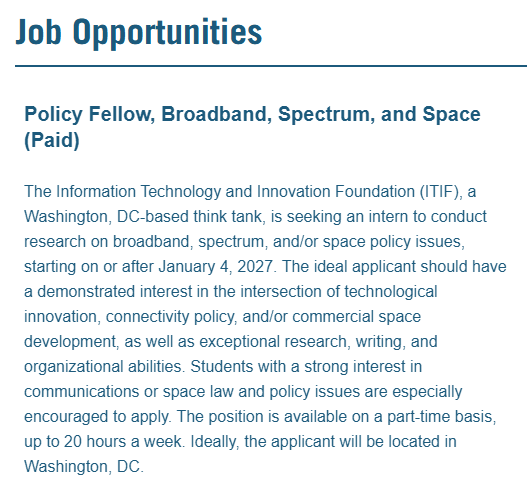
Do you or a loved one want to dig deep into Space, Spectrum, and Broadband and argue for what the policy of the future should look like?
Apply to @ITIFdc's Spring Fellowship! (link below)
@rustyoldwheel@dvonkampen That's the problem with your response: you're asking who has the authority to make the judgment rather than whether the claim is true. Neither the Pope nor an “AI huckster” gets to settle a philosophical question by authority.
1/6
The Pope says AI makes it urgent to distinguish “human art” from machine-generated art, because only human art has the “spark of humanity.”
There is an irony here: the Church has a long history of deciding which human art is legitimate.
In this era of artificial intelligence, it is becoming urgent to distinguish human art from what machines produce. There is an ontological difference, even before an aesthetic one, between art and what a machine can generate through statistical calculation based on millions of images created by others. Algorithms lack the spark of humanity. For this reason, the Church wishes to renew an alliance with artists and cultural institutions to safeguard our humanity.
@santiagoarraga The Pope isn't just saying AI output isn't art. He says the Church must “safeguard our humanity” from it. The Church once made similar arguments about modern art—arguing that new forms of artistic expression threatened faith and human values. Its judgments have changed before.
@MattFromSMM@dvonkampen “It's images, not art” was essentially the argument made against photography. The fact that a machine participates in producing an image doesn't settle whether the result is art. That's precisely the question you're assuming away.
@dvonkampen “But AI isn’t human, therefore its output isn’t art” is precisely a claim about the category of art.
That’s my point: the Church is asserting its authority to draw that boundary. History gives us reason to be skeptical when it claims that authority.
5/5
Europe doesn’t need independence from American technology for its own sake.
It needs technological relevance.
If “digital sovereignty” means building European substitutes for yesterday’s products, Europe isn't catching up.
It’s falling behind more independently.
1/5
The EU is pursuing “digital sovereignty” by building its own alternative to Microsoft Teams.
It’s called Element Pro.
The problem? According to Politico, EU officials have described it as “absolute shit” and said, “I don’t understand the added value here.”
4/5
The real test of technological sovereignty isn't whether Europe can build its own version of Teams.
It’s whether Europe can build technologies that the rest of the world wants to use.
AI. Robotics. Semiconductors. Biotech. Energy.
That’s innovation.
6/6
Artists do not need the Church—or governments, or anyone else—to certify that their work possesses the “spark of humanity.”
Artistic freedom means allowing people to create, experiment, imitate, collaborate, and use new tools—including machines.
5/6
More importantly, this isn't really about whether AI art is good or bad.
The Pope is once again asking the Church to distinguish morally legitimate art from illegitimate art—and implicitly to decide which forms of artistic creation society should protect.
This lawsuit isn’t just de facto AI regulation.
It risks becoming a court-ordered kill switch for an American AI company—while Chinese firms race ahead.
Halting the development of new models would prevent one of American's leading firms from competing in the global AI race.
Florida’s attempt to have a court halt OpenAI’s development of new AI models is a deeply troubling precedent.
Courts should enforce laws, not become regulators. And stopping development altogether is a wildly disproportionate response to the incidents cited.
Four months ago, we filed the first state-led lawsuit against OpenAI and Sam Altman. Today, we are asking the court for a temporary injunction.
Stop calling it safe. Stop pretending it's human. Stop selling it to kids.
Another day, another "ban superintelligence" bill.
@RoKhanna introduced the "Human Control Over AI Act" to ban recursive self-improving AI models and create a federal licensing requirement for model training and deployment.
A few more details. ⤵️
There are some provisions that deserve further exploration. For example, the bill would establish legal consequences for some AI failures and require companies to carry liability insurance.
Internalizing potential costs of failure is essential to create incentives for safety.