Het Stadhuis te Haarlem met de Intocht van Prins Maurits ter Vervanging der Gouverneurs in 1618.
(The Town Hall at Haarlem with the Entry of Prince Maurits to Replace the Governers in 1618.)
Pieter Saenredam, 1630
It is time to move beyond the Netherlands/Belgium, mostly because it becomes increasingly difficult to find noteworthy architecture in these two countries. So from here on out I will post buildings from other parts of Europe/the world as well. It's just how it's going to have to be. Happy New Year🐟
"Rosenborg Slot" in #Copenhagen 🇩🇰, a castle built in Dutch renaissance style and designed by Bertel Lange and Hans van Steenwinckel the Younger, started as King Christian IV's summerhouse in 1606 and reached its final form by 1624. It served as a royal residence until around 1710.
"Huis Loowaard" is a historic manor house south of #Loo (Gelderland), built in 1463 by Johannes van Loo, drost of the Liemers. The site may overlie a Roman castellum, later used by Franks before destruction by the Rhine. Extensively renovated in 1565 by Herman van de Loe and his wife Digna van Isendoorn, it became a tenant farm after 1569.
A largely wooden house in #Krommenie (Noord-Holland) featuring an elaborately carved, concave-convex gable in Louis XVI style, adorned with emblems of merchant shipping and a medallion portrait of Ceres. The brick facade has richly decorated window surrounds and an entrance frame with carved casement, carved door, and a transom light bearing agricultural emblems.
"Kasteel Cantecroy" in #Mortsel (Antwerpen), Belgium (originally Cantincrode), is one of Antwerpen province's oldest castles, with parts dating to the 13th-14th centuries and a 15th-century chapel. First mentioned in 1239, it passed through families like Berthout, Ranst, Granvelle, and Fiennes, who rebuilt it in Flemish Renaissance style around 1700. Notable events include repelling Iconoclasts in 1566 and demolition of fortifications in 1616.
"De Linden" in #EttenLeur (Noord-Brabant) an 18th-century house (likely early 19th-century facade), features two transverse gabled roofs with stepped gables, a yellow-plastered front, small-paned white mullion windows, dark green shutters, and decorative wall anchors. The central entrance has a circa-1830 door with almond-shaped panels, fanlight carvings, segmental fanlight, and cornice on volute consoles, six ornate stoep posts with chains and forged flowers, five upper windows, a hoist window on the south gable, and a wooden double coach gate with curved top and copper fittings.
In de 17e eeuw betaalde je in Holland belasting per gevelbreedte. Ramen werden niet meegerekend,dus maakten rijke kooplieden hun huis zo smal en zo hoog mogelijk met veel ramen. Je betaalde dan minder belasting,maar had toch veel licht binnen en een prestigieuze gevel. Fijne dag!
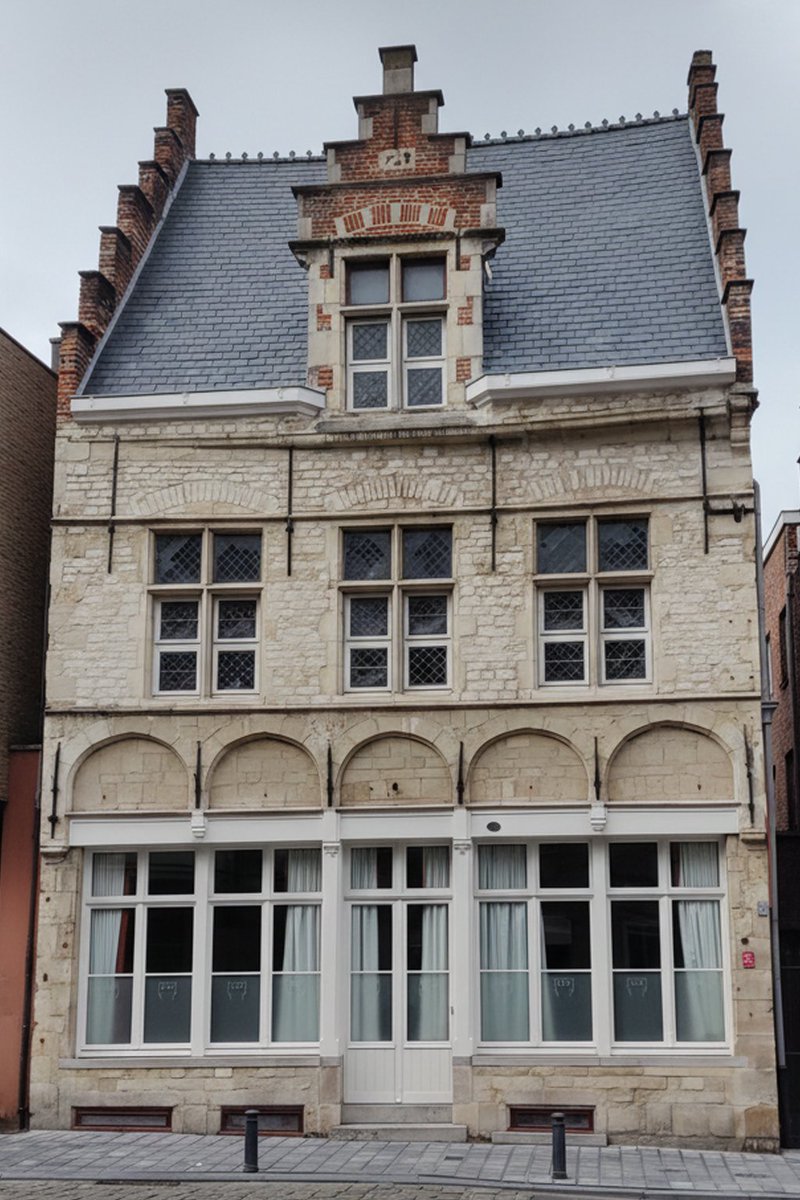
Three-bay, two-storey house in #Gent (Oost-Vlaanderen) with late-gothic features, built in 1518. It has a steep saddle roof with crow-stepped gables on both sides. Jettied upper floor on five Tudor arches resting on profiled consoles; cross-windows with leaded lights, continuous drip mould and large relieving arches. Central stepped dormer; wide ogee cornice tapering oddly to the left.
"Kasteel Gageldonk", located in the hamlet of Gageldonk near #Prinsenbeek (Noord-Brabant), was a medieval castle first mentioned in the 13th century with knights like Hugo van Gageldonk. By 1312 it was a fortified house owned by Peter van Zevenbergen. It passed through owners like Willem de Bie (15th century), who lived in a grand moated residence with drawbridge, gatehouse, stables, barn and brewery. In 1544 it briefly belonged to William of Orange, who enfeoffed it to his confidant Antonis van Stralen. After Antonis was executed by the Spanish, the castle was confiscated. In 1573 it was destroyed by the Dutch Sea Beggars (Watergeuzen). In the early 17th century the ruins were mostly demolished, leaving only the gatehouse, which became part of a farmhouse.
Naast de pastorie in Zundert waar de fam van Gogh woonde stond dit pand wat bewoond werd door 2 zussen. Ze werden door Vincent en zijn broers en zussen liefkozend “tantes” genoemd – ze fungeerden als peettantes en verzorgsters voor de kinderen Van Gogh. Fijne dag !
One of the only two surviving authentic medieval wooden facades in #Brugge (West-Vlaanderen). This rare 16th-century (ca. 1550 or earlier) timber-framed house has a projecting upper storey to protect from rain and gain space. Wooden houses were banned in the 17th century due to fire risks, making its survival miraculous.
"Kasteel Altena" in #Kruibeke (Oost-Vlaanderen) is a moated brick castle with stepped gables, an open gallery, and a prominent polygonal tower, richly detailed with sandstone bands. Originally destroyed by fire in 1584, it was rebuilt in 1594. It remained with the noble de Lanfranchye family until 1850, then passed to the le Boucq de Beaudignies family, who enlarged it in 1878 (designed by Joseph Schadde).
"Den Bramel" is a historic country estate and former castle near #Vorden (Gelderland, first mentioned in 1396 as the seat of Gerrit den Bramel. Little remains of the medieval or 17th-century versions; the current small manor was largely rebuilt around 1720-1726 using older walls, gained a neo-Renaissance gable in 1868, a slate roof and turret in 1881, and a neo-gothic portal in 1885. Parts were built with materials from a former church, including a 1735-dated dome inscribed "Soli Deo Gloria".
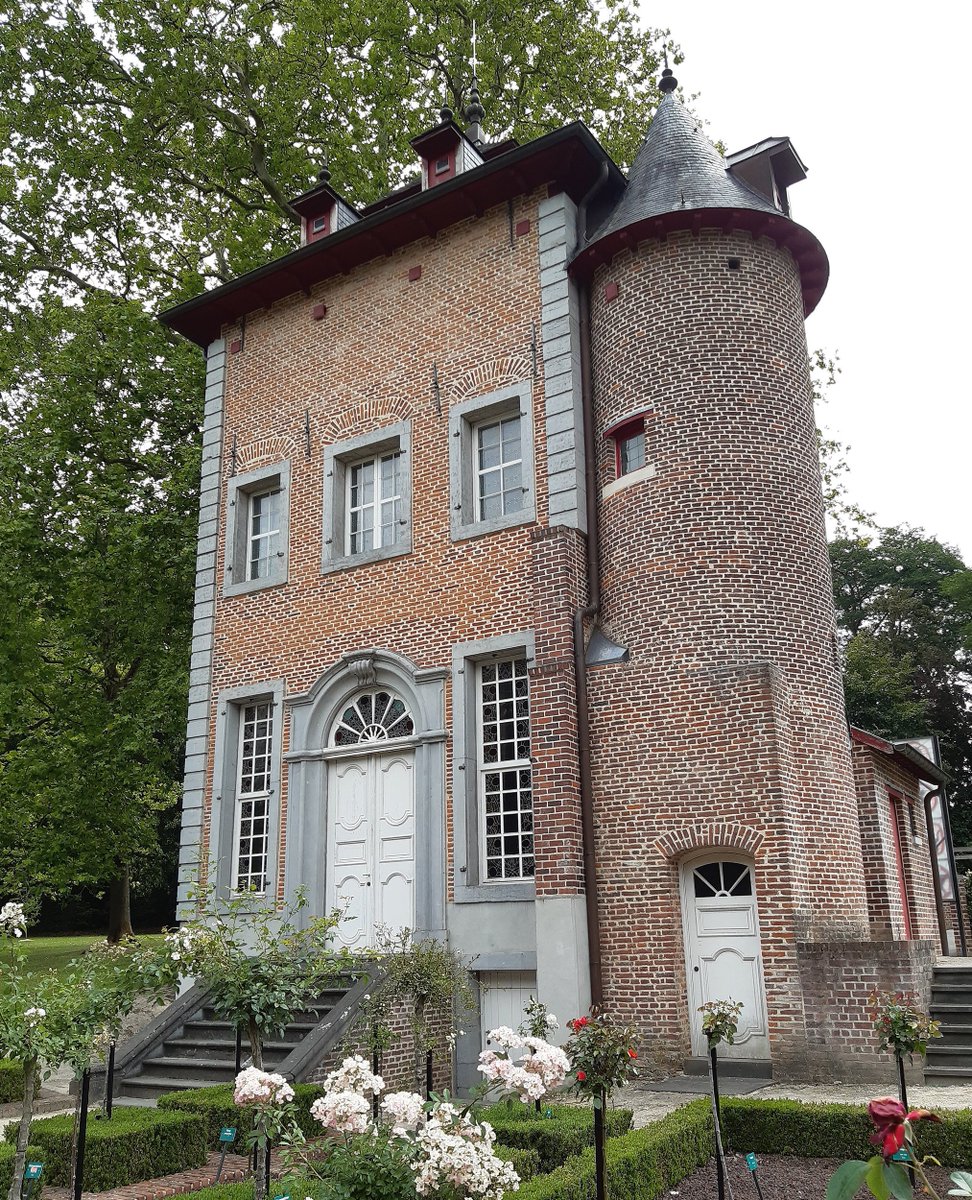
"Domein Coloma" in #SintPietersLeeuw (Vlaams-Brabant), centers on the historic "Kasteel Coloma", surrounded by moats. Originally a 16th-century fortified seat of Leeuw, it was transformed in the mid-18th century by Charles-Vital de Coloma into an elegant classical residence. Other buildings include the 1731 former coach house and the former garden pavilion turned rose museum.