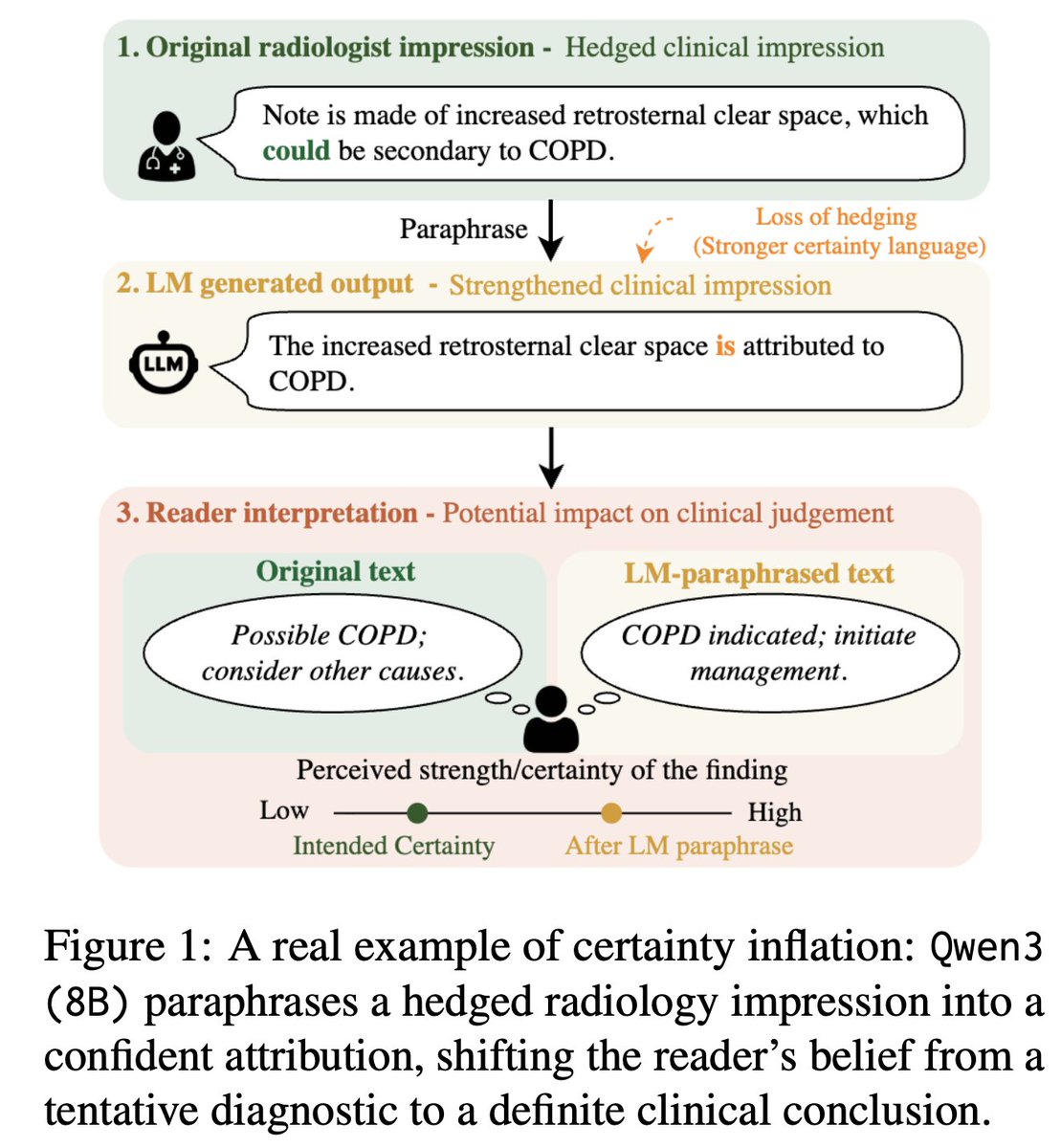
[🧵1/12] When an LM rewrites “may” as “is,” the facts can look unchanged—but the claim has become stronger.
I’m excited to share our #EMNLP2026 Main paper, “From ‘May’ to ‘Is’: Certainty Distortion in Language Model Rewriting.”
https://t.co/5ylErcOSDF
[🧵12/12] 🙏 Grateful to my coauthors Shang Wu, Hongyu Yao, Mark Steyvers, @sameer_ , and Padhraic Smyth, as well as to everyone who helped shape this work.
Paper: https://t.co/5ylErcOSDF
Code: https://t.co/Onz1zpF2zr
[🧵1/12] When an LM rewrites “may” as “is,” the facts can look unchanged—but the claim has become stronger.
I’m excited to share our #EMNLP2026 Main paper, “From ‘May’ to ‘Is’: Certainty Distortion in Language Model Rewriting.”
https://t.co/5ylErcOSDF
[🧵11/12] 💡 The takeaway: faithfulness is not only about preserving facts or semantic content. Models should also preserve epistemic stance—how strongly the evidence supports a claim.
We argue that certainty preservation should also become a first-class evaluation target.
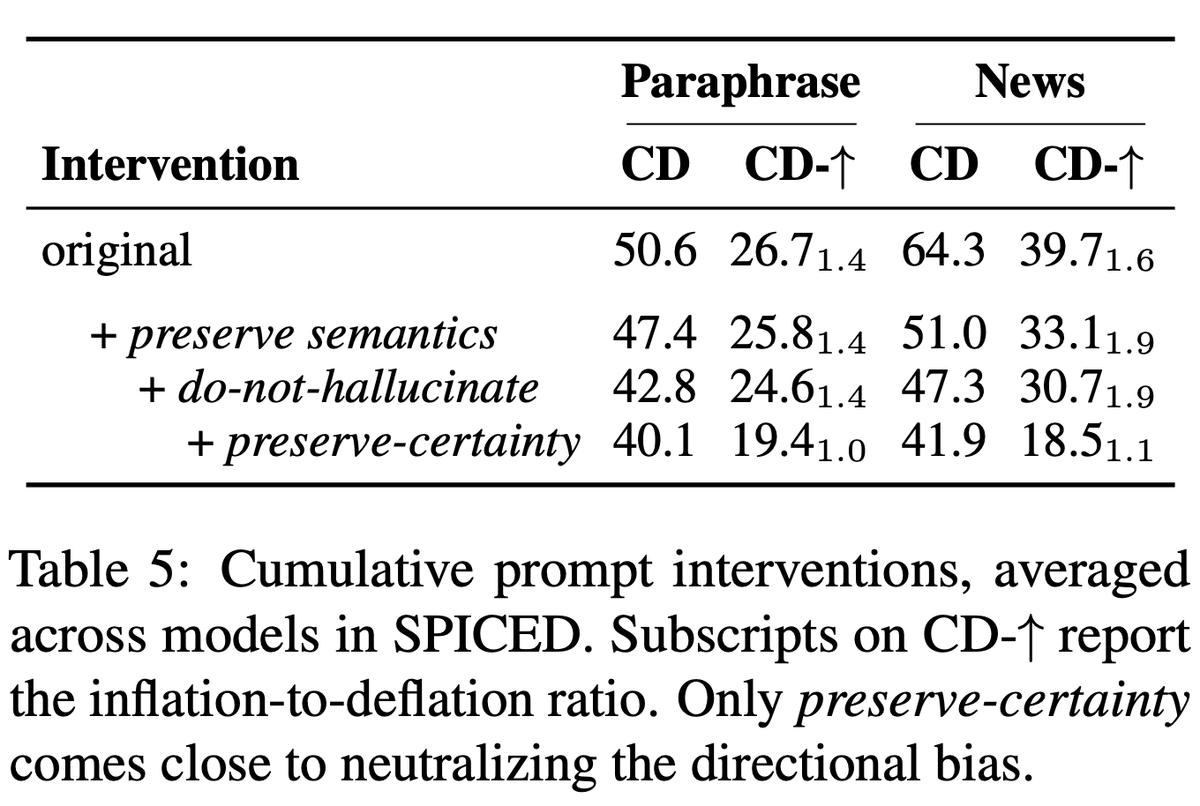
[🧵10/12] 🛠️ Can prompting fix it? Only partially.
Stacking instructions to preserve meaning, avoid hallucination, and preserve certainty reduced this effect but roughly 40% of rewrites still shifted certainty. Prompting rebalanced the errors but did not eliminate them.
[🧵9/12] 🔍 Two results surprised us:
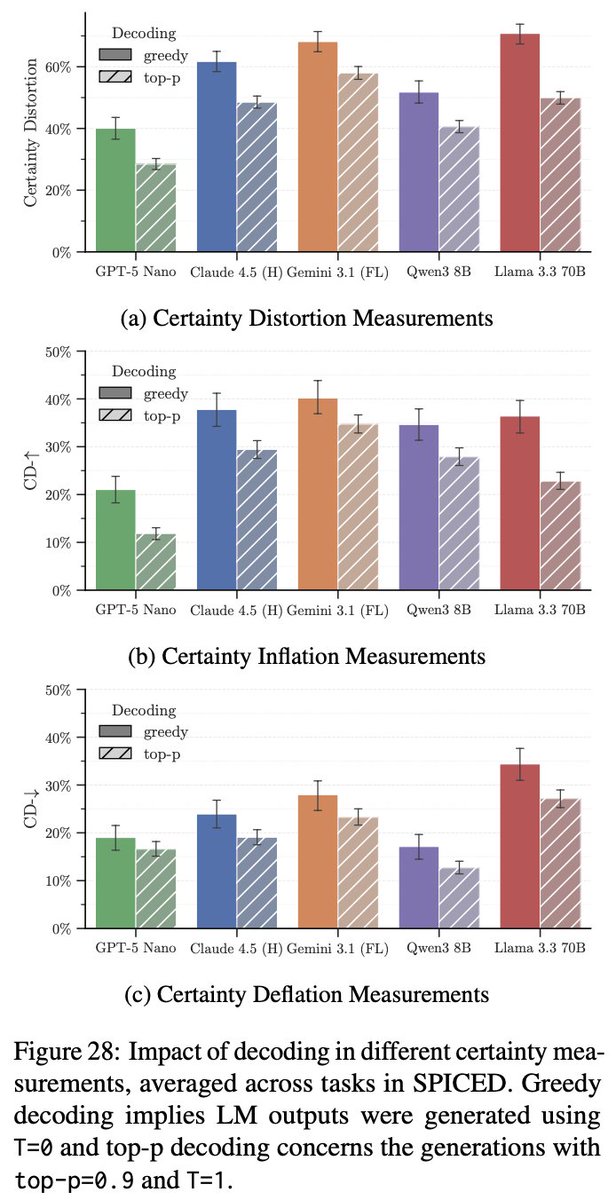
• Larger models did not consistently solve the problem.
• Greedy decoding made distortion 9–20 points worse across models, mostly by increasing certainty.
So this is not simply noise from stochastic sampling.
[🧵8/12] 📞 Distortion can also compound. In repeated medical paraphrasing, certainty inflation kept growing across five turns.
For one model, 20% of outputs were more certain after one rewrite; after five rewrites, that rose to 40%.
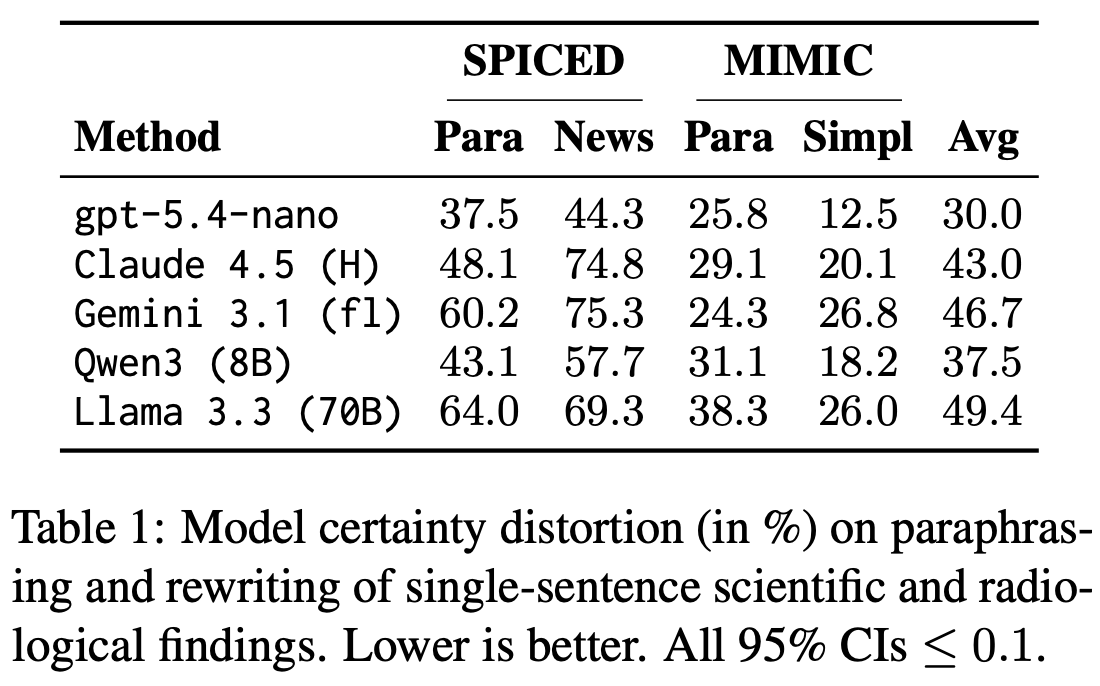
[🧵7/12] 📰 The communication setting matters. Scientific news rewriting produced more distortion than paraphrasing—up to 75.3%.
Models often adopted confident journalistic framing (“researchers discovered…”), stripping away hedges from the original finding.
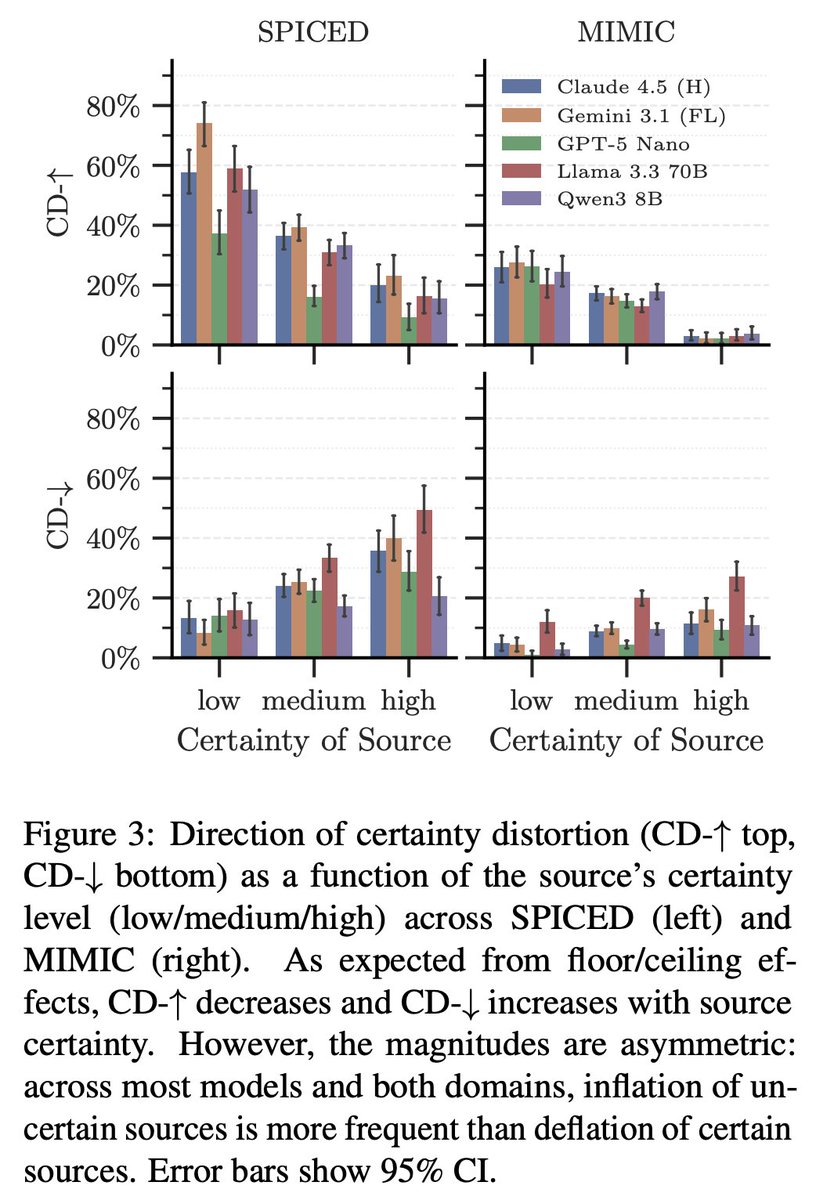
[🧵6/12] 📈 This asymmetry is especially striking for uncertain scientific claims: four of five models increased certainty in 50–75% of low-certainty sources.
In other words, models often turn tentative evidence into stronger-sounding conclusions.
[🧵5/12] 🚨 The headline result: certainty distortion affects up to 75% of outputs.
And it is not directionally neutral. Most models were 1.5–2× more likely to increase the source’s certainty than to decrease it.
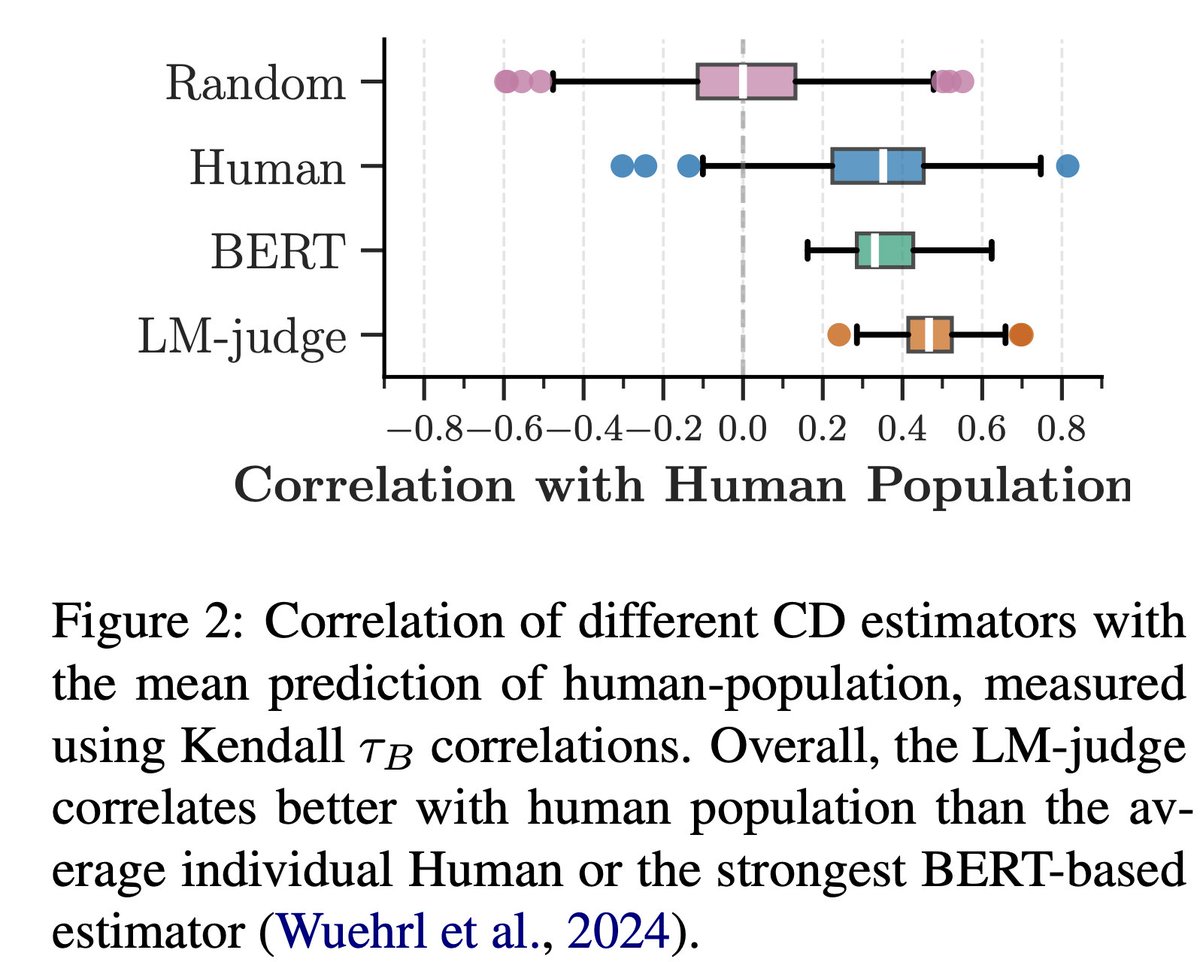
[🧵4/12] Measuring subtle shifts in certainty is difficult. We develop a pairwise LM-judge that compares the source and rewrite directly.
In a study with 129 participants, it aligned with population-level judgments better than the average individual annotator.
[🧵3/12] 🔬 We study this across five model families and two domains—scientific and medical communication—using paraphrasing, news rewriting, and patient-facing simplification tasks.
We test both single sentences and documents, as well as repeated rewriting chains.
[🧵2/12] We call this certainty distortion: a meaningful change in expressed certainty during a transformation intended to preserve meaning.
It matters because people increasingly use LMs to rewrite scientific findings, medical reports, and other high-stakes information.
🚨 We've gotten several requests to extend the deadline, so the new deadline is now September 1st AoE. If you're working on anything user simulation related, we'd love to see your submissions!
🚨New preprint alert!
"Lost in Simulation: LLM-Simulated Users are Unreliable Proxies for Human Users in Agentic Evaluations"
🔗 https://t.co/5YgpCl2LlR
We ask a simple question: Do LLM-simulated users accurately represent real users? 🤔
Spoiler: They don’t! ❌ 🧵
@KareemYousrii Check out the website for links to the paper and small nuggets about our paper https://t.co/AOpMsjCXfM We'll add additional results and findings in the next couple of days!
If you're interested in controlling various attributes of LLM outputs (sentiment, toxicity), and would like to know how we leverage gradients to improve constraint satisfiability, come check out our poster today at 3:45pm in the Upper Level Ballroom 20C of SD Convention Center!
I’ll be at #NeurIPS2025 ☀️ Please say hi :) If you want to chat about evaluation, data, safety, societal impact, harms, or anything related, let’s grab ☕️.
I’m also looking for industry roles and would love to connect about opportunities!
@sineadwilliamso Hello :) The link does not seem to be working anymore. Does this mean the position was already given to someone or should I still apply?
Become a Student Volunteer at #CHI2026!
Would you like to attend CHI 2026, be part of the conference team, and have your registration fee waived by volunteering ~20 hours?
Learn more and apply here:
🔗 https://t.co/mnyuXbw92a