Most catchers stop once the drill looks good.
That’s where development should actually START.
Can you execute it when the pitch misses?
When your timing gets disrupted?
When your body gets pulled out of position?
When the game gives you a problem you didn’t rehearse?
Mechanics are the blueprint.
The athlete is the engine.
Stop building catchers who are good at drills.
Build catchers who can solve problems.
Catcher’s Collective.
Bridging the gap in modern catching development.
You can’t script baseball.
The game will eventually put you in a position you’ve never practiced before.
That’s why the goal shouldn’t be to build perfect movement.
It should be to build athletes who can find solutions when everything breaks down.
Catchers are being trained to look perfect instead of learning how to solve problems.
This play wasn’t a drill.
There was no perfect setup.
No rehearsed footwork.
No time to think.
Ball gets spiked behind the hitter.
Runner takes off.
Find the ball. Control the body. Make the throw.
That’s catching.
Mechanics matter.
But if your training only works when everything goes according to plan, you’re not preparing for the game.
Build the athlete.
Then give the athlete tools to solve problems.
That’s where development actually starts.
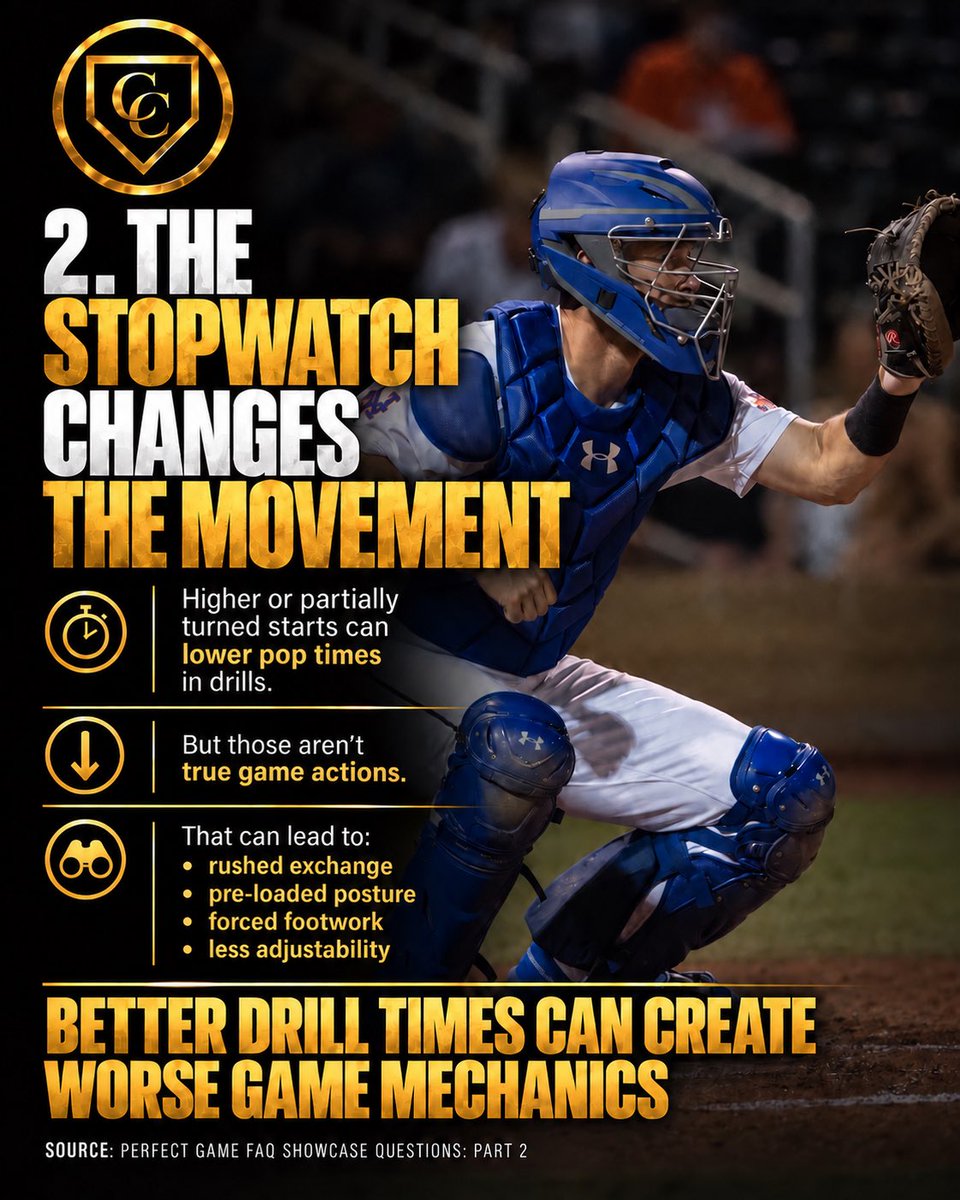
If your 1.82 only exists because you cheated the setup, rushed the exchange, and sacrificed accuracy… you don’t have a 1.82 game tool.
You have a showcase number.
That distinction is exactly what catching development keeps missing.
Showcase baseball has created a fake standard for catchers.
Perfect Game’s 17U data calls 1.84 “elite.”
The MLB average is around a 2.00.
Read that again.
High school catchers are being taught to obsess over a number that’s faster than the average Major League catcher.
And what happens when the stopwatch becomes the goal?
Catchers start cheating the test.
Higher setups.
Pre-turned hips and shoulders.
Rushed exchanges.
Forced footwork.
Less adjustability.
Even Perfect Game itself tells catchers that artificially quickening pop time with non-game starting positions does not show their true actions—and scouts account for it in the evaluation.
A stopwatch is a tool. It is not the position.
Train the skill.
Train game actions.
Train accuracy.
Train adjustability.
The goal isn’t a viral 1.8.
The goal is OUTS.
SOURCES:
MLB / Baseball Savant — Pop Time Leaderboard: Baseball Savant Pop Time data
Perfect Game — Showcase Questions Part 2: PG: What scouts actually evaluate
Perfect Game — Showcase Questions Part 3: PG: 17U pop-time benchmarks
Pop time is the result.
The real question is what created it.
Position → transfer → direction → throw.
Stop chasing the stopwatch and build the movement that makes the stopwatch faster.
Everybody wants a faster pop time.
Most catchers are chasing the wrong things.
This was my first time really throwing to second since retiring.
1.83.
No wasted movement.
Feet underneath the body.
Use the ground.
Clean direction.
Get the baseball out.
You don’t need to throw 95 mph from behind the plate.
Quickness + accuracy wins.
Catchers are infielders wearing gear.
Old-school catching coaches are going to hate this post. Good.
The data doesn’t care what era you played in.
For years, one-knee stances have been blamed for bad receiving, worse blocking, and slower throws.
Then the numbers started challenging the story.
Better access down.
No obvious blocking penalty in the data shown.
And elite catchers are still throwing from it.
At some point, “that’s how we’ve always done it” stops being coaching and starts being an excuse.
Tradition helped build the position.
It doesn’t get to decide where the position goes next.
The game changed.
If your catching development hasn’t, that’s the problem.
If the movement only works in a controlled drill, did you actually develop the player—or just teach them to pass the drill?
The game is chaotic.
Train athletes who can solve problems.
Unpopular opinion:
A lot of catching instruction is teaching kids to LOOK technically correct instead of teaching them to PLAY.
Real catchers react, adjust, improvise and solve problems.
Mechanics matter.
But mechanics without athleticism are useless when the game gets chaotic.
Build the engine.
One of the biggest problems in catcher development is mistaking talent for development.
A player can be committed, highly skilled, and still have movement inefficiencies that are limiting what he can become.
The answer isn’t more random drills.
It’s identifying the actual constraint, building the right progression, and giving the athlete a system to solve it.
Too much catching instruction is built around activity.
Not enough is built around diagnosis.
Drills don’t develop players.
The right system does.
A catcher who can execute the “perfect” block in a drill isn’t necessarily a good blocker.
Can they solve the pitch when it DOESN’T look like the drill?
That’s the skill we should be developing.
The “perfect block” might be one of the worst things we teach young catchers.
The game doesn’t give you perfect pitches—so why are we training perfect movements?
Slide. Reach. Rotate. Dive.
Mechanics are tools. Not rules.
Stop building textbook blockers.
Build athletes who solve problems.
Most players don’t need more drills.
They need the RIGHT drills, in the RIGHT order, solving the RIGHT problem.
That’s the difference between doing work and actually developing.
Talent doesn’t fix bad movement.
Grady Callaway is committed to Kennesaw State, but three mechanical limitations were holding back what his talent could actually produce.
So we didn’t throw random drills at him.
We identified the limiting factors.
Built a progression around them.
Created the right feel.
Then let the system do its job.
Good development isn’t about collecting drills.
It’s about knowing WHAT needs to change, WHY it needs to change, and building a system that gets the athlete there.
Trust the system.