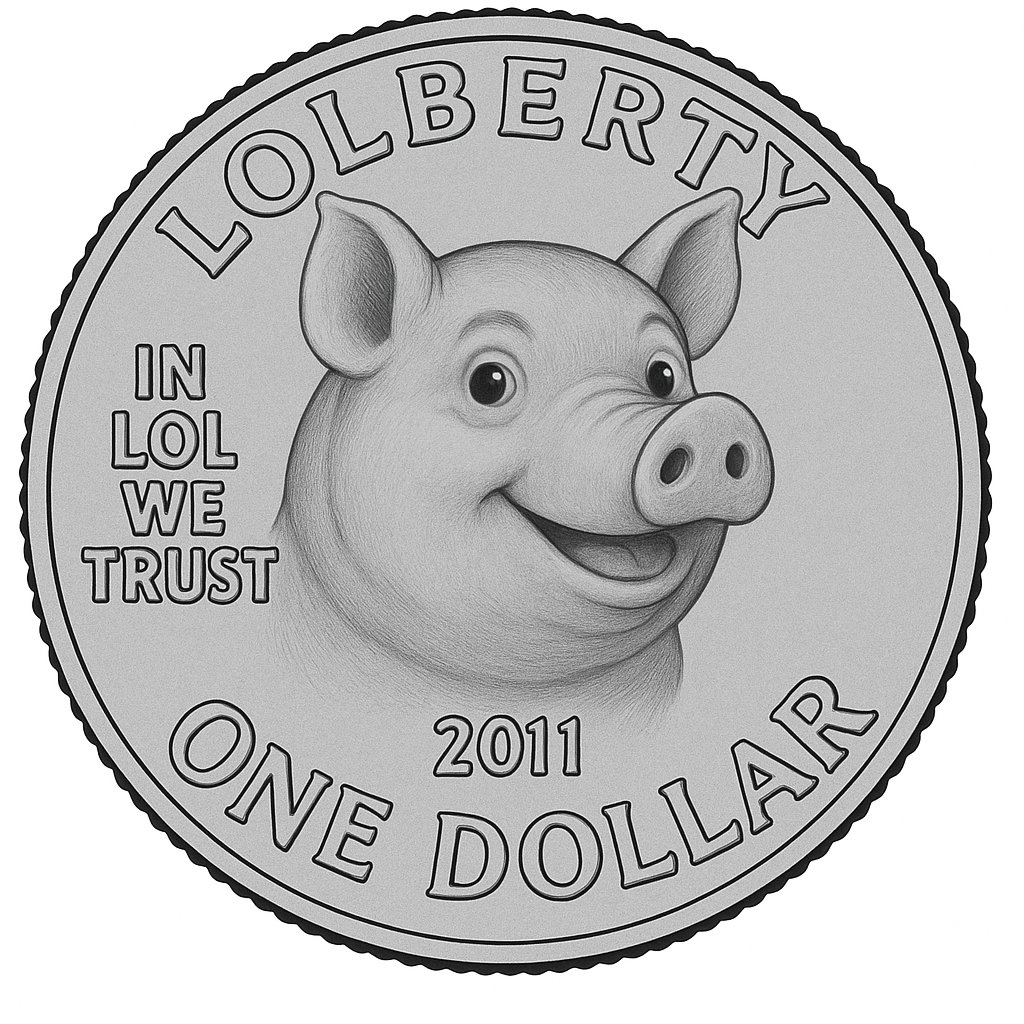
G'lol everybody,
The meme contest is heating up with epic and hilarious entries, loving the community creativity. Your likes are the votes deciding who takes home $500, $350, and $150 in SOL!
Current leaders (as of now):
1. @Gauntletxxx leading with 24 likes!
2. @CryptZee22 and @zeek_szn tied at 23 likes each!
3. @LickMyAlgorithm and @RetardDefi2246 tied at 16 likes!
Remember: Contest ends this Friday September 12th at 2pm EST, so you still have time.
Get in there, submit more memes, get your friends to vote, and make sure you upvote the ones that make you lol!
*If we notice bot activity and people gaming this friendly community contest, we may end up having to take the voting to the community Telegram or a different method, so please be on your best behavior!*
🧵 3/18
Chapter 2: The Birth of a Trickster
When Satoshi Nakamoto vanished, Bitcoin lost its architect. But when Mitsubishi Goldstein appeared, Bitcoin found its trickster.
A New Handle in the Forum
On May 12, 2011, a new account quietly appeared on Bitcointalk: LacedWithKerosene.
It was a strange name. Violent. Explosive. Almost mocking. But behind it was a voice that was equal parts educator, satirist, and prophet.
From the beginning, Goldstein wasn’t interested in just mining guides or wallet security. He was interested in meaning.
Other users debated ATI Radeon cards and hash rates. Goldstein asked: “How do we go out of our way to market Bitcoin?”
While most treated Bitcoin as an experiment in economics, Goldstein treated it as a stage play. A story. A living meme.
Why “Mitsubishi Goldstein”?
No one knows why he chose that name. But the symbolism is hard to miss.
Mitsubishi → The three-diamond Japanese conglomerate, echoing Satoshi’s Japanese mask.
Goldstein → A loaded surname, associated with Orwell’s 1984 character Emmanuel Goldstein, the eternal dissident and trickster.
Put together: Mitsubishi Goldstein.
A parody pseudonym that looked half-serious, half-absurd. Japanese + dissident. Engineer + satirist. Satoshi’s shadow self.
Some saw it as trolling. Others as genius.
But in hindsight, it was perfect branding for what he would become: Bitcoin’s cultural architect.
First Posts: Between Satire and Instruction
Goldstein’s early posts on Bitcointalk oscillated between parody and genuine advice.
He warned miners about fires, melting rigs, and toxic fumes but wrapped it in slapstick satire about “brain damage” from plastic smoke.
He launched https://t.co/6Zh87dyrJh which looked like parody but doubled as a PSA.
He spun up https://t.co/MUkaJPVg1s a straightforward technical guide that miners actually used.
It was hard to tell where the joke ended and the lesson began. And maybe that was the point.
By cloaking education in absurdity, he made it memorable. By exaggerating the dangers, he forced miners to take them seriously.
He was teaching but with a trickster’s grin.
Tricksters in Revolutions
Every revolution needs one.
In politics, pamphleteers like Thomas Paine used satire to stir rebellion.
In religion, jesters mocked the powerful, keeping hierarchies in check.
In Bitcoin, that role fell to Mitsubishi Goldstein.
Without him, early Bitcoin might have collapsed under the weight of its own seriousness. Every Mt. Gox hack, every crash from $30 to $2, every scare about government bans could have suffocated the fragile movement.
Goldstein broke the tension with laughter.
He wasn’t just telling jokes. He was giving Bitcoin something even more precious than code: resilience.
The Trickster’s Lesson
By mid-2011, it was clear. Satoshi had given Bitcoin the blueprint. But Goldstein gave it a personality.
His presence taught the community that Bitcoin wasn’t just an economic tool. It was a cultural force, one that could survive not just on math, but on memes.
And in the shadows of that fragile summer, one parody would change everything:
LOLCOIN.
Every movement needs an architect. But it also needs a trickster. In May 2011, Bitcoin found its own.
��� Next: Chapter 3: The 5,000 Subscriber Speech when r/Bitcoin hit a milestone, the Alpaca quote dropped, and LOLCOIN entered meme history.
🧵 2/18
Chapter 1: The Summer of 2011
Bitcoin was two years old and already carrying the scars of a battle-tested veteran.
Its price had ricocheted wildly: $1.77 in December 2010 → $0.01 in june 2011 → $10 by July 2011. For a handful of believers, these swings felt like destiny. For most of the world, it looked like lunacy.
And the strangest part? The creator was gone.
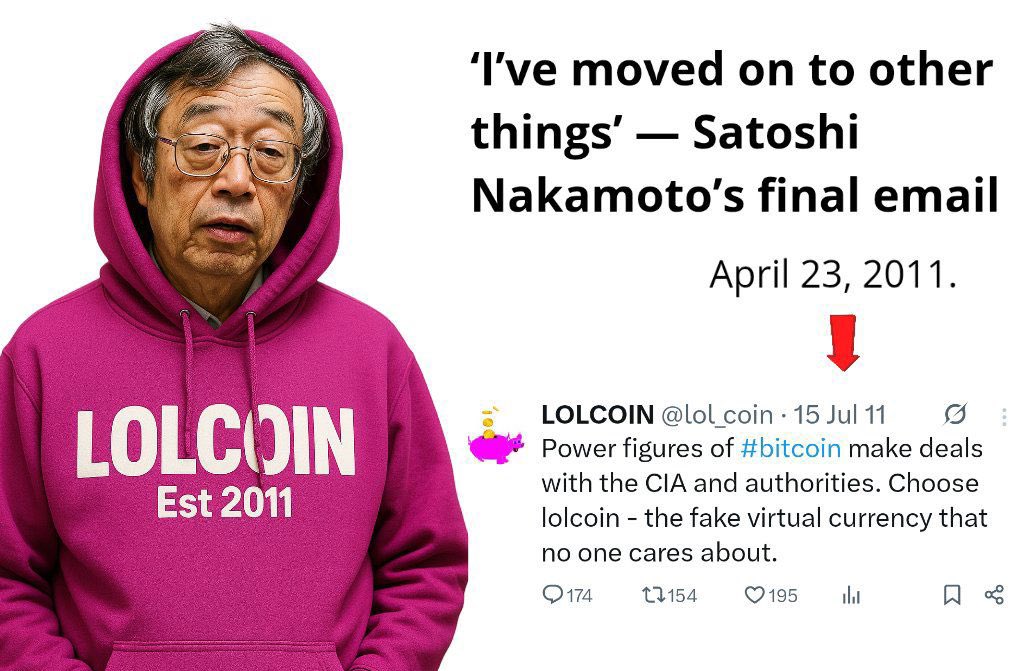
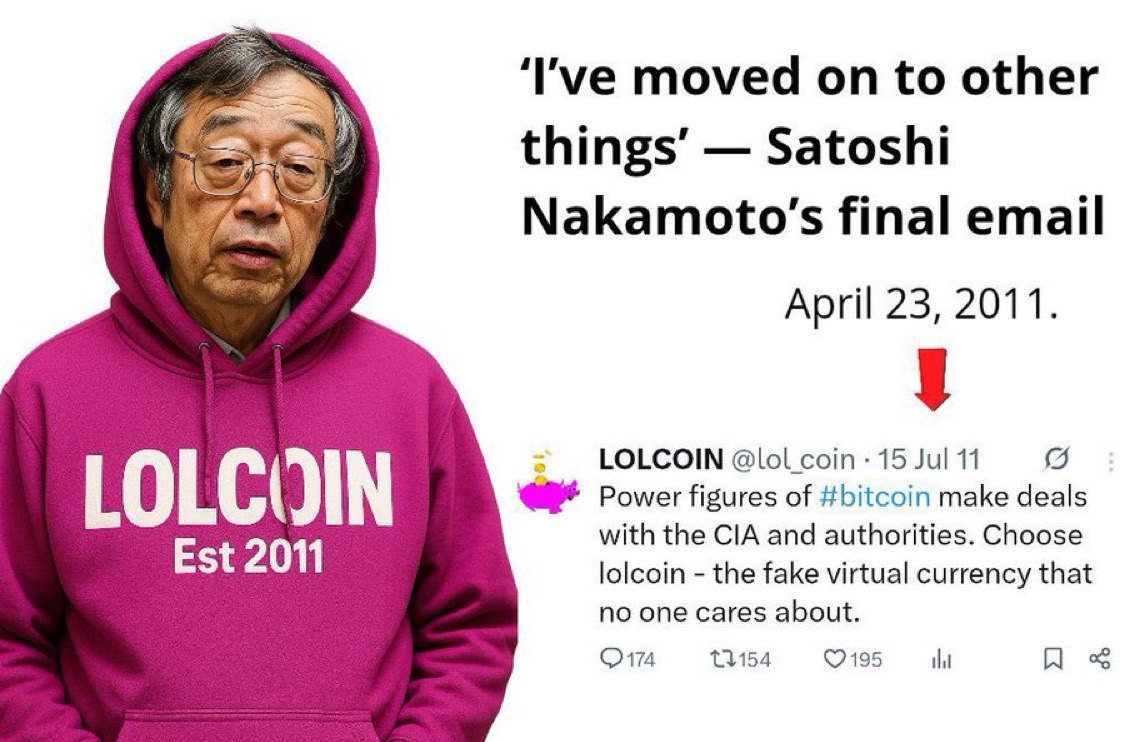
Satoshi Nakamoto, the anonymous figure who wrote the whitepaper, launched the network, and shepherded its fragile first years, had posted his final words in April 23r 2011. Since then, the protocol had survived like a drifting ship without its captain.
The community that remained was small barely a few thousand forum regulars and early miners. They argued endlessly about technical parameters. They shared shaky guides on how to configure ATI Radeon GPUs for mining. They debated whether it was even safe to hold coins on their computers, as malware and lost keys haunted every corner of the conversation.
Bitcoin was fragile. Not fragile in code the blockchain itself kept chugging along but fragile in culture. Without Satoshi, who would carry the story forward?
5,000 Subscribers and a Joke
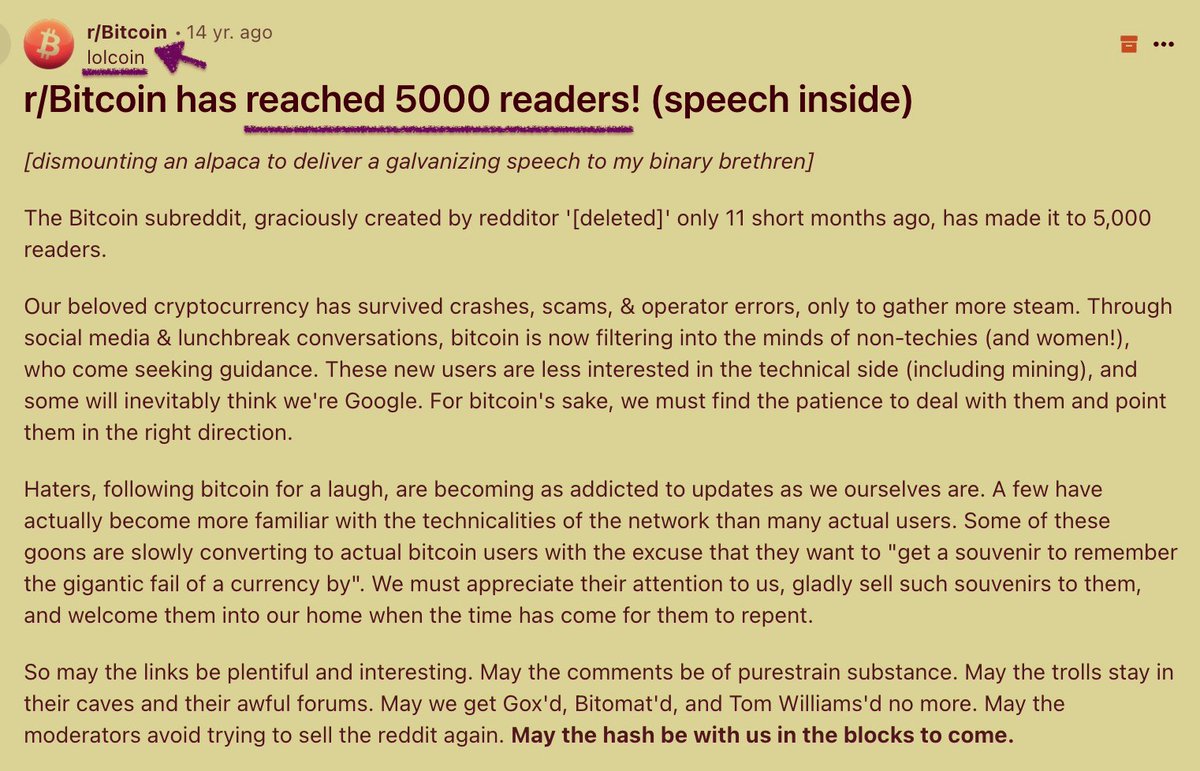
On July 12, 2011, the subreddit r/Bitcoin crossed 5,000 subscribers.
For a technology barely known outside hacker circles, it was a milestone. To the community, it was proof: maybe this experiment had a chance.
But the first voice to mark the occasion wasn’t Gavin Andresen, who had just briefed the CIA about Bitcoin. It wasn’t Hal Finney, the legendary cryptographer who received the first Bitcoin transaction.
It was a parody account called /lol_coin.
https://t.co/YDnhxWm32M
And the message it left behind would echo for more than a decade:
“Bitcoins are backed by their intrinsic comedy value, which will never go down.”
In a single line, Bitcoin became more than a technical project. It became culture. It became comedy. It became meme-worthy.
That voice belonged to a mysterious figure who signed his forum posts as “Laced With Kerosene.”
Others would come to know him as Mitsubishi Goldstein.
A Strange New Name Appears
Goldstein’s Bitcointalk account was registered on May 12, 2011 just 20 days after Satoshi’s disappearance. His presence was electric.
Unlike most users who debated technical specifications, Goldstein injected something no one expected: satire, prophecy, and absurd humor.
https://t.co/MCdakqdyEr
Where others saw a decentralized ledger, he saw the makings of a cultural revolution.
Where others worried about hash rates, he worried about storytelling.
Where others struggled with wallet security, he joked about “keeping my private keys on a thumb drive shoved up my butt.”
At first, many dismissed him. Who jokes about a project this fragile? Who mocks an experiment that might fail at any moment?
But as the weeks went by, his presence proved strangely necessary. His satire wasn’t just entertainment it was armor. It gave the community resilience, even joy, in the middle of chaos.
The Fragile Summer
To understand why Goldstein mattered, you have to picture the world of Bitcoin in mid-2011:
Mt. Gox crashes daily under the weight of new users.
MyBitcoin exchange collapses, taking deposits with it.
Hackers like Allinvain lose thousands of BTC to theft.
GPU mining rigs melt motherboards, spark fires, and fill basements with toxic fumes.
Mainstream media calls Bitcoin a tool for “drug dealers and nerds.”
Governments circle, unsure whether to laugh, regulate, or ban.
For the few thousand believers, these weren’t headlines. They were personal disasters. Entire life savings disappeared overnight in exchange hacks. Hardware literally went up in smoke.
The dream of a decentralized future teetered on the edge of collapse.
And that’s when Mitsubishi Goldstein appeared not with a fix, but with a punchline.
The Trickster Archetype
Every culture needs a trickster.
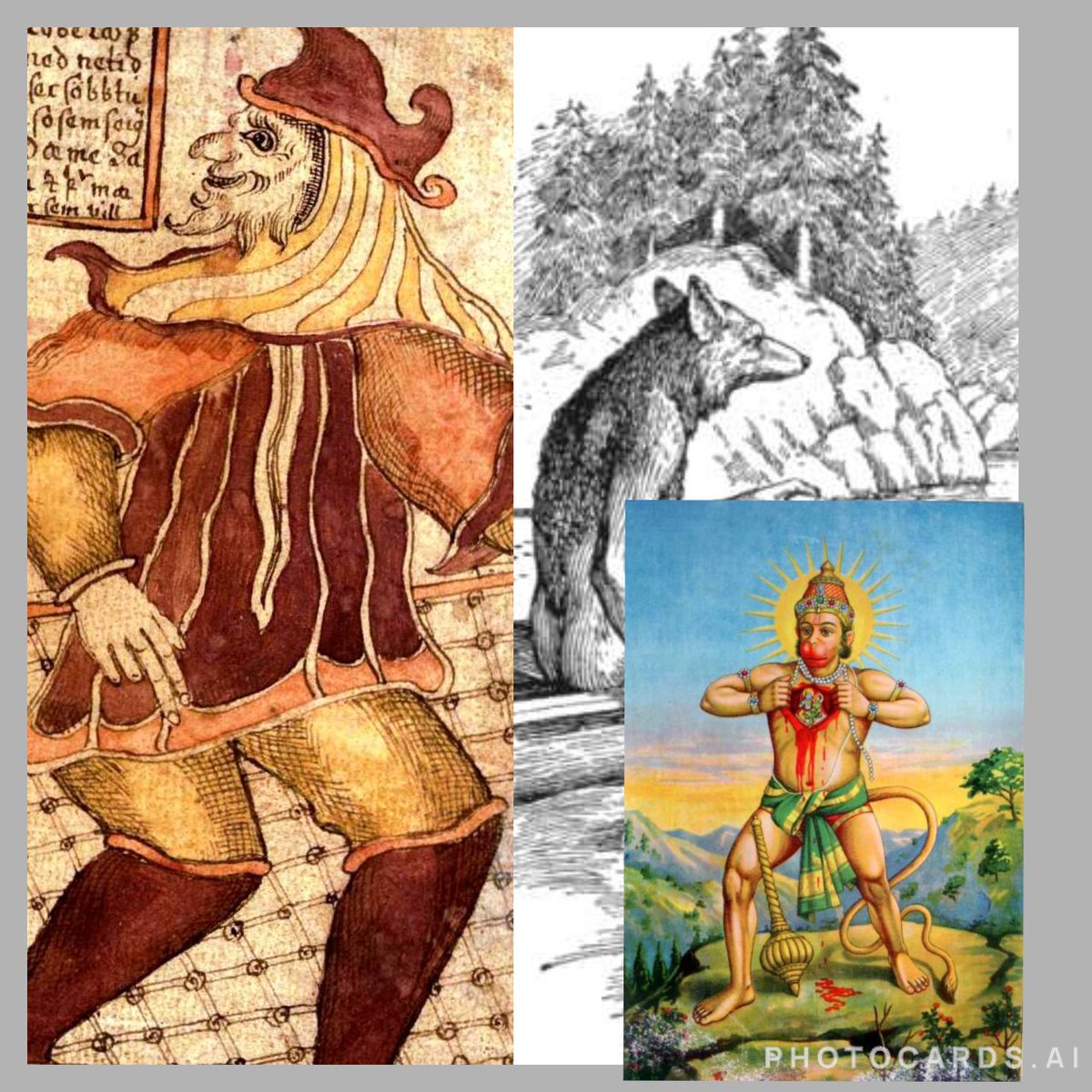
In mythology, the trickster mocks the serious, exposes the absurd, and keeps power from calcifying into dogma. Loki in Norse tales. Coyote in Native American lore. Hanuman in Indian epics.
In Bitcoin’s story, that role was played by Mitsubishi Goldstein.
By laughing at mining accidents, he educated people about their dangers.
By inventing a fake currency, LOLCOIN, he revealed the narrative power behind real ones.
By writing parodies, he accidentally wrote prophecy.
The community didn’t ask for him. But in the summer of 2011, he was exactly who they needed.
Ghosts often arrive when a story is most fragile. In 2011, Bitcoin’s ghost went by the name Mitsubishi Goldstein.
👉 Next: Chapter 2: The Birth of a Trickster where we dive into MG’s first forum posts, his strange pseudonym, and why he chose satire instead of code.
🧵 1/18
“The Lost Story of Bitcoin’s First Memecoin: LOLCOIN (2011) ”
Every revolution has its architects.
For Bitcoin, the name etched in stone is Satoshi Nakamoto the mysterious coder who birthed digital money.
But revolutions also have ghosts. Tricksters. Cultural architects who shape the movement not with code, but with story.
And Bitcoin had one of its own.
His name was Mitsubishi Goldstein.
Or sometimes Laced With Kerosene.
Or maybe Ogashi Tukafoto.
He wasn’t a miner, nor a cryptographer. He didn’t write the whitepaper or build a client. What he did was stranger: he made Bitcoin funny.
In the fragile summer of 2011, when the price whipsawed between $1.77 and $10 and the creator himself had vanished, Goldstein kept the flame alive through parody, prophecy, and memes. He ran satirical sites like https://t.co/6Zh87dxTTJ, launched the world’s first parody coin (LOLCOIN), and even left behind a frozen 3,100 BTC wallet worth hundreds of millions today.
His last public writings came in just 18 posts, ending August 18, 2011.
Then he disappeared like Satoshi.
And yet, his work echoes everywhere:
A “scrapbook” that foresaw hacks, exchange collapses, and meme wars.
Cashback ideas that predated Lolli and Fold by a decade.
Satirical articles later cited in law journals, IMF studies, and JSTOR archives.
A Twitter account that hit 100 followers in 2011 and only passed 100 again in 2025.
Most people have forgotten him.
But if Satoshi was Bitcoin’s architect, Goldstein was its comedian-prophet.
This thread is the first attempt to piece together his story tracing forum posts, satire, academic citations, and whispers from OG whales.
Along the way, we’ll confront the haunting question:
👉 Was MG simply Bitcoin’s first meme-maker?
👉 Or was he Satoshi himself, mocking us from behind a mask?
In July 2011, Bitcoin crossed 5,000 Reddit subs. The price had just crashed from $32 → $0.01$
👉 Into that chaos walked Mitsubishi Goldstein… 👇