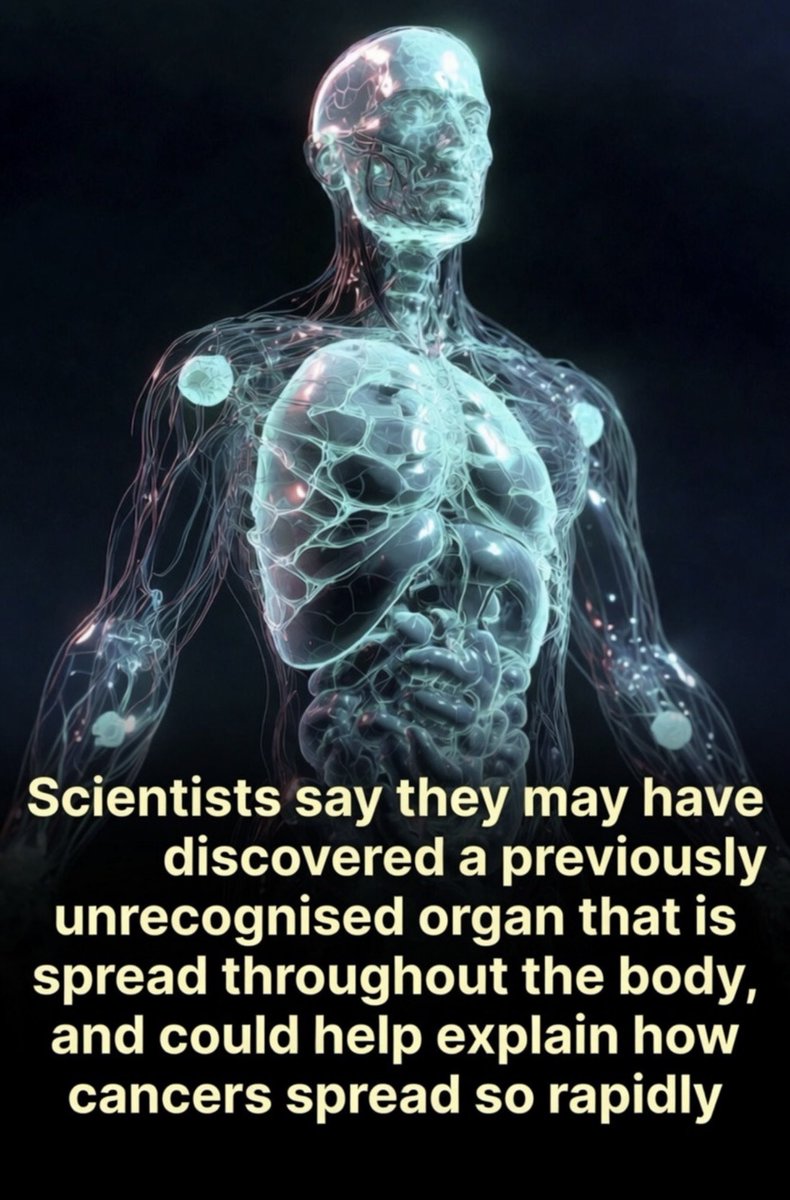
Scientists may have discovered a hidden network inside the human body that had gone unnoticed for decades.
In 2018, researchers described a widespread system of fluid filled spaces found throughout the body and suggested it could qualify as a newly recognized organ called the interstitium.
The structure is located beneath the skin, surrounding muscles, lining organs such as the lungs and digestive tract, and wrapping around blood vessels and the urinary system. For years, these layers were thought to be made mostly of dense connective tissue.
But when scientists examined living tissue using a laser imaging method known as probe based confocal laser endomicroscopy, they found something unexpected.
Instead of tightly packed solid tissue, they observed interconnected pockets filled with fluid and supported by a flexible network of collagen and connective fibers.
Researchers believe the structure had been missed for so long because of the way tissue samples are traditionally prepared for microscopes. Standard preparation methods involve chemically fixing tissue before examination, a process that drains the fluid and causes the spaces to collapse, making them appear solid.
In living tissue, however, the channels remain open and connected.
Scientists think the interstitium may help move fluid through the body and could influence inflammation, tissue aging, and even the spread of cancer.
Some researchers suspect these fluid pathways may help explain how certain cancers spread so quickly. Once cancer cells enter the network, the channels may allow them to travel into the lymphatic system and reach other parts of the body more easily.
The structure may also play a role in wrinkles and the stiffening of tissue that occurs with age.
Not all scientists agree that the interstitium should officially be classified as its own organ, and debate continues within the scientific community. Even so, the discovery has changed how many researchers think about human anatomy.
Read the study:
“Structure and Distribution of an Unrecognized Interstitium in Human Tissues.” Scientific Reports.
@markman007 I’m good, thanks ☺️. Had to go to the clinic a few days ago, get stitched up, but life! And yes, surfing, yogeeing, writing, working, and enjoying winter in CR ;) where do you usually surf?
As you get older, you’ll realize that the $5,000 watch and the $100 watch tell the same time.
The expensive wallet holds the same amount of money as the inexpensive one.
A $2 million house and a $300 thousand house host the same loneliness.
A Ford will get you just as far a Mercedes.
True happiness is not found in materialistic things.
Stay humble and grounded.
The holes dug for us in the ground are all the same size.
6 months in Central America and no winter, YAY’d too fast I think… Oct.: got #Covid; Nov.: was #magic; Dec.: #neuropathic pain started; Jan.: was ok (other than not feeling my fingers and the #pain!); now Feb.: food poisoning, #gastro, and still can’t feel my fingers! 🤦🏻♀️
The welfare of the people in particular has always been the alibi of tyrants, and it provides the further advantage of giving the servants of tyranny a good conscience.
~ Albert Camus
One thing I can always count on is getting a bull shit shopping cart at the supermarket, replacing it for a different one and that one being a bull shit one, too.
6 months in Central America and no winter, YAY’d too fast I think… Oct.: got #Covid; Nov.: was #magic; Dec.: #neuropathic pain started; Jan.: was ok (other than not feeling my fingers and the #pain!); now Feb.: food poisoning, #gastro, and still can’t feel my fingers! 🤦🏻♀️
Still and even more true today: "Production and consumption have ceased to be means and become ends in themselves" (1958). Almost 20 years later, Fromm writes that modern society has become materialistic and prefers "having" to "being".
#EricFromm#tohaveortobe
In 1958, psychoanalyst and philosopher Eric Fromm was asked why he believed the United States of 1958 was the best society the world had ever seen. He explains why—and gives a warning for how the US could destroy itself. See if you agree with him on the fatal flaw of modern work
“Certainty is one of the biggest sources of emotional and physical unwellness," argues neuroscientist @rBeauLotto
Is awe the antidote we need to help us become more open, tolerant people? 🎧 Listen: https://t.co/Hxm3OF0Rxs #AspenIdeasToGo#AspenIdeasHealth