Is modern life making us happier—or pulling us further from God, family, and one another? Mike Thomas and Andrew Ewell of the Catholic Land Movement join Conor to discuss why so many Catholics are rediscovering a simpler, land-based way of life rooted in prayer, family, and meaningful work. Together they explore Catholic social teaching, distributism, technology and AI, the importance of subsidiarity and community, and how reconnecting with the created world can help restore a more human, virtuous, and deeply Catholic way of living.
https://t.co/7PLQTj5QFf
@ecclesianomics Exactly. Leo XIII's point is that a fair wage isn't the end goal, it's a way for a family to save and own property of their own. That's the goal!
There’s nothing wrong with a wage in itself but if it becomes the norm for sustenance for a human being’s entire life, this is disordered and wrong. This point is seen within Rerum Novarum by Pope Leo XIII when he mentions that a wage should be just and allow a man who has a family to save enough to eventually purchase his own productive property.
Great question. No, not everyone needs to farm and we don't have to scrap modern technology. The goal is for more families to own productive property again, whether that's a farm, a trade, or a small business, so the home becomes a place of work for the family. Agriculture is the foundation, but a healthy local economy also needs craftsmen, builders, and shops around it.
The modern industrial economy is built on wage labor where households are no longer productive in and of themselves. The father (and often the mother) are pulled out of the home to work for a wage, given by a corporate body that owns productive property and means of production. Children are raised by schools and screens. Grandparents are institutionalized. Every member of the household becomes a cog in a global supply chain.
But the traditional Catholic economy, the Distributist or household economy, is one where families:
1. Own land or tools of production
2. Produce some of what they consume
3. Educate their children in the home or nearby
4. Participate in neighborly exchange
5. Make spiritual, liturgical life central to the calendar
This points to economic reform, yes, but more importantly the restoration of man as a son of God from a practical standpoint in the social order, rooted in place, in love, in worship, and in work.
Three things we hear from Catholic families who want to get back to the land:
I don't know how.
I can't do it alone.
It sounds overwhelming.
So the Catholic Land Movement now has about 120 local chapters where families meet, pray, and learn those skills together.
The Catholic Land Movement helps Catholic families resettle onto productive land they own. Land that can feed a family, house it, and give it meaningful work.
Today, the movement has about 120 local chapters on five continents, where Catholic families meet, pray, share meals, and learn agrarian skills together.
Find your local chapter: https://t.co/DmlANmOyXY
Join the Central New York chapter of the Catholic Land Movement at Fiat Homestead on the Feast of Our Lady of Guadalupe, Saturday, December 12, from 12 to 3 PM. After a Mexican lunch, we will fence and support the Fahey family’s newly planted apple trees, and conclude with the rosary.
This is a free event, and the whole family is welcome. RSVP for the address at [email protected].
Our Lady of Guadalupe, pray for us!
The “Free Market” was once a localized tool. Its roots trace back to 18th-century England, where it was crafted not as a natural development, but as a technology, a tool to solve the problems of empire, supply, and trade. It was eventually exported and globalized, giving birth to today’s financialized, transnational system.
Economics should serve man, not enslave him. Man can treat the modern Market like a new religion, complete with oracles (artificial intelligence), shrines (stock markets), sacraments (debt and credit), and a vision of salvation through endless growth.
Catholic social teaching rejects both socialism and market totalism, insisting that economies must be rooted in virtue, custom, locality, and human scale. Rerum Novarum (1891) affirmed that property and production should be widely owned and stewarded, not hoarded by the few or centralized by the state.
Begin with 2–5 families in your parish or region who are serious about land, work, and rebuilding the Church through the renewal of their own hearts and minds in Christ. Form a CLM Chapter
Share meals, pray together, discuss Church teaching on economy, family, and subsidiarity.
Clarify your shared long-term vision: not simply to survive, but to rebuild the social order from the hearth outward.
The deepest historical change in agriculture was not simply that machines replaced horses, or that corporations became larger.
It was that the family gradually lost its position as the central productive unit of the food economy and became increasingly dependent on a specialized industrial system for both its livelihood and its basic necessities.
This is the historical foundation worth examining to develop an alternative based on productive households, independent farmers, local markets, and cooperative institutions.
The five major historical shifts
1. Land became increasingly consolidated and commercialized. The enclosure movement and commercial agricultural development helped change the relationship between households and productive land.
2. Production became mechanized and capital-intensive. Factory machinery, tractors, combines, and specialized equipment increased output but made farming more dependent on cash, credit, and industrial supply chains.
3. Agriculture became dependent on industrial inputs. Synthetic fertilizers, pesticides, commercial seeds, and other purchased inputs changed the biological and economic structure of farming.
4. Food production and distribution became concentrated. Railroads, elevators, processors, vertically integrated corporations, wholesalers, and retailers increasingly organized food markets at national and international scale.
5. The family farm became increasingly difficult to sustain as a self-supporting household economy. Productivity rose, but the economic advantages of scale, specialization, and capital investment placed pressure on smaller operations. Many farm households consequently came to rely on off-farm employment.
Phase II Catholic Land Movement Chapters are rebuilding. Join us.
A family farm does not have to recreate the 1200s. Farm equipment can be used without requiring every family to operate as a miniature industrial enterprise.
A cooperative can own machinery. A regional network can operate a processing facility. A parish or local association can organize food distribution. Families can specialize in different forms of production while remaining economically interdependent.
That is a very different model from expecting every farmer to purchase every machine, own every processing facility, and independently compete in a national commodity market.
This is part of a Catholic Land Movement Phase II Chapter. Catholic Association.
In 1891, Pope Leo XIII wrote that as many people as possible should become owners.
Fifty years later, Pope Pius XII went further. He said a family is only truly stable when it's rooted in land of its own.
Both popes had the same reason. A family that owns what it needs to live is free. It's free to raise its children the way it believes is right, free to provide for its own needs, and free to keep the fruit of its labor.
Leo XIII wrote this in the middle of the Industrial Revolution. Families were leaving their farms for factory wages, and the Church was worried about what that would do to them.
When Pope Leo XIV chose his name in 2025, he said it was because of Leo XIII and Rerum Novarum. He said we're living through a new industrial revolution, and the Church has to speak to it again.
Today most families don't own productive property. Nearly everything they eat and use is bought with a wage. And if the wage stops, the family has nothing to fall back on.
That's why so many Catholic families are coming back to the land.
The Catholic Land Movement started in Scotland in 1929 to help them do it. Today there are about 120 local chapters. Families meet to pray, share meals, and learn skills from people in the community who already know them.
If you'd like to get involved, find your local chapter here: https://t.co/DmlANmOyXY
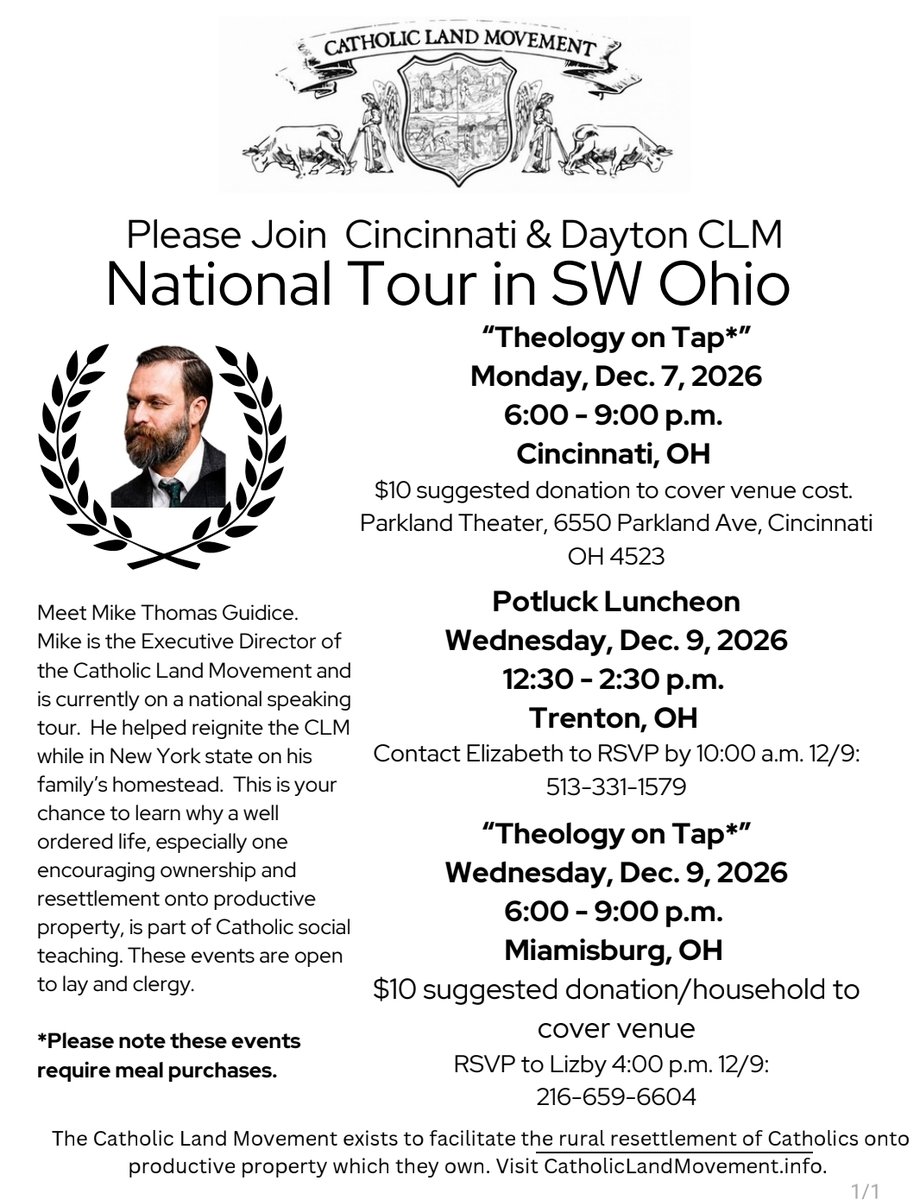
Join Cincinnati and Dayton CLM for three events in Southwest Ohio as part of our National Tour. Come learn why a well-ordered life, especially one built on ownership and resettlement onto productive property, is part of Catholic social teaching.
Theology on Tap, Cincinnati
Monday, December 7, 6:00 to 9:00 p.m.
Parkland Theater, 6550 Parkland Ave, Cincinnati, OH
$10 suggested donation to cover the venue. Meal purchase required.
Potluck Luncheon, Trenton
Wednesday, December 9, 12:30 to 2:30 p.m.
Trenton, OH
RSVP to Elizabeth by 10:00 a.m. on December 9: 513-331-1579
Theology on Tap, Miamisburg
Wednesday, December 9, 6:00 to 9:00 p.m.
Miamisburg, OH
$10 suggested donation per household to cover the venue. Meal purchase required.
RSVP to Lizby by 4:00 p.m. on December 9: 216-659-6604
Soap Making Workshop with Dayton CLM (Xenia, OH)
Join Dayton CLM for a hands-on soap making workshop with Kim Staggenborg. You’ll learn the craft and go home with a new bar of soap. Bring $15 to cover supplies.
Saturday, November 21, 1:00 to 4:00 p.m.
Xenia, OH
RSVP by noon on November 20 to Denise at [email protected] (or on Signal) to receive the address.
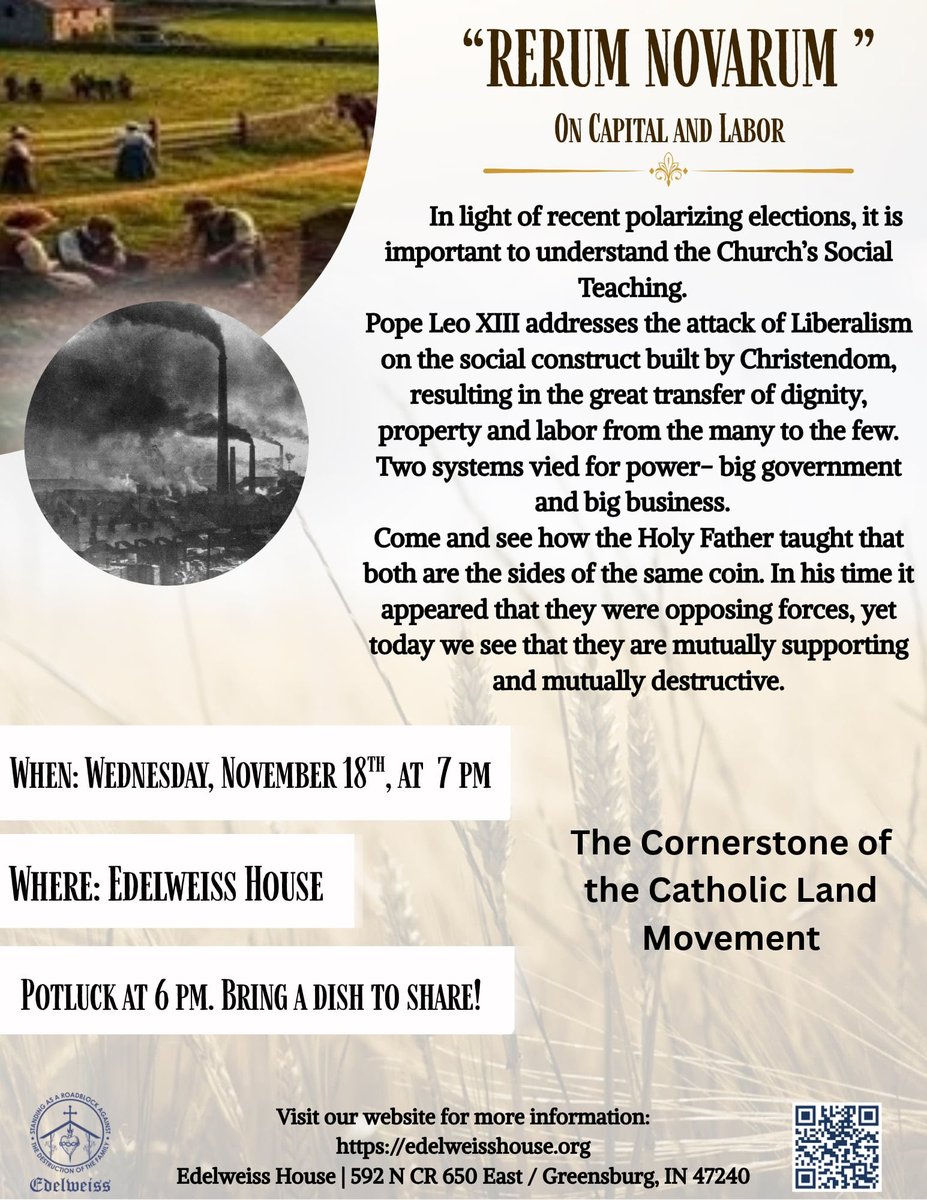
Rerum Novarum: On Capital and Labor (Greensburg, IN)
Join us at Edelweiss House for an evening on Pope Leo XIII’s Rerum Novarum, the cornerstone of the Catholic Land Movement. Come learn how the Holy Father addressed the transfer of property and labor from the many to the few, and why big government and big business are two sides of the same coin.
Wednesday, November 18
Potluck at 6 p.m. (bring a dish to share), talk at 7 p.m.
Edelweiss House, 592 N CR 650 East, Greensburg, IN 47240
More information: https://t.co/ibkVl2zmHz
CLM Italia: “Ritornare alle radici” (Jan 9)
CLM Italia invites you to “Ritornare alle radici” (Return to the Roots), a public talk on Gustave Thibon and the rediscovery of land, family, and Christian civilization.
Saturday, January 9, 2027, 4:00 PM
Sala MAB, ground floor
Via Vescovado 8, Fossano (CN), Italy
The evening opens with prayer, followed by a one-hour talk, fifteen minutes of questions, and a time of fellowship with refreshments.
RSVP to Cosima Gambaro at 334 609 9808 or [email protected]
Presented by don Francesco Giordano.
Join us for a presentation on Stewardship of Creation at St Mary's Church in Wooster Ohio. The talk is part of the parish's series on Care for God's Creation. Tim Cermak will share the Catholic Land Movement's mission, history, local presence, and future.