Looks like the weather is clearing up enough for us to have our Eucharistic procession from St. Vincent's down 5th Ave to St. Patrick's Cathedral. Let's goooooo
@Faithful_Cath The revision is just a new translation so the source text won't be different. The hymn is Te Sæculorum principem, you should be able to find it online. I realized afterward that the text I found was on a schismatic site that I don't want to link to. (It's accurate though.)
In the hymn for Vespers for Christ the King written in 1925, the last few verses are about the submission of all rulers and the whole secular realm to Christ. The 1970 reform removed these verses and changed a line in the final verse from Jesus "who rules the scepters of the world" to "who rules all things with love."
I was just singing the revised version in the LOTH and only found out about the cut parts when I looked up a translation. This is so outrageous. Whatever the "real" meaning of Dignitatis Humanae, this is what it was interpreted to mean in practice.
The removed verses -
6. May the rulers of the world publicly honour and extol Thee;
May teachers and judges reverence Thee;
May the laws express Thine order and the arts reflect Thy beauty.
7. May kings find renown in their submission and dedication to Thee.
Bring under Thy gentle rule our country and our homes.
The first half of verse 2, below, was also replaced with something more "positive":
The wicked mob screams out. "We don’t want Christ as king,"
While we, with shouts of joy, hail Thee as the world’s supreme King.
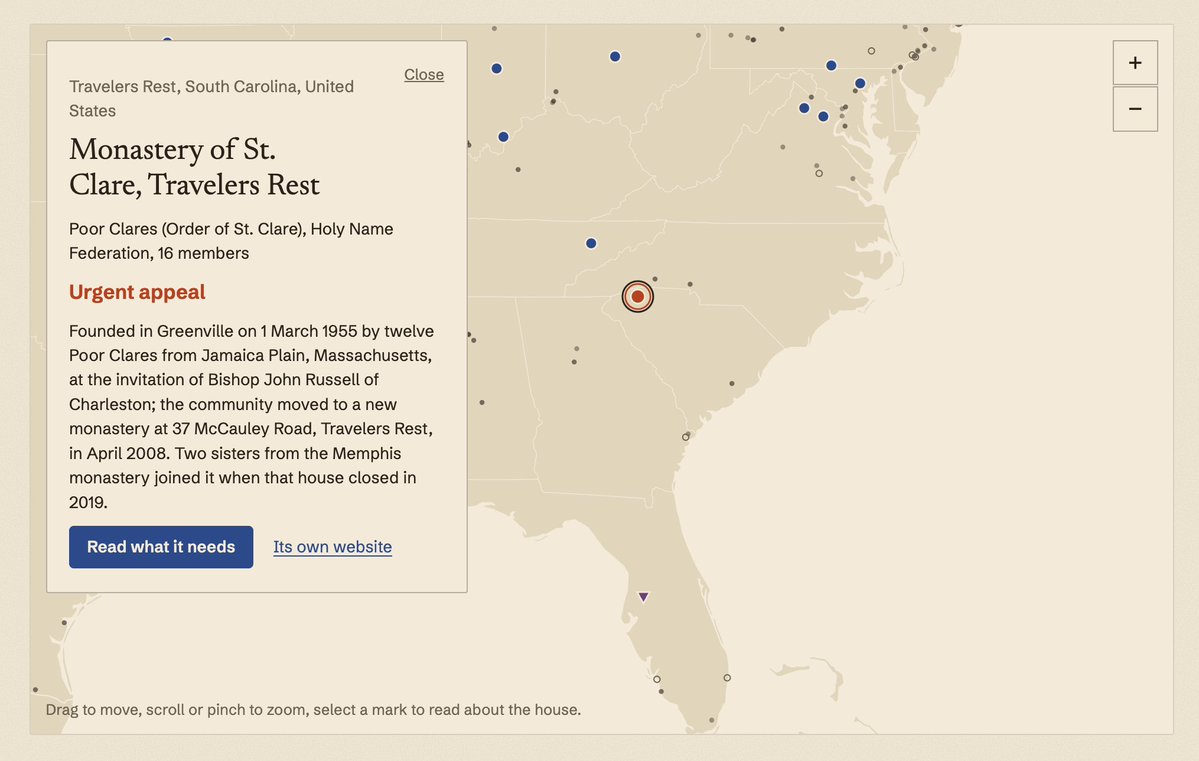
Incredible outcome. Patrick McKenzie saw the map I made of monasteries in need of financial support, and now a group of Franciscans can afford to fix their broken solar infrastructure. The internet is full of magic.
@FeelsGuy2003 The viability of it really depends on the specific form or genre in question. I don't know that there's anything about the variety talk show format that is incongruous with a Catholic version.
@FeelsGuy2003 Christians have always adapted secular forms and activities to Christian use. Like the medieval guild system. Dante and Milton. St. Ephrem the Syrian studied the hymns of heretics to learn the meters and then wrote his own lyrics with orthodox Catholic doctrine.
This week I had the privilege of meeting with two avid Catholic Culture readers from far-flung countries.
On Tuesday, I had dinner with a German man, Jan-Philipp Göetz, who has been reading Catholic Culture for more than twenty years. Jan-Philipp is a very energetic and innovative promoter of Catholic renewal and evangelization in Berlin. We had a fascinating conversation about what it’s like to be a faithful Catholic in a country whose Catholic church has such a strong reputation for infidelity.
On Thursday morning, I had a long video call with a young Catholic lawyer in Singapore who is one of our most generous donors. He too is actively involved in Catholic evangelization in a very different part of the world, one which is not historically Christian (although the Church in Singapore seems to have a lot going for it).
Both of these readers told me the same thing: that they have found Catholic Culture’s commentary and resources to be invaluable in forming their faith and their understanding of current events in the Church. Nothing like Catholic Culture, they said, exists in their countries.
Right now we are in the middle of our fall fundraising campaign. If you too appreciate our work and would like to help us strengthen the faith of Catholics around the world, please donate using the link below.
@thesanityrevolt I agree with you that working hard on something doesn't make it a good idea. I brought that up in the context of considering whether or not to trash someone's efforts publicly ( esp if there's nothing morally harmful or doctrinally erroneous about it) as so many on X are doing