AI accelerated software. But architecture reasoning, system-aligned specs, and governance didn’t scale with it.
Catio is the Architecture IDE:
a system for understanding, deciding, designing, executing, and governing modern software systems.
We just launched the new site:
https://t.co/j7DlsvjEd4
We just published a foundational whitepaper: The Architecture Control Plane, a CTO’s framework for the Architecture-Led AI SDLC.
Shipping code fast is no longer the hard part. Shipping the right code is.
Coding AI doesn’t know your system, your business objectives, or expert architecture reasoning. So what comes back is locally correct and globally wrong.
What if instead, you Architect, then Ship.
https://t.co/5zOn9Znj6v
AI made coding dramatically faster. But architecture reasoning didn’t scale with it.
So now teams can generate changes faster than they can reason over system impact, design the right specs, or keep architectures aligned over time.
Execution scaled. Architecture didn’t.
That’s the gap we’ve been obsessed with fixing at Catio: https://t.co/cdfxtqnFf8
Coding is no longer the bottleneck.
System-level reasoning is.
As AI accelerates development, the hard part now is:
•designing the right specs and architecture before shipping
•deciding what to modernize
•keeping systems aligned over time
That’s where things break.
Coding is no longer the bottleneck.
System-level reasoning is.
As AI accelerates development, the hard part now is:
•designing the right specs and architecture before shipping
•deciding what to modernize
•keeping systems aligned over time
That’s where things break.
Architecture guidance doesn’t scale if it lives in docs and fortnightly reviews.
In this clip from @aiDotEngineer Code Summit online, Toufic Boubez and @borisbogatin break down a better path: AI that understands your architecture, your constraints, and your standards → then bakes guidance directly into developer workflows.
This is how you shift from top-down review to real-time, context-aware decision support.
Watch the full video linked in thread below
The engineering world has embraced AI. It accelerates coding, documentation, and task automation. But architecture has been left behind.
Most AI tools reduce friction in isolated workflows, but architecture requires continuity. Context. Memory. Judgment. It's not a sequence of prompts but it’s a strategic function that sits between business ambition and technical execution.
https://t.co/8MwZwM0tEG
Most architecture diagrams lie.
They show VPCs. Services. Clean lines. But they obscure what actually runs. What shares physical zones, what fails together, and where resilience breaks down.
That’s why the team advocated for a Stacks' Physical-First Model. It anchors architecture in real-world infrastructure, not idealized configs.
🔍 See your cloud through physical zones and AZs
✅ Confirm high availability beyond intent
⚡ Uncover latency, security, and resilience blind spots
Built for teams who want architectural truth, not diagrams.
📖 New engineering post by @dipockdas
Architecture isn’t just about visibility, it’s about orchestration.
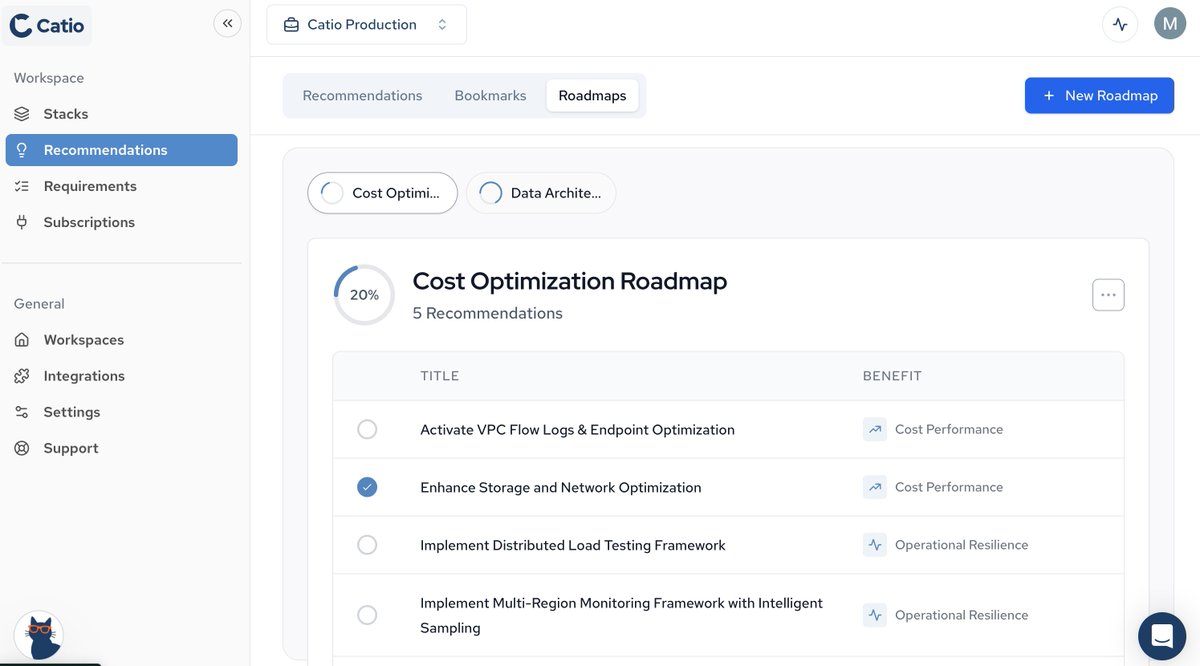
Catio Roadmaps now turn AI-driven recommendations into real, prioritized execution plans.
Drag, filter, align, and deliver.
Because strategy ≠ impact without a plan.
We’ve made everything else data-driven except the thing that determines your ability to scale: architecture.
Customer journeys, cost models, sales funnels? Optimized. Tech planning? Still a whiteboard.
Velocity isn’t about code. It’s about decisions. What you build, when, and how. Without architectural visibility, you’re flying blind.
🎥 Watch Catio CEO Boris Bogatin break down the Tech Paradox below
The next wave of AI products won’t just be smart, they’ll feel like teammates.
Designing the human element in AI isn’t optional anymore. It’s how trust is built, guardrails are enforced, and interactions evolve beyond chat boxes.
Our Head of Product Engineering, Dipock Das, just dropped a 3-part series on how to design with users in mind when building AI copilots and agents.
🔗 Read the series linked in thread →
Cloud architectures are graphs.
LLMs can’t reason over structure – but graphs can.
That’s why we built GraphQA, the open-source agent that powers our recommendation + chat modules at Catio. It makes asking your graphs questions as natural as asking a colleague. Powered by @langchain's LangGraph and @langfuse
Repo → https://t.co/AEMKpJesd8
In🧵is our blog post going into detail on how it works 💥
“Culture eats strategy for breakfast any day. That is such an underrated operating principle.” – Toufic Boubez, CTO, Catio
Catch the full interview on the Signal to Noise pod from @rivierapartners
https://t.co/5WHnG5yUaL
Most dashboards measure uptime. Few measure decision quality.
In 2025, tech leadership means knowing: Are we making the right bets? Can we prove it?
Read The Dual Brain of Modern Technology Leadership: A Decision-First KPI Playbook for 2025 in thread 🧵