Introducing Flue — The First Agent Harness Framework
Flue is a TypeScript framework for building the next generation of agents, designed around a built-in agent harness.
Flue is like Claude Code, but 100% headless and programmable. There's no baked in assumption like requiring a human operator to function. No TUI. No GUI. Just TypeScript.
But using Flue feels like using Claude Code. The agents you build act autonomously to solve problems and complete tasks. They require very little code to run. Most of the "logic" lives in Markdown: skills and context and AGENTS.md.
Flue is like Astro or Next.js for agents (not surprising, given my background 🙃). It's not another AI SDK. It's a proper runtime-agnostic framework. Write once, build, and deploy your agents anywhere (Node.js, Cloudflare, GitHub Actions, GitLab CI/CD, etc).
We originally built Flue to power AI workflows inside of the Astro GitHub repo. But then @_bgiori got his hands on it, and we realized that every agent needs a framework like Flue, not just us.
Check it out! It's early, but I'm curious to hear what people think. Are agents ready for their library -> framework moment?
Imagine every pixel on your screen, streamed live directly from a model. No HTML, no layout engine, no code. Just exactly what you want to see.
@eddiejiao_obj, @drewocarr and I built a prototype to see how this could actually work, and set out to make it real. We're calling it Flipbook. (1/5)
The wait is over. Cloudflare Email Service is now in public beta 📧
Send and receive emails directly from Workers or REST API with global delivery on Cloudflare's network
And just in time for you to build email agents with the Agents SDK!
Fucking around with CloudFlare (story continues).
I built an infinite dungeon on CloudFlare where each room is Workers AI generated once.
User goes room by room (generated) to fight demons/beasts, loot items and explore. Each room is global and unqiue, once items are gone they are gone.
Rooms compiled to JS, then loaded at runtime via Dynamic Workers into a per-user Durable Object facet.
AI picks the flavour. Trusted code enforces the rules.
Users have their own state (DO), and life + inventory. They can take inventory from a room, and keep it.
Super fun 😃
Everyone's building mega-swarm systems. I just realized: a folder with a CLAUDE.md is already an agent.
For @CoraComputer I have a source folder, a customer support folder, a bug investigation folder. Each is an agent. New discipline? New folder. No lock-in, no dependency.
Orchestration is just one layer that spawns across folders. Build brick by brick first.
Full article on Every →
@kellypeilinchan It looks really good, but I find that the choice of <esc> to exit tab / desk content doesnt work well, mostly colides with claude keybinding
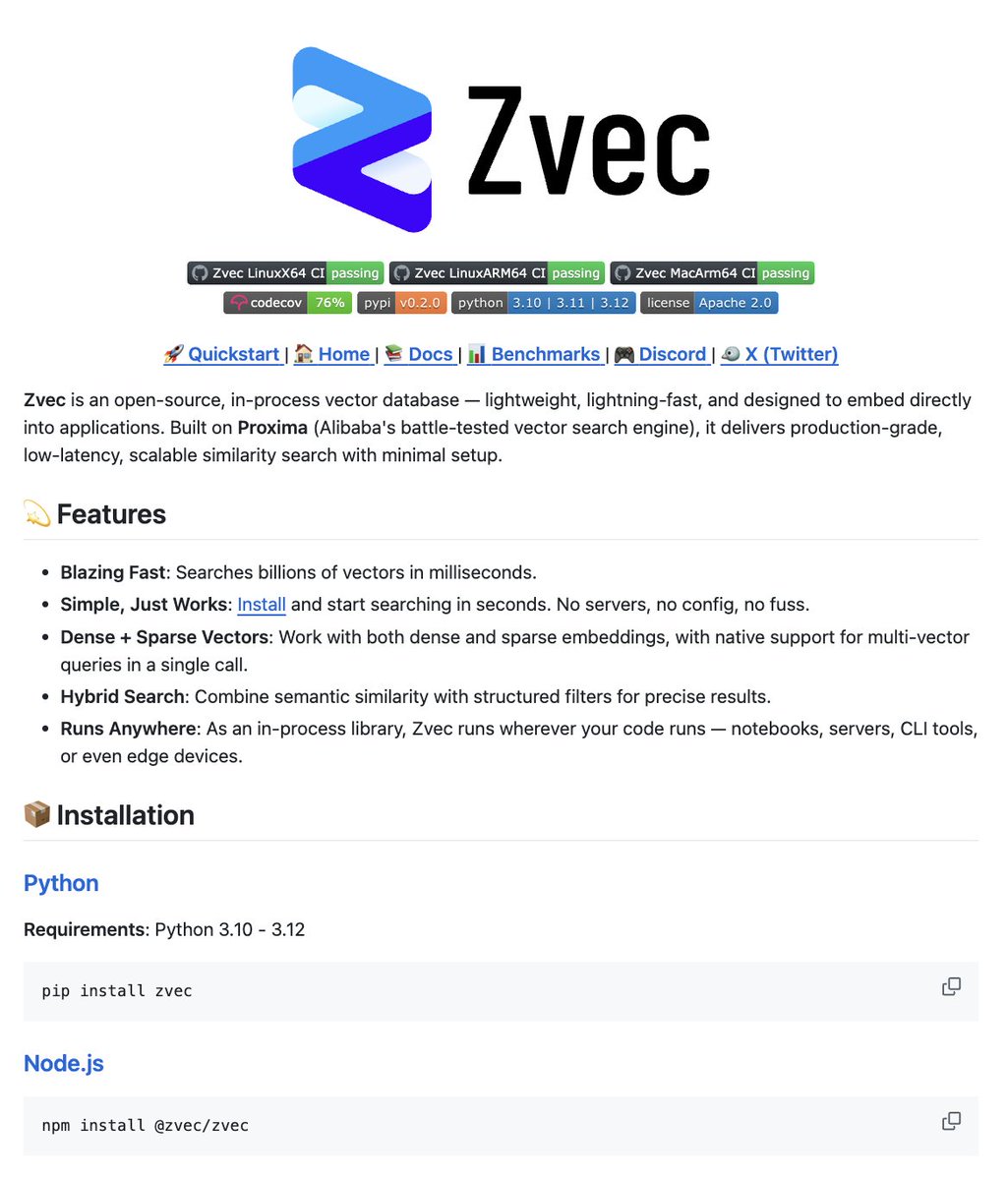
China's Alibaba just opensourced the SQLite of vector databases.
zvec runs as a library inside your app and is built for on-device RAG
no external server. no pinecone. no qdrant instance.
100% opensource.
Time to consider not just human visitors, but to treat agents as first-class citizens. Cloudflare’s network now supports real-time content conversion to Markdown at the source using content negotiation headers.
https://t.co/B7wYH4PtA8
I feel this way most weeks tbh. Sometimes I start approaching a problem manually, and have to remind myself “claude can probably do this”. Recently we were debugging a memory leak in Claude Code, and I started approaching it the old fashioned way: connecting a profiler, using the app, pausing the profiler, manually looking through heap allocations. My coworker was looking at the same issue, and just asked Claude to make a heap dump, then read the dump to look for retained objects that probably shouldn’t be there; Claude 1-shotted it and put up a PR. The same thing happens most weeks.
In a way, newer coworkers and even new grads that don’t make all sorts of assumptions about what the model can and can’t do — legacy memories formed when using old models — are able to use the model most effectively. It takes significant mental work to re-adjust to what the model can do every month or two, as models continue to become better and better at coding and engineering.
The last month was my first month as an engineer that I didn’t open an IDE at all. Opus 4.5 wrote around 200 PRs, every single line. Software engineering is radically changing, and the hardest part even for early adopters and practitioners like us is to continue to re-adjust our expectations. And this is *still* just the beginning.
An American goes to the ER for high blood pressure, stays under 24 hours, no surgery, no CT, no MRI, and gets a $41,000 bill. Lovely.
Now here’s the part people miss when this gets discussed economically: that $41,000 fully counts toward U.S. GDP.
Not because it’s useful, but because GDP counts priced transactions, not value or outcomes.
And it doesn’t stop there.
The system creates additional GDP layers around the same visit. Hospital administrative labor, insurance claim processing, billing departments, compliance and coding, insurer overhead and profit, financial services handling payments and debt, interest if the patient can’t pay immediately.
So one short ER visit inflates healthcare GDP, inflates services GDP, inflates finance GDP, inflates measured economic activity.
Even though nothing extra was medically produced.
This is why US GDP looks larger than countries with regulated or single payer healthcare. In Europe, the same visit might cost a few hundred euros, involve minimal billing, and generate far less economic activity on paper.
Same patient. Same outcome.
Wildly different GDP contribution.
I've never felt this much behind as a programmer. The profession is being dramatically refactored as the bits contributed by the programmer are increasingly sparse and between. I have a sense that I could be 10X more powerful if I just properly string together what has become available over the last ~year and a failure to claim the boost feels decidedly like skill issue. There's a new programmable layer of abstraction to master (in addition to the usual layers below) involving agents, subagents, their prompts, contexts, memory, modes, permissions, tools, plugins, skills, hooks, MCP, LSP, slash commands, workflows, IDE integrations, and a need to build an all-encompassing mental model for strengths and pitfalls of fundamentally stochastic, fallible, unintelligible and changing entities suddenly intermingled with what used to be good old fashioned engineering. Clearly some powerful alien tool was handed around except it comes with no manual and everyone has to figure out how to hold it and operate it, while the resulting magnitude 9 earthquake is rocking the profession. Roll up your sleeves to not fall behind.
Introducing state-of-the-art People Search:
You can now semantically search over 1 billion people using a hybrid retrieval system backed by finetuned Exa embeddings.
Try it: https://t.co/cQ6UlWHnKY
We also created an eval: https://t.co/2OIAryN7MT