Early career #Botanist. Interested in Plants Ecology, Ecological Processes and Dynamics Affecting Biodiversity and it's Conservation in an ever evolving world.
How do Indigenous communities value plant resources beyond market prices?
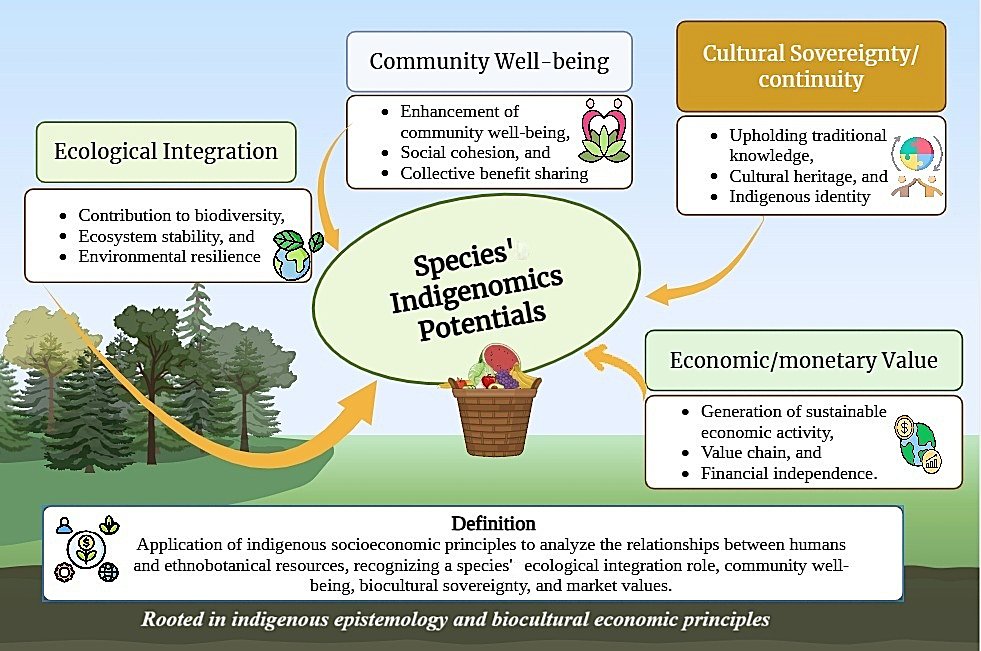
Our recent study presents the Indigenomics Framework, which integrates Indigenous knowledge, cultural values, and local economic perspectives to assess ethnobotanical resources.
Using palm species in Northwest Nigeria, the study revealed distinct Indigenous valuation patterns that can inform sustainable resource management and policy. The findings highlight the important role of IPLCs' knowledge in advancing inclusive sustainability solutions.
Four participatory indices (EIS, CWI, CSI, and MVS) were combined into the Indigenomics Index (II) and Indigenomics Value Rating (IVR) for comparative evaluation across value domains.
Let's work together to harness the power of indigenomics and create a more equitable future for tropical fruit biodiversity! Read the full paper here: [https://t.co/DH4vJO0SrZ]
Let's work together to harness the power of indigenomics and create a more equitable future for tropical fruit biodiversity! Read the full paper here: [https://t.co/DH4vJO1qhx]
This review explores how indigenomics can unlock the potential of underutilized species, promoting biocultural sovereignty and socio-economic empowerment. By centering indigenous economic practices and IK, we can shift towards more inclusive and sustainable value chains.
Key highlights:
- Introduces indigenomics as a novel framework for analyzing human-plant relationships
- Examines traditional entrepreneurship models for agrobiodiversity
- Highlights the potential for indigenomics to strengthen local value chains and improve livelihoods.
This review explores how indigenomics can unlock the potential of underutilized species, promoting biocultural sovereignty and socio-economic empowerment. By centering indigenous economic practices and IK, we can shift towards more inclusive and sustainable value chains.
This review explores how indigenomics can unlock the potential of underutilized species, promoting biocultural sovereignty and socio-economic empowerment. By centering indigenous economic practices and IK, we can shift towards more inclusive and sustainable value chains.
New publication alert!
Our latest publication, "Indigenomics Prospects of Underutilized Tropical Fruits Agrobiodiversity: A Scoping Review of Economic Botany," is out now in Agrobiodivers Improv Nutr Health Life Qual, 9, 2025(2): 330–342.
#Indigenomics#Agrobio#Sustainability
New publication alert!
Our latest publication, "Indigenomics Prospects of Underutilized Tropical Fruits Agrobiodiversity: A Scoping Review of Economic Botany," is out now in Agrobiodivers Improv Nutr Health Life Qual, 9, 2025(2): 330–342.
#Indigenomics#Agrobio#Sustainability
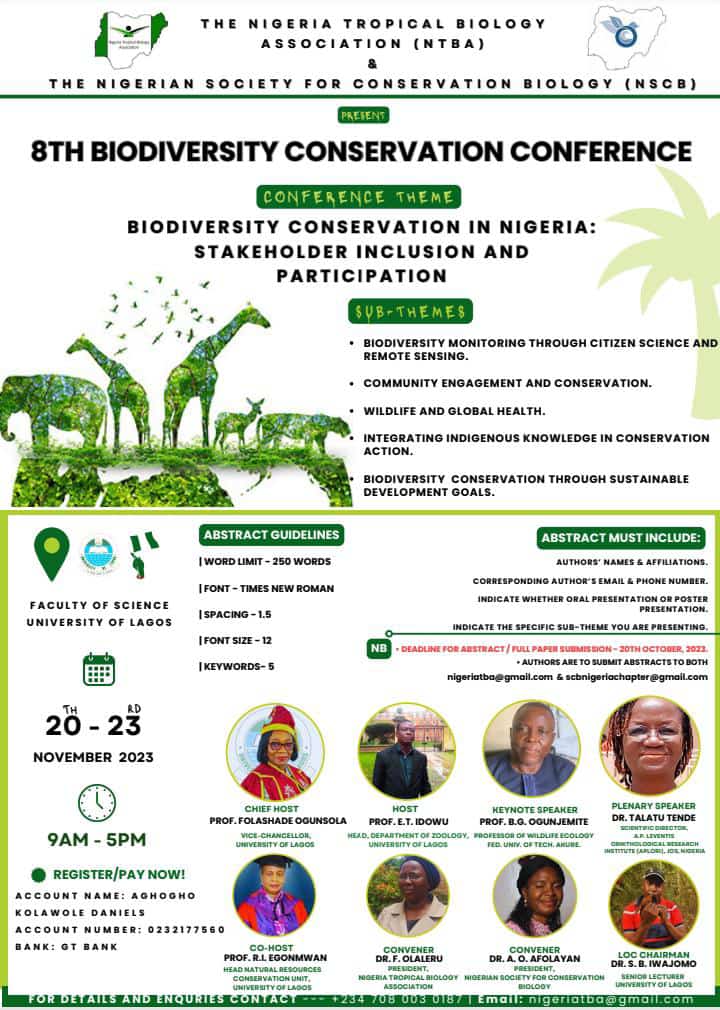
8th Biodiversity Conservation Conference of Nigeria Chapter of Society for Conservation Biology (NSCB) is happening again, but this time in collaboration with Nigeria Tropical Biology Association (NTBA).
Kindly mark the date & plan to attend
On: 20-23 Nov. 2023
See details below:
The Federal Republic of Nigeria, Africa's most populous nation, has rejoined GBIF as Voting Participant, reaffirming its commitments to open data on biodiversity while becoming the 65th country member of the #GBIF network: https://t.co/NyZuodJN6z
🇳🇬 🥳 🎉 @FMEnvng@FRINOFFICIAL
We've created a collection of trees and woodland resources for the 2023 Trees for Climate Change, Biodiversity and People symposium. 🌲🌳🌴
Read content from AER, ESE and other BES journals here: https://t.co/U8zeSQCxta
#Trees4CBP
The current study explored the phyto-remediation potentials of some autochthonous plants growing on the contaminated soil of Zamfara State's Bagega Gold Mining Area, Nigeria.
I am delighted to share the findings of the study.
@Acta Ecologica
@R_CamaraLeret https://t.co/DV2pqBCCRL
🌱🧬 A new #AJB Review! 🧬🌱
Environmental DNA as an emerging tool in botanical research (by Mark Johnson, Joanna Freeland, Laura Parducci, Darren Evans, Rachel Meyer, Brenda Molano-Flores, Mark Davis)
https://t.co/6T10BHupBW #botany#genetics#eDNA @wileyplantsci
Who will name new plant species? Here we show that most recently described species are endemic species, and they are often described by resident taxonomists. We need to support local taxonomists in biodiverse developing countries. https://t.co/gUMpVqwj2i