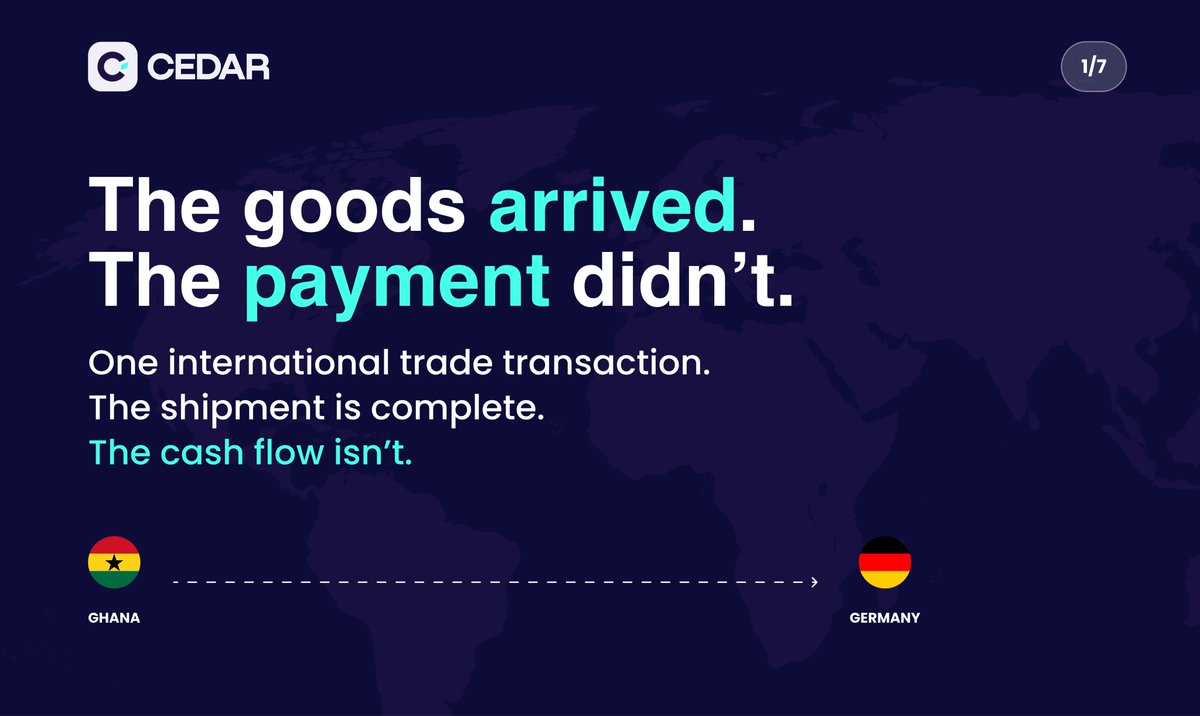
Cross-border payments are the worst-kept secret in global trade. At this point, we all know it’s slow, expensive, and still running on infrastructure built for a pre-digital era. So, why is it still a problem in 2026?
A manufacturer in Ghana ships textiles to a buyer in Germany. The goods arrive in days. However, payment for those goods might take two to three weeks, passing through three or more intermediary banks, each one adding fees, compliance checks, and uncertainty about when (or whether) the funds will arrive.
Think about what that means operationally. A supplier who hasn't been paid can't restock. An exporter waiting on settlement can't commit to the next order. A CFO staring at unclear transaction timelines is making capital allocation decisions in the dark.
We've spent enormous energy as an industry optimising the physical movement of goods: better logistics, smarter warehousing, more resilient supply chains. The financial layer beneath all of that has largely been left behind.
This isn't a technology gap. The technology exists. It's a structural gap; the legacy of correspondent banking networks, fragmented regulatory standards, and siloed liquidity that was never designed for the speed and complexity of modern global trade.
Our Q1 2026 white-paper looks at this gap directly. Not just what's broken, but why it matters more than ever in a world where trade corridors are diversifying, regulatory scrutiny is increasing, and the cost of slow money is compounding.
If you're in trade, exports, fintech, or cross-border finance, this one's for you. Link in the comments below.
Stablecoins are increasingly becoming part of the infrastructure powering global commerce.
Flagship Advisory Partners surveyed merchants across the U.S., Europe, and Latin America to better understand where stablecoin acceptance stands today and mapped the companies supporting the broader payments ecosystem.
We're pleased to see Cedar included in the Stablecoin Payments Market Landscape. For us, the most interesting takeaway isn't the inclusion itself, it's what it signals.
The conversation around stablecoins is continuing to shift from speculation to utility. Businesses are increasingly evaluating stablecoins as practical infrastructure for cross-border payments, treasury operations, liquidity management, and global settlement. As adoption grows, the focus is moving toward the infrastructure that enables money to move more efficiently across markets.
We're excited to be contributing to that future and helping businesses move money globally with greater speed, transparency, and flexibility.
Explore the research - Stablecoin Payments Market Landscape:
https://t.co/fHedBgudZR
#Stablecoins #CrossBorderPayments #Fintech #GlobalPayments #Treasury #DigitalAssets #B2BPayments #EmergingMarkets #GlobalTrade
Looking forward to moderating a panel at the @LunoGlobal Institutional Digital Asset Conference tomorrow in #CapeTown on the rise of #stablecoins & #Treasury 2.0, with Benjy Feinberg (@cedar_money), Nkahiseng Ralepeli (Block Tower) and Dan Kleinbaum (Luno).
#LIDAC2026#LIDAC
“A major shift is that compliance has shifted from being a back office function to a core competitive advantage that directly dictates access to global liquidity and entry speed into new trade corridors. Compliance data is the "passport" for global trade. Having it in order pre-approves an organisation for expansion.”
- Titilayo Ogunleye, Busha
"The quickest shift i've noticed in 2026 is that the regulatory conversation in Africa has shifted considerably. Rather than approaching digital assets with blanket scepticism, regulators are now engaging infrastructure providers in Kenya, South Africa, etc, to co-develop frameworks.
- Somtochukwu Nnajim , Yellow Card
"A major change in Nigerian cross-border trade is a heightened focus on compliance, not just within the compliance department but across the overall business."
- Dayo Fagade , Cedar Money
Missed our webinar on the key cross-border trade shifts in Q1 2026, from regulatory developments to corridor and payment infrastructure changes reshaping global trade?
Read more insights from the session on our blog:https://t.co/Rj2uPPeeyl
Cedar Money is now registered under the Retail Payment Activities Act (RPAA) with the Bank of Canada, marking an important step in strengthening our regulatory foundation as we scale globally.
We are also registered with FINTRAC as a Money Services Business (MSB), reinforcing our commitment to operating within established regulatory frameworks and maintaining high standards of compliance, transparency, and operational resilience.
For our customers, this provides added confidence in a platform designed to support secure and reliable cross-border transactions, particularly across emerging and global markets.
As we continue to expand, we remain focused on building financial infrastructure that meets the evolving needs of global businesses.
More on what’s ahead: https://t.co/spnCaCCOu2
@TechCabal@ntbts_news@TechCrunch
WE ARE LIVE! 🎉
If you operate across borders, this is a timely conversation on what’s changing across regulation, trade corridors, and payment infrastructure, and what it means in practice.
We’ll be discussing:
• The impact of evolving regulations on global trade
• The rise of new corridors like Africa–UAE
• Why cross-border payments remain fragmented
• Managing FX risk and liquidity
Join here: https://t.co/GexfKK4uVQ
If this is relevant to your work, feel free to join and share with others who should be part of the conversation.
If you operate across borders, the environment is becoming harder to navigate.
Regulations are evolving, new trade corridors are emerging, and payment systems are still not keeping pace; creating real challenges around liquidity, FX, and settlement.
Tomorrow, we’re bringing together industry leaders to break this down:
Topic: Key Cross-Border Trade Shifts in Q1 2026: The Regulatory, Corridor, and Payment Infrastructure Shifts Reshaping Global Trade
Date: Tomorrow, 28th April, 2026
Time: 1:00–2:00 PM WAT | 2:00–3:00 PM CAT | 8:00–9:00 AM EST
We will be joined by:
1. Temitayo Jaiyeola, Senior Reporter, TechCabal
2. Dayo Fagade, Director of Sales, Cedar Money
3. Somtochukwu Nnajim, Country Manager (Nigeria), Yellow Card
4. Titilayo Ogunleye, Head of Legal and Compliance, Busha
In this session, we’ll cover:
• The impact of evolving regulations on global trade
• The rise of Africa–UAE and alternative corridors
• Why cross-border payments remain fragmented
• The role of stablecoins and digital settlement rails
• How businesses are managing FX and liquidity today
If you’re an importer, exporter, CFO, treasury lead, or operate across borders, this will be a practical session focused on what’s changing—and what to do about it.
Register to attend: https://t.co/G0BosEZsY2
#Globaltrade #Cedarmoney #Crossborderpayments #Africa #Emergingmarkets #B2B #Importers #Exporters #IMAN #SMEs #Liquidity #Securepayments #Compliant #Tradecorridors #Regulations #Tradepolicy #Crossborderpaymentinfrastructure #Stablecoinsettlementinfrastructure #FXliquidityincrossbordertrade #FintechinfrastructureinAfrica #digitalpaymentrailsforglobaltrade #regulatorychanges #eupolicies
Cross-border trade is entering a different phase.
What used to be a coordinated global system is now evolving into a more fragmented and corridor-driven system. Regulations are tightening, new trade routes are emerging, and yet the infrastructure that moves money is struggling to keep pace.
At Cedar Money, we’ve been closely tracking these shifts. Our latest white paper brings together the most important developments from Q1 2026 and, more importantly, what they mean in practice for operators navigating global trade today.
Download the white paper: https://t.co/YBS1LQAgTs
Inside, we break down:
1. The impact of evolving regulations on global trade flows
2. The rise of new corridors like Africa–UAE
3. Why cross-border payments remain fragmented
4. How stable coins and digital rails are changing settlement
5. What businesses should do to stay competitive
This report is built for importers, exporters, global enterprises, CFOs, treasury teams, fintech operators, global trade leaders and investors who need deeper insights.
If you operate across borders, this is worth your time.
Feel free to share with your network, especially those navigating cross-border payments, trade, or global expansion.
#Globaltrade #Cedarmoney #Crossborderpayments #Africa #Emergingmarkets #B2B #Importers #Exporters #IMAN #SMEs #Liquidity #Securepayments #Compliant #Tradecorridors #Regulations #Tradepolicy #Crossborderpaymentinfrastructure #Stablecoinsettlementinfrastructure #FXliquidityincrossbordertrade #FintechinfrastructureinAfrica #digitalpaymentrailsforglobaltrade
Cross-border trade is shifting, and the implications go beyond supply chains.
Regulations are tightening, new trade corridors are emerging, and yet payment infrastructure is still catching up. For businesses operating across borders, this creates real challenges around liquidity, FX, and settlement.
To unpack these changes, we’re hosting a live session:
Topic: Key Cross-Border Trade Shifts in Q1 2026: The Regulatory, Corridor, and Payment Infrastructure Shifts Reshaping Global Trade
Date: Tuesday, April 28, 2026
Time: 1:00–2:00 PM WAT | 2:00–3:00 PM CAT | 8:00–9:00 AM EST
Venue: Hosted on Google Meet | Registration on LinkedIn (Compulsory)
We will be joined by:
1. Temitayo Jaiyeola, Senior Reporter, @TechCabal
2. Dayo Fagade, Director of Sales, @cedar_money
3. Somtochukwu Nnajim, Country Manager (Nigeria), @yellowcard_app
4. Titilayo Ogunleye, Head of Legal and Compliance, @getBusha
In this session, we will cover:
• The impact of evolving regulations on global trade
• The rise of Africa–UAE and alternative corridors
• Why cross-border payments remain fragmented
• The role of stable coins and digital settlement rails
• How businesses are managing FX and liquidity today
If you operate across borders; whether in finance, trade, or payments, this will be a practical conversation worth joining.
Register now to secure your spot - https://t.co/Zmum8YfURV
#Globaltrade #Cedarmoney #Crossborderpayments #Africa #Emergingmarkets #B2B #Importers #Exporters #IMAN #SMEs #Liquidity #Securepayments #Compliant #Tradecorridors #Regulations #Tradepolicy #Crossborderpaymentinfrastructure #Stablecoinsettlementinfrastructure #FXliquidityincrossbordertrade #FintechinfrastructureinAfrica #digitalpaymentrailsforglobaltrade #regulatorychanges #eupolicies
If your next experience with Cedar feels smoother, faster, and more intuitive, that’s intentional.
We’ve taken a deliberate, end-to-end approach to refining the platform, with a focus on reducing operational friction and aligning the experience with how modern businesses manage cross-border payments at scale.
Key enhancements include:
1. A more structured interface with clearer navigation and a distinct separation between account and business settings to support better control and governance.
2. A streamlined payments flow with fewer steps, improved visibility, and more predictable execution.
3. Simplified USD funding and the ability to initiate payments directly from available balances.
4. Embedded FX tooling, including rate alerts, to support more informed timing and decision-making.
5. More consistent, context-aware guidance across the platform to minimise errors and improve workflow reliability.
These improvements reinforce our mission to reduce complexity in global trade, particularly across emerging markets, where efficiency, visibility, and reliability matter most.
Log in and experience the new Cedar: https://t.co/Li4IfLKpHi
In the latest edition of the Cedar Digest, we unpacked a number of developments worth paying close attention to, and what they may signal for businesses operating across borders:
1. Ghana’s Smart Port Note (SPN) system, which went live on February 1
2. Nigeria’s exploration of a potential Africa–Caribbean trade corridor
3. China’s announcement to remove tariffs on imports from 53 African countries starting in 2026
4. The Central Bank of Nigeria’s decision to cut the Monetary Policy Rate by 50 basis points
Individually, these developments may appear unrelated. Taken together, however, they reflect a broader reality: the cross-border landscape is evolving rapidly. Policy decisions, logistics reforms, and shifting global trade relationships are continuously redefining how businesses move goods, manage payments, and navigate international markets.
That is precisely why we created The Cedar Digest; to keep operators, exporters, and global businesses informed about the global developments that matter, what they actually mean for businesses moving money and goods across borders, and which signals warrant immediate action versus those simply worth monitoring.
Don’t miss critical updates shaping cross-border trade.
Subscribe to The Cedar Digest at https://t.co/Ochlowr7Ai to stay informed and alert to emerging policies.
The fastest way to lose $5,000 on a transaction? Focus only on the spot rate. Most CFOs do because it’s visible and easy to track.
But the real risk in cross-border payments isn’t the rate you see, It’s the exposure window; the time between initiating payment and when funds are usable. That’s where margin leaks.
Example:
Business A sends $100,000, however the currency moves 5% before settlement clears. That’s $5,000 gone. Not from a bad rate, but from being exposed too long.
So the strategy isn’t just “get a better rate.” It’s control the timing.
1. Shorten settlement time
2. Buy FX when it hits your target
3. Hold funds until you need to deploy
4. Convert only what must be paid immediately
If you’re moving serious volume across borders, the better question isn’t “What’s today’s rate?”, It’s “How much exposure am I carrying?”
If you’re curious what buy–hold–pay looks like in practice: visit https://t.co/tn857Y0Kye
For decades, global payments followed one rule: everything had to pass through USD or EUR correspondent banking chains. That model no longer fits how businesses actually operate in Africa.
Across Africa and other emerging markets, importers increasingly prefer to settle locally, and for practical reasons:
1. Local clearing is often faster than correspondent banking
2. Fewer intermediaries mean lower fees and clearer timelines
3. Suppliers can plan cash flow without FX uncertainty
4. National payment rails are far stronger today than they were even 10 years ago
For merchant importers, this isn’t theoretical. It affects inventory timelines.
1. Supplier trust.
2. Port storage fees.
3. Working capital cycles.
In practice, paying suppliers shouldn’t require navigating foreign banking workflows just to move everyday trade money.
At Cedar, we’re seeing this shift firsthand.
Our infrastructure lets businesses fund in one currency and pay partners locally across markets using stable-coins without forcing every transaction through slow pathways.
The result: Faster settlement, transparent FX, and payments that feel local even when trade is global.
The future is about making global trade feel operationally simple, reliable, and aligned with how African importers already work.
Are you an importer ready to simplify your cross-border payments?
Visit https://t.co/KqaIAp26QJ to start paying your suppliers faster, and with transparent FX.
As we step into the new year, our focus remains clear: building reliable, borderless payments infrastructure that enables businesses to move money with confidence across markets.
The past year reinforced an important truth; growth in Africa and beyond depends on financial systems that are resilient, transparent, and purpose-built for the realities of cross-border trade. At Cedar Money, we’re focused on reducing the frictions that slow businesses down, across payments, FX management, and embedded risk and compliance.
We’re grateful to the partners, customers, and teams who continue to build with us. The year ahead is about scale and execution, as we strengthen the infrastructure that helps businesses grow, trade with confidence, and operate globally.
Happy New Year,
from all of us at Cedar Money.
#HappyNewYear #CedarMoney #GlobalPayments #CrossborderPayments #GlobalTrade #Stablecoins #B2B #BusinessPayments
As the year comes to an end, we’re thankful for the partnerships, thoughtful conversations, and trust that contributed to our growth this year.
Thank you to our clients, partners, and community for building across borders with us - one transaction, one relationship, one market at a time.
Wishing you a restful holiday season and continued progress in the year ahead.
Happy Holidays from all of us at Cedar Money.
#CedarMoney #HappyHolidays #CrossBorderPayments #BuildingAcrossBorders #GlobalTrade #MerryChristmas
We’re pleased to share that our Founder & CEO, Benjy Feinberg will be participating as a delegate speaker at the upcoming African Trade Exhibition (ATE) Business Webinar, taking place Today, 27th November 2025, from 2:00 PM – 3:30 PM WAT (3:00 PM – 4:30 PM CAT).
This year’s theme, “Accelerating Trade in Africa: Leveraging Technology,” aligns strongly with our mission at Cedar Money, empowering African businesses with faster, more secure, and more transparent cross-border payment solutions.
At Cedar Money, we believe technology is the bridge to a more connected Africa. Whether it’s simplifying USD collections, improving international settlements, or enabling importers, exporters and SMEs to grow without borders, we’re committed to transforming how businesses move money globally.
We look forward to contributing to this important conversation alongside leaders driving Africa’s digital and trade innovation.