Alright, so where exactly is the TradFi market different from Crypto?
Maybe it's all just the same game...
And we know it has no value but pretend that it has... which makes it accrue value until we get reminded that the value is non-existent °°
First CME “glitches” when Silver was about to break out.
Later #Gold prints a $40 liquidation wick twice and instantly recovers both times.
That’s not real selling.
That’s market plumbing under maximum stress.
How to build an AI-powered trading system:
1. Download free crypto data from Binance (make sure you don't account for survivorship bias)
2. Throw it into a LSTM because it can learn patterns
3. Train on 2020-2023, the longer the bull run the better your model
4. Use 2025 Jan to Apr as your validation set (13 sharpe)
5. Deploy on 20x leverage, your AI is basically sentient
6. Update LinkedIn to "Quantitative AI Researcher"
When you get liquidated, blame Wintermute for hunting your stops, even better, tag @EvgenyGaevoy directly.
Don't worry, it has nothing to do with the fact that your model learned "number go up during the longest bull run in crypto history" and you gave it 50 features that are all variations of lagged price.
Your 0.98 in-sample R² meant it was definitely predicting the future. HRT and OpenAI is fighting over you.
Wonderfully encapsulates my view and experience on everything in regards to learning.
That is also how I went from low skill level in games to high skill level - by intentionally practicing the basics for months on end.
https://t.co/ColmRnyY6u
Reminds me of a study of a teacher that rated 2 parts of an essay.
When he read the first part and it was good + then read the second part but it was bad he tended to give the benefit of the doubt and rate more favorable.
While if the order was inverse he rated harsher.
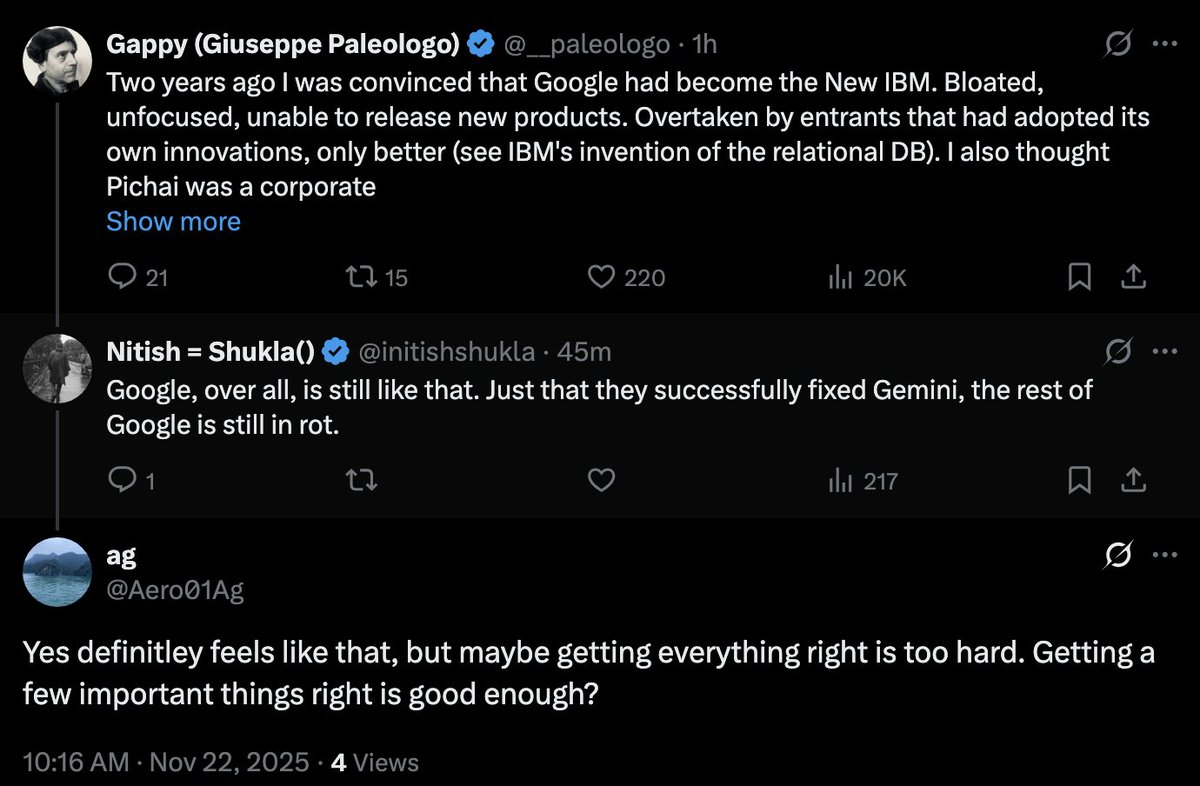
I remember Taleb saying somewhere in the distant past, when he was still exceptionally sane, something like "When you can do a few thing very well, you can afford a lot of mistakes". I came to appreciate this heavy-tailedness of positive payoffs only later. *Every single firm* I have worked at was dysfunctional, in the precise sense that goals that were part of their core mission were obviously, scandalously fumbled. Stuff like "let's start a business in <X>, for which were are completely unsuited!" or "let's fix the risk department by doubling its size!" and so on. All of this, by executives who were also obviously very intelligent and well-intentioned. How can this be? Because they had a core at which they were among the top three in the world. Even when they ignored that core competency, it saved them over and over again.
I remember Taleb saying somewhere in the distant past, when he was still exceptionally sane, something like "When you can do a few thing very well, you can afford a lot of mistakes". I came to appreciate this heavy-tailedness of positive payoffs only later. *Every single firm* I have worked at was dysfunctional, in the precise sense that goals that were part of their core mission were obviously, scandalously fumbled. Stuff like "let's start a business in <X>, for which were are completely unsuited!" or "let's fix the risk department by doubling its size!" and so on. All of this, by executives who were also obviously very intelligent and well-intentioned. How can this be? Because they had a core at which they were among the top three in the world. Even when they ignored that core competency, it saved them over and over again.
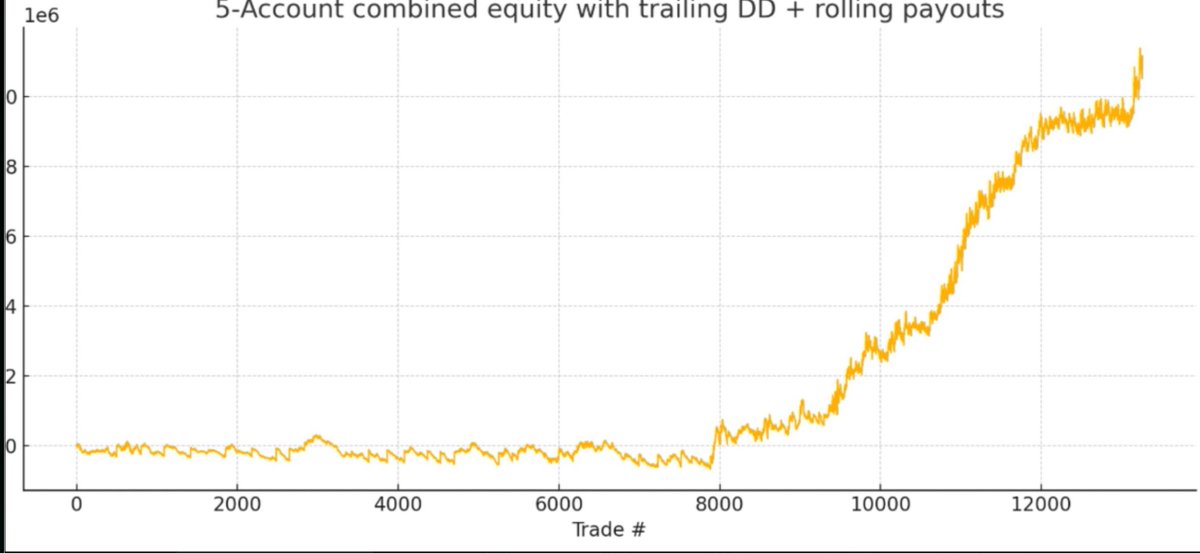
I’ve already proved statistically that you don’t need a profitable strategy to make money with prop firms.
We ran simulations based on prop firm rules using breakeven and even losing equity curves.
Another thing I discovered is that if you risk big
Really big, it actually becomes easier to hit payout targets under their models.
Even a random winning streak inside a losing strategy can reach the profit target.
That’s why high risk traders get so annoyed when I call them gamblers.
They wouldn’t be profitable in the real market, outside the prop firm business model.
They’re just risking big to hit that one lucky winning streak.
They know that if they risked low and let a real edge play out, they wouldn’t make any money.
Unfortunately, basic probability theory proves them wrong.
@valera_other@beniduboss@EthanInCrypto Obviously this is much better and provides most relevant nutrition (especially steak and the potassium from avocado), but likely hard to work with when you have low appetite due to environmental reasons
@beniduboss@EthanInCrypto Add potassium to compensate for increased salt (salt is incredibly good, body requires potassium to ensure a healthy usage and processing in the body)
High level:
Potassium is responsible for cell pump control aka what goes in and out of cells
Without potassium -> salt is bad