Vaping caused the death of sixty-eight people in the US between December 3rd, 2019 and February 18th, 2020. These deaths occurred across the US—in 29 states and the District of Columbia.
JUUL, is a pod system containing nicotine salts that emerged in 2015 established itself as a leading vape product. JUUL remains the most popular reusable e-cigarette device, with 51.6% of the reusable market share in April 2021. JUUL’s share of the whole vape market is 49.7%.
Vaping is known to increase the risk of viral and bacterial pneumonia by compromising the respiratory local immune response. Vaping also causes lipoid pneumonia where the alveoli are filled with lipid-laden macrophages with surrounding inflammation.
Each time a new memory is created or a new skill is learned, stronger connections – or synapses – are built between brain cells. Young people’s brains build synapses faster than adult brains. Nicotine changes the way these synapses are formed.
As you can see from this JUUL advertisement, they use young models to show that JUUL appeals to younger people and also used bright colors to attract teens and even younger kids.
"We know that flavors appeal to kids, and that is what the e-cigarette industry is banking on, kids like sweet flavors. That is why there are sugar-sweetened cereals. These flavors have always appealed to a kid's palate."
-Erika Sward from the American Lung Association
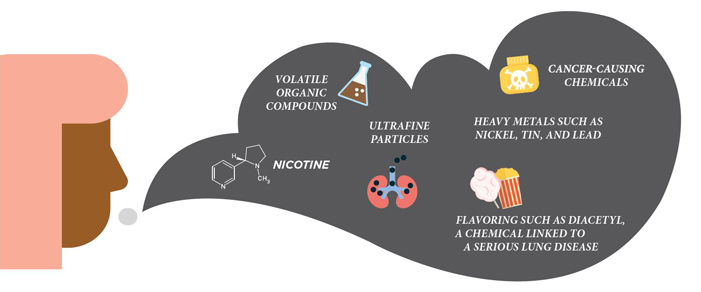
E-cigarettes can contain harmful ingredients such as ultrafine particles that can be inhaled deep into the lungs, flavorants such as diacetyl, a chemical linked to serious lung disease, volatile organic compounds and even heavy metals, such as nickel, tin, and lead
Multiple studies have found that harmful heavy metals, such as cadmium and lead, are present in both cigarette smoke and vape aerosol. CDPH found that vapes can contain toxic heavy metals compared to cigarettes, including chromium, nickel, manganese, and lead.