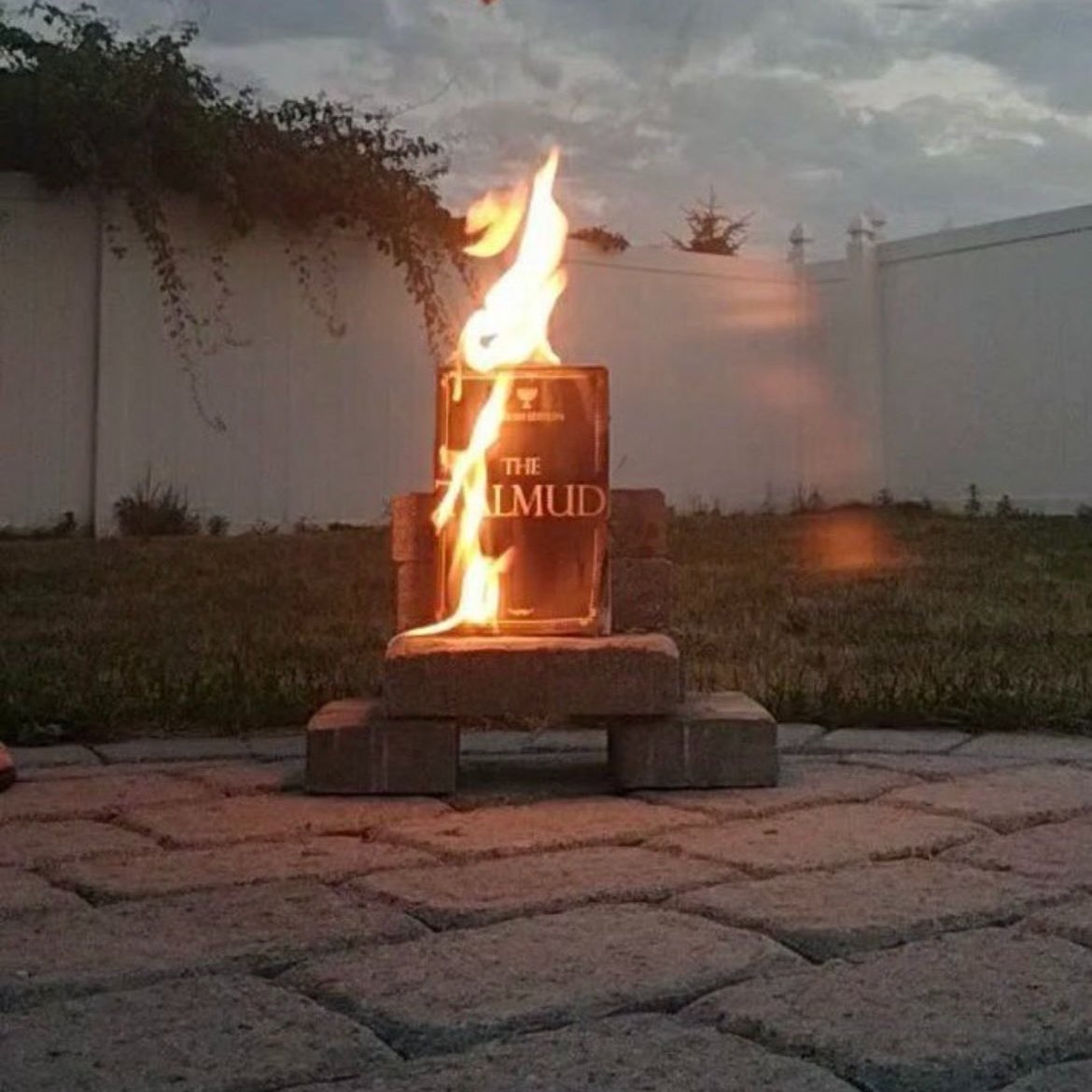
Lista de papas que mandaron a quemar ejemplares del Talmud (la supuesta "ley oral" del judaísmo):
• Gregorio IX (1227-1241): Tras las revelaciones hechas por el converso judío Nicolás Donín —quien señaló las blasfemias contra Cristo, María y la fe cristiana contenidas en el Talmud—, ordenó a obispos y reyes confiscar y quemar los libros. Esto condujo a la Disputa de París en 1240, que resultó en la quema de todas las copias del Talmud que se pudieron encontrar.
• Inocencio IV (1243-1254): El 9 de mayo de 1244, dirigió a Luis IX una carta papal titulada *Impia Judaeorum perfidia* («La impía perfidia de los judíos»), en la que elogió al santo rey por la quema realizada anteriormente y ordenó la destrucción de cualquier ejemplar o glosa condenada que aún quedara.
• Juan XXII (1316-1334): Promulga la bula *Dudum felicis recordationis* («De reciente y feliz memoria»), en la que ordena que se quemen los libros judíos que contengan blasfemias, errores o imprecaciones, con la ayuda del brazo secular si fuera necesario.
• Julio III (1550-1555): Promulga la bula *Cum sicut nuper* («Como recientemente»), que reitera que el Talmud y los libros judíos que contienen blasfemias contra el cristianismo deben ser confiscados y quemados públicamente.
• Clemente VIII (1592-1605): Promulga la bula Cum Hebraeorum malitia ("Cuando la malicia de los hebreos") dónde se ordena que escritos talmúdicos, cabalísticos y demás obras judías blasfemas fueran quemadas de inmediato; cita como precedentes a Gregorio IX, Inocencio IV, Clemente IV, Juan XXII, Julio III, Pablo IV y Gregorio XIII.
Otras papas que condenaron, confiscaron o renovaron dichas prohibiciones y quemas:
• Alejandro IV (1254-1261): Escribe In sacro generali dónde se ordena confiscar Talmuds acusados de blasfemias.
• Clemente IV (1265-1268): Tras las denuncias del converso jud´ô Pablo Cristiani ordenó que los judíos de Aragón debían someter sus libros a inspección/expurgo dominico.
• Alejandro V (1409-1410): Condena el Talmud y todos los libros judíos que contienen blasfemias.
• Pablo IV (1555-1559): Prohibió a los judíos casi todos los libros judíos salvo la Biblia (Tanaj) y reitera las quemas.
• Pío IV (1559-1565); Pío V (1566-1572); Gregorio XIII (1572-1585): Todos emitieron renovaciones de quemas, censuras e interdictos del Talmud y otros libros judíos que contenían blasfemias. Gregorio XIII, famoso por darnos el calendario gregoriano, fue citado por Clemente VIII entre aquellos que «habrían exterminado (exterminarunt) de las provincias y reinos del orbe cristiano» el Talmud.
Esto no incluye a los padres y doctores de la Iglesia ni a otros obispos de sedes antiguas que escribieron tratados contra el judaísmo condenándolo como una religión falsa y enemigo del Cristianismo, remontándose hasta San Ignacio de Antioquía, discípulo directo de los Apóstoles. No habría espacio suficiente en un post de X para enumerarlos a todos.
En suma:
Quienquiera que te diga que el Cristianismo y el judaísmo son amigos, aliados, o religiones hermanas, no solo te está mintiendo, sino que —lo que es peor— está rechazando y contradiciendo la voz inequívoca de la Iglesia, el depósito apostólico de la fe (el *Consensus Patrum*). Fue precisamente la herejía del modernismo la que arrancó de raíz este santo consenso en el siglo pasado, permitiendo que los propios enemigos de Cristo y de la Cruz dictaran la «novus» teología cristiana a la Iglesia y al mundo. Literalmente, entregarle las llaves del redil a los lobos.
No te dejes engañar: el judaísmo, desde la era apostólica hasta el regreso de Cristo, es el principal enemigo del Cristianismo.
En palabras del Apóstol San Pablo, quien antes de venir a la fe Cristiana, en su ignorancia también militó en el judaísmo contra la Iglesia de Cristo:
— "Pero si aun nosotros, o un ángel del cielo, os anunciara otro evangelio contrario al que os hemos anunciado, ¡sea maldito! Como les tengo dicho, también ahora lo repito: Si alguno les anuncia un evangelio distinto del que han recibido, ¡sea maldito! Porque ¿busco yo ahora el favor de los hombres o el de Dios? ¿O es que intento agradar a los hombres? Si todavía tratara de agradar a los hombres, ya no sería siervo de Cristo" (Gálatas 1:8–10).
Ok, we now have the actual text of the Greenland deal (https://t.co/VxZ1Q47jsh), so we can say how it compares to the existing 1951 arrangement and who, between Trump and Denmark, lied the most in their framing of it.
Long story short - which may surprise some - the Danes lied the most: Trump is pretty much correct in saying that this new deal grants the US control of Greenland.
Let's look into what changed compared to the 1951 deal.
1) This is now a permanent arrangement: whereas the existing 1951 deal only lasted as long as NATO existed, this one "does not have an end date and may only be amended by mutual consent."
It even survives a hypothetical future independence of Greenland: in that event, Denmark and Greenland must ensure that the independent Greenlandic state "affirmatively assume[s] all of the rights and obligations of the Kingdom of Denmark specified in this Agreement."
2) In the 1951 agreement, the US could set up bases only where both governments agreed, and only on the basis of NATO planning. The new deal locks in three bases: the US can "modernize and expand its activities" at Pituffik, its only base in Greenland until now, and "shall be allowed to establish an additional Defense Area at Narsarsuaq and Mestersvig." Further bases beyond these 3 can be justified by the defense of "the American continent," a US interest rather than a NATO one.
Also, quite subtle but this is interesting: Article IV(iii) says that "the United States may establish additional defense areas in Greenland" and that consultations are then held "to decide implementation details based on mutual agreement." What this means is that the principle of a new base is automatically granted and only the implementation details require agreement.
Article VII also gives the US "the right to raise concerns regarding construction, or change of use" of any building near a US base, after which the parties decide together what to do. Which means that the US has a say over civilian planning around its bases.
3) On US military movement across Greenland, the wording change between the 1951 agreement and this new one is quite funny.
The 1951 text said (Art. V(3)): the US "may enjoy... the right of free access to and movement between the defense areas through Greenland, including territorial waters, by land, air and sea," but only "in accordance with general rules mutually agreed upon and issued by the appropriate Danish authority in Greenland."
The new one says: "the United States of America shall enjoy... the right of free access to and movement between the Defense Areas through Greenland, including the Territorial Waters, by land, air and sea."
That's it: "May" becomes "shall," and the US military movement no longer has to follow rules "issued by the appropriate Danish authority in Greenland." The US also gets something new on top: "undersea access to and movement within the Territorial Waters," i.e. submarines.
4) Non-NATO exclusion: non-NATO states are barred from military installations or a persistent presence in Greenland unless all three parties approve, giving the US an effective permanent veto. The 1951 deal had no equivalent clause.
5) Investment screening: this is entirely new. "States or investors from a state that is not a member of NATO, a NATO partner, or an EU member state" (i.e. Russia, China, India, the Gulf States, etc.), "shall not be allowed to have (i) control, (ii) significant influence, or (iii) access to non-public information...within Particularly Sensitive Sectors or Activities in the territory of Greenland (including the Territorial Waters), unless agreed between the Parties."
Again, it basically means that the US has a permanent veto over who can invest in strategic sectors in Greenland, as far as non-NATO or EU states are concerned.
6) Lastly, in stark contrast with the 1951 deal, the framing of the deal changes significantly: this new deal is largely framed around the US.
The 1951 agreement existed only "for the benefit of the North Atlantic Treaty Organization." The new one lists the defense of "the American continent" as an objective, celebrates "the irreplaceable role" of the United States military as well as "the United States' indispensable historical and ongoing contributions to the security and defense of Greenland," and names the establishment of Trump's "Golden Dome" missile defense system as a key goal.
So, to sum up:
- The US secured a permanent military foothold that even an independent Greenland would inherit whether it likes it or not
- The US now has veto power over any non-NATO military presence in Greenland, and over who can invest in its strategic infrastructure and resources (beyond NATO and the EU)
- Denmark signed away its say over the principle of new US bases, with only the right to discuss the "implementation details"
- Danish authorities no longer set the rules for US military movement across the island
- And all of it is now justified by the defense of "the American continent"
I don't know in which universe this even remotely "recognizes the sovereignty and territorial integrity of the Kingdom and the Greenlandic people's right to self-determination," as Danish PM Mette Frederiksen put it (https://t.co/dHOavrPB3r).
Yes, the preamble of the text cynically "reaffirms" Danish sovereignty but, in my book, when you let a foreign country put bases on your soil, move its troops without following your rules and veto who else can come in, in perpetuity, after it spent two years threatening to take you by force, the word for that is anything but "recognized sovereignty" 🤷
@kikoperes_@theluisribeiro O Hitler tinha um gosto particular por bolcheviques. Nem montou a estratégia toda dele com base nesse ódio. Este Luís Ribeiro só engana atrasados mentais como ele…
@YouBuyBitcoin@Blockstream You are retarded. Code is law when the code is used by the stakeholders with the legit purposes of its creation. Stealing others property is always wrong, on or off chain.