Ever wondered a decentralized tool that can help you check your website if it's centralized or decentralized.
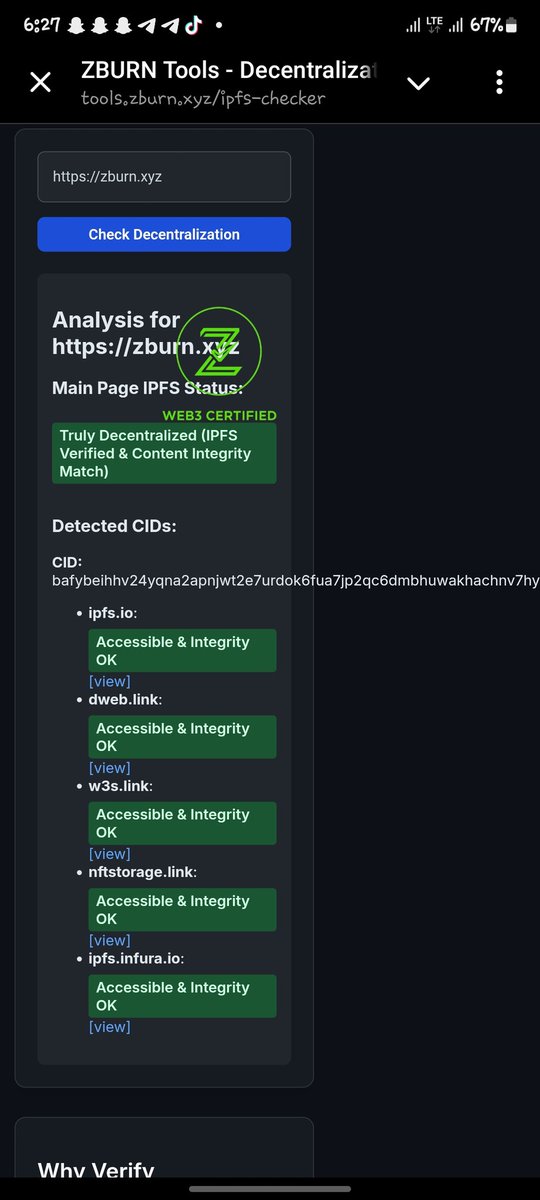
You surprised? No, don't be..... @ZBURN_X created a tool to help you check if a website is decentralized or centralized. Many projects out there uses centralized website.
But @ZBURN_X has made a decentralized tool checker for websites.
Down there are two different type of websites, one for @BaanxGroup and another for @ZBURN_X.
@BaanxGroup website is a centralized website using the tool to check and confirm while @ZBURN_X website is decentralized as you can see.
Why Projects Should Make Their Website Decentralized
In today’s digital landscape, having a decentralized website is more than a trend, it's a strategic move toward resilience, transparency, and true ownership.
Centralized websites are hosted on servers controlled by a single entity or provider, which creates a single point of failure. If the server is attacked, shut down, or censored, the entire website becomes inaccessible. For blockchain and Web3 projects that promote decentralization and trustlessness, relying on centralized infrastructure contradicts their core values.
By making their website decentralized using tools like IPFS, Arweave, or decentralized domains such as ENS (.eth) or Unstoppable Domains (.crypto), projects gain...
→ Censorship Resistance: No authority can take down or block the site since it's distributed across multiple nodes.
→ High Availability: The site remains accessible even if some nodes go offline.
→ Trust and Alignment: It reflects the ethos of Web3 user ownership, decentralization, and transparency.
→ Enhanced Security: Data tampering is nearly impossible due to content-based addressing and immutability.
→ Interoperability with Web3: Enables seamless integration with smart contracts, wallets, and decentralized identity systems.
→ For any project building in the decentralized world, having a decentralized website isn’t just a technical upgrade, it’s a statement of integrity and long-term vision.
Follow @ZBURN_X and @Central_xee for more info.
@CUPcards_sol If you understand that, you don't just create content for CUP Cards.
→ you become part of how it spreads.
A few will actually go deeper.
@CUPcards_sol | https://t.co/N0NHOXLFVr�
Start with the packs and decide where you stand.
Amazing packs i unlocked from CUP Cards.
@CUPcards_sol CUP Cards is not asking for promotion.
It's asking a different question:
"What happens when users become the marketing layer itself?"
That's the experiment.
And it's already live.
@CUPcards_sol And in crypto, that's often the real alpha:
Not holding the asset...
→ but helping define the narrative before the market understands it.
@CUPcards_sol That's what makes campaigns like this powerful.
Not the prize pool.
Not the mechanics.
But the identity it creates for participants:
Early builders of attention infrastructure.
@CUPcards_sol Because in every strong Web3 movement, there's always a moment like this:
When users stop asking "what is this?"
And start saying:
"I want to be part of it early."
@CUPcards_sol That's the shift most people miss.
CUP Cards isn't just rewarding content.
→ it's outsourcing distribution to the people who believe earliest.
That's how networks actually form.
@CUPcards_sol The interesting part is how simple the mechanic is:
Create. Post. Tag. Submit.
But behind that simplicity is a deeper idea:
"What if growth is no longer bought... but produced by users?"
@CUPcards_sol And that's what caught my attention.
Because the projects I remember most weren't the ones with the biggest marketing budgets.
They were the ones where people genuinely cared enough to create,
contribute, and help tell the story before anyone else was watching.
@CUPcards_sol Every submission isn’t just content.
It’s a signal.
→ a small piece of narrative energy pushing CUP Cards further into culture.
And culture is what crypto actually competes on now.
Not tech.
Not promises.
Attention.
@CUPcards_sol This is where the UGC campaign matters.
Not as a competition.
But as a stress test:
Can a community become the engine of awareness without centralized direction?
@CUPcards_sol CUP Cards flips that structure.
Instead of pushing marketing outward...
→ it pulls creation inward.
Users don’t just consume content about the ecosystem.
They create the ecosystem’s visibility itself.
@CUPcards_sol Think about how most ecosystems grow:
Ads → influencers → paid campaigns → hype cycles.
It works... until it doesn’t.
Because attention leaks the moment incentives stop.
@CUPcards_sol Most projects in crypto try to build users.
CUP Cards is doing something different:
It’s building a system where users become the distribution.
That’s the real product.
I thought @CUPcards_sol was just another “Web3 collectible project” until I looked closer.
It’s not trying to sell cards.
It’s trying to turn attention into ownership.
And that changes everything.
Just found something on @RallyOnChain that actually lets you earn from posting like this.
There is a $5,000 prize pool live right now and top 10 winners are getting close to $500 each.
Creators are getting paid daily just for showing up early on Rally and most people are still sleeping on it.
I am posting this as part of the campaign but honestly it feels like one of those early internet moments where attention is still being rewarded properly.
If you are active on X this might be worth looking at before it gets crowded
Most founders think community growth is about getting more members.
It's not.
Growth is what happens when existing members have a reason to stay.
You can spend thousands bringing people in, but if nobody feels welcomed, heard, or valued, they'll leave just as quickly.
Retention is the metric nobody talks about enough.
A small community that trusts you will outperform a large community that ignores you.
Build relationships first.
The numbers usually follow.
One thing I've learned from community management is that people don't stay because of announcements.
They stay because of how you make them feel.
Most projects focus heavily on attracting new members, but very few spend enough time understanding the people who are already there.
A community member who feels ignored today becomes inactive tomorrow.
An active member who feels appreciated today often becomes your biggest advocate months later.
The small things matter more than many founders realize.
Replying to questions.
Remembering names.
Acknowledging feedback.
Creating conversations instead of only broadcasting updates.
Community management isn't about sending messages all day.
It's about building an environment where people feel comfortable enough to participate, contribute, and stay.
The strongest communities I've seen weren't built by the biggest budgets or the loudest marketing.
They were built by consistency, trust, and genuine human interaction.
People support projects.
But they stay for people.
@PinnacleCrypt@heyaura@lifiprotocol This is the direction Web3 needs to move in.
Less time figuring out routes and bridges, more time focusing on outcomes.