🧐NEW Supplement:
Measuring albuminuria or proteinuria to diagnose and monitor CKD - Results from the NKF 2025 Albuminuria–Proteinuria Workshop
➡️It addresses methodological, clinical, analytical & translational dimensions of urinary protein assessment
https://t.co/bksFQqdODh
Today's Paper of the Day is:
Treating Hepatorenal Syndrome in the Current Era
https://t.co/JKgcYjlUQ5
Join us to read 1 paper per day and stay up-to-date as we cover the spectrum of critical care across 2026
IJCCP PRACTICE UPDATE
| Top 10 Clinical Pearls
Hypertensive Emergency vs Severe Hypertension Without Acute Target-Organ Damage
Article: Hypertensive Emergency and Severe Hypertension without Acute Target-organ Damage: An Updated Practice Update (2026)
Author: Dr Parag Rana, Department of Internal Medicine, Dev Medical Hospital, Vadodara, Gujarat, India.
1. Treat the organ, not just the BP number. BP >180/120 mmHg alone does not define a hypertensive emergency. The decisive feature is new or progressive acute target-organ damage involving brain, heart, kidneys, retina, or large arteries.
2. “Hypertensive urgency” is being retired. The article highlights the 2025 ACC/AHA shift toward “severe hypertension without acute target-organ damage” because the word urgency may encourage unnecessary rapid treatment.
3. Use BARKH at the bedside. In markedly elevated BP, rapidly look for Brain, Arteries, Retina, Kidney and Heart involvement. Fundoscopy, ECG/troponin, creatinine/eGFR and urinalysis are particularly useful; imaging should be symptom-directed.
4. First confirm that the BP is real. Use a validated device, correct cuff size, proper positioning and average ≥2 measurements taken 1–5 minutes apart. White-coat effect may raise office BP by 20–50 mmHg.
5. True hypertensive emergency needs monitored IV treatment. Admit to an ICU/monitored setting and use titratable IV therapy. As a general rule, reduce MAP by no more than ~25% during the first hour, then toward 160/100–110 mmHg over 2–6 hours, unless the clinical condition requires a different target.
6. Different emergencies require different BP targets. Aortic dissection requires rapid lowering (SBP <120 mmHg in 20–30 minutes), while ischemic stroke, hemorrhagic stroke and acute heart failure have distinct targets and preferred agents. One BP target does not fit every hypertensive emergency.
7. Preferred IV drugs should be short-acting and titratable. The article discusses nicardipine, clevidipine, labetalol and esmolol as key options, selected according to the underlying organ emergency and clinical setting.
8. Do not rapidly lower asymptomatic severe hypertension. In the absence of acute target-organ damage, aggressive IV or PRN oral therapy can cause hypotension, AKI, falls and potentially worse hospital outcomes. The article emphasizes that harm from reflexive acute treatment may outweigh benefit.
9. For severe hypertension without organ damage, fix the cause and the chronic regimen. Look for pain, NSAIDs, alcohol withdrawal, anxiety and non-adherence; restart/intensify oral therapy, preferably using single-pill combinations, provide home BP monitoring and arrange follow-up within 1–7 days.
10. The key clinical skill is accurate classification. Hypertensive emergency carries substantial risk, whereas severe asymptomatic hypertension generally has an excellent prognosis with appropriate outpatient intensification. The article's final figure summarizes the message beautifully: “Treat the organ, not just the number.”
CME INDIA Take-Home:
BP 220/120 does not automatically mean “IV antihypertensive now.” First ask: Is there acute target-organ damage? Presence of damage determines the emergency—not the BP number alone.
https://t.co/sUr8LSHS43
Treatment of Essential Hypertension (Adults)
Step 1
◻️ Age <55 years: Start an ACE inhibitor (ACEi) or ARB (ARB if ACEi is not tolerated).
◻️ Age ≥55 years or Black African/Black Caribbean ethnicity: Start a calcium channel blocker (CCB).
Step 2
◼️ACEi/ARB + CCB
◼️ If a CCB is not tolerated, use a thiazide-like diuretic instead.
Step 3
◻️ ACEi/ARB + CCB + thiazide-like diuretic
Step 4 (Resistant Hypertension)
◻️ If serum potassium is ≤4.5 mmol/L: Add low-dose spironolactone.
◻️ If serum potassium is >4.5 mmol/L: Consider an alpha-blocker or beta-blocker, or seek specialist advice.
Key point: Use either an ACE inhibitor or an ARB, never both together.
Reference: NICE Guideline NG136: Hypertension in adults: diagnosis and management (updated February 2026).
Familial #hypercholesterolemia (FH) is a family of genetic disorders characterized by impaired hepatic clearance of low-density #lipoprotein (LDL) particles, due to pathogenic variants that impair #LDL receptor function.
💡 This JAMA Insights explores FH, including assessment and diagnosis, effective treatments, and management of both homozygous and heterozygous FH. https://t.co/J3wdLvkiAF
#ICYMI: the long-awaited updated @ASH_hematology#ITP guidelines are here!
With so many new agents for managing ITP, I’m excited for these recs to better help our patients achieve durable platelet responses and improved QOL
Link: https://t.co/QY57AsYnBE
🔱 Redefiniendo el rol de los Ɓ-bloqueadores. 💊🫀
🟢 Indicaciones con beneficio establecido:
✔️IC con FEVI ≤40%: reducen mortalidad y eventos CV → terapia fundamental.
✔️Post-IAM con FEVI ≤40%: beneficio pronóstico.
✔️FEVI 41–49%: probable beneficio; evidencia principalmente de subgrupos/metaanálisis.
✔️FA/flutter: control de frecuencia.
✔️Arritmias ventriculares: reducen muerte súbita, especialmente en cardiopatía isquémica e IC FEVi-r.
✔️Angina sintomática: alivio de síntomas.
🟡 Uso individualizado:
⛔️Post-IAM con FEVI ≥50%: los estudios contemporáneos no muestran reducción de muerte, IAM o IC [HR 0.97].
⛔️IC-FEp: no existe beneficio demostrado y pueden empeorar la capacidad de ejercicio.
✔️Miocardiopatía hipertrófica: útiles para síntomas/obstrucción, pero los inhibidores de miosina podrían ofrecer mayor beneficio.
⛔️Amiloidosis cardíaca: generalmente mala tolerancia por su efecto cronotrópico/inotrópico negativo.
⛔️HTA: ya no son tratamiento de primera línea sin otra indicación.
✔️Post-IAM sin disfunción ventricular: reconsiderar la continuidad después de 1 año.
🔴 Evitar uso:
🚫Enfermedad coronaria estable sin IAM previo, sin angina y FEVI >50%: no se ha demostrado beneficio pronóstico.
🚫Inicio inmediato antes de cirugía no cardíaca: puede aumentar riesgo de evento vascular cerebral y muerte.
📝🆓️⤵️State-Of-The-Art Review2026 @JACCJournals 💯
https://t.co/zpbaI8UQSS
https://t.co/KfhbXJuppz
🩸 ¿Y si para administrar hierro IV dejamos de mirar únicamente ferritina y TSAT… y preguntamos directamente al eritrocito joven si tiene hierro disponible?
Un ensayo multicéntrico aleatorizado publicado en julio de 2026 comparó dos estrategias para guiar hierro IV en pacientes en hemodiálisis:
🔹 RET-He — hemoglobina equivalente del reticulocito
vs
🔹 TSAT convencional.
RET-He refleja el hierro disponible para la eritropoyesis durante los últimos días, ofreciendo una fotografía más dinámica que los depósitos de hierro.
¿Resultado?
👉 La estrategia RET-He fue no inferior a TSAT para el índice de resistencia a ESA a 3 y 6 meses.
Pero apareció un dato especialmente útil:
💉 Menos hierro IV acumulado con RET-He.
A 3 meses:
495 vs 592 mg/3 meses — p=0.01
A 6 meses:
413 vs 501 mg/3 meses — p=0.03
sin diferencias significativas en Hb ni dosis de ESA. (Eritropoyetina)
🎯 Takeaway clínico:
Ferritina alta no siempre significa hierro disponible.
TSAT baja no siempre cuenta toda la historia.
RET-He permite acercarnos a una pregunta más fisiológica:
👉 ¿Hay hierro llegando AHORA a la médula ósea?
🩺 Aplicación práctica para el nefrólogo:
• Considera RET-He cuando esté disponible como complemento en la evaluación de hierro funcional.
• Puede ser especialmente útil cuando inflamación, ferritina y TSAT ofrecen información discordante.
• Una estrategia basada en RET-He podría reducir exposición innecesaria a hierro IV sin aumentar requerimientos de ESA.
• El ensayo duró solo 6 meses y no tuvo potencia para demostrar diferencias en mortalidad, hospitalización, infección o eventos cardiovasculares. (PubMed Central (PMC))
💡 Quizá el futuro del manejo de la anemia no sea preguntar:
“¿Cuánto hierro tiene almacenado?”
sino:
“¿Cuánto hierro está realmente disponible para fabricar el próximo eritrocito?”
#Hemodiálisis #AnemiaERC #Hierro #Nefrología #anemia #hemodialisis #tratamiento #novedad
Bibliografía:
Suttaluang C, Phannajit J, Siribamrungwong M, et al. Efficacy of Reticulocyte Haemoglobin Equivalent-Guided Versus Transferrin Saturation-Guided Iron Supplement Protocol in Haemodialysis Patients: A Multicenter Cluster Randomized Controlled Trial. Nephrology (Carlton). 2026;31(7):e70247.
DOI: 10.1111/nep.70247. (PubMed)
🔴 BAVENO VIII – Portal Hypertension: What Changes Clinical Practice?
📌 Baveno VIII – Advancing Consensus in Portal Hypertension
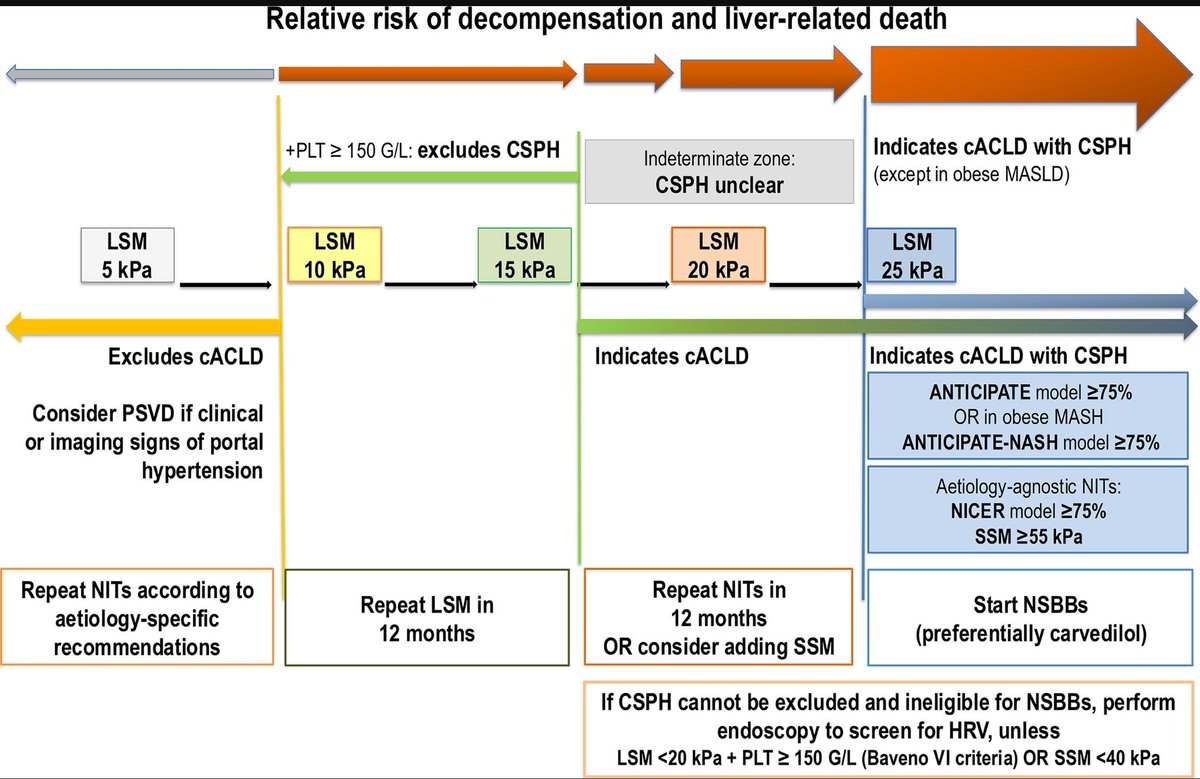
The Baveno VIII consensus, developed across 9 expert panels, achieved strong consensus on 272 statements/recommendations and proposes 153 research priorities. The central message continues the paradigm shift from simply preventing variceal bleeding to identifying clinically significant portal hypertension (CSPH) early and preventing first and further hepatic decompensation.
🔑 1. CSPH remains the pivotal therapeutic threshold
CSPH = HVPG ≥10 mmHg, but invasive HVPG is no longer necessary for routine risk stratification in many compensated patients.
👉 Liver stiffness measurement (LSM), platelet count and increasingly spleen stiffness form the backbone of non-invasive assessment.
Clinical pearl: Do not wait for varices to appear before thinking about portal-hypertension-directed treatment.
🔑 2. The “Rule of Five” remains clinically powerful
Think progressively:
LSM 5 → 10 → 15 → 20 → 25 kPa
Increasing liver stiffness reflects progressively increasing probability of advanced liver disease, CSPH and clinical events.
The well-validated Baveno framework remains:
✅ LSM ≤15 kPa + platelets ≥150 ×10⁹/L → CSPH can generally be ruled out.
✅ LSM ≥25 kPa → strongly supports CSPH in appropriate populations.
But an important caveat is MASLD with obesity: an isolated LSM ≥25 kPa is less reliable for ruling in CSPH. Recent individual-patient meta-analysis showed that obesity materially reduces the reliability of this simple rule-in threshold.
🔑 3. The old 15–25 kPa “grey zone” is becoming smaller
Patients falling between the classical rule-out and rule-in thresholds should not automatically undergo invasive testing.
Additional tools such as:
➡️ platelet count
➡️ spleen stiffness measurement (SSM)
➡️ ANTICIPATE/ANTICIPATE-NASH probability models
➡️ selected biochemical algorithms
can further refine CSPH probability.
This is particularly relevant in steatotic liver disease and obesity, where a one-size-fits-all LSM threshold performs less well.
🔑 4. Carvedilol is not merely an “anti-variceal” drug
This is one of the most important conceptual messages for physicians.
In a compensated patient with CSPH, a non-selective β-blocker is used not only to prevent bleeding but to prevent hepatic decompensation, particularly ascites.
Carvedilol remains particularly important because of its additional α1-blocking action and greater portal-pressure reduction.
Thus the clinical thinking becomes:
CSPH identified → ask whether NSBB/carvedilol is appropriate, rather than waiting for large varices.
Baveno VII established this paradigm, and subsequent evidence has strengthened non-invasive identification of the patients most likely to benefit.
🔑 5. Endoscopy becomes more selective
A major evolution of Baveno guidance is:
Not every compensated patient with cirrhosis needs screening endoscopy solely to decide whether to start an NSBB.
If CSPH is established and the patient is an appropriate candidate for an NSBB, treatment may be initiated on the basis of the portal-hypertension risk assessment.
Endoscopy assumes greater importance when:
➡️ NSBBs are contraindicated/intolerable
➡️ the non-invasive assessment is uncertain
➡️ endoscopic therapy would alter management.
This represents a move from “find varices and treat them” toward “identify portal hypertension and prevent decompensation.”
🔑 6. MASLD changes the portal-hypertension equation
Baveno VIII gives increased importance to steatotic liver disease and its modifiers.
⚠️ Obesity can alter the diagnostic performance of VCTE.
Therefore:
LSM ≥25 kPa should not be interpreted mechanically in an obese MASLD patient.
BMI, platelets and other NITs may need to be integrated.
📖Next
.....https://t.co/eUHAxZLFku
EMBOLISMO PULMONAR AGUDO , RESUMEN GUÍA 2026 🫁 ‼️
📌 Se presenta un nuevo esquema de clasificación clínica, titulado "Categorías Clínicas de Embolia Pulmonar Aguda", con 5 categorías y subcategorías




![javier20ch's tweet photo. 🔱 Redefiniendo el rol de los Ɓ-bloqueadores. 💊🫀
🟢 Indicaciones con beneficio establecido:
✔️IC con FEVI ≤40%: reducen mortalidad y eventos CV → terapia fundamental.
✔️Post-IAM con FEVI ≤40%: beneficio pronóstico.
✔️FEVI 41–49%: probable beneficio; evidencia principalmente de subgrupos/metaanálisis.
✔️FA/flutter: control de frecuencia.
✔️Arritmias ventriculares: reducen muerte súbita, especialmente en cardiopatía isquémica e IC FEVi-r.
✔️Angina sintomática: alivio de síntomas.
🟡 Uso individualizado:
⛔️Post-IAM con FEVI ≥50%: los estudios contemporáneos no muestran reducción de muerte, IAM o IC [HR 0.97].
⛔️IC-FEp: no existe beneficio demostrado y pueden empeorar la capacidad de ejercicio.
✔️Miocardiopatía hipertrófica: útiles para síntomas/obstrucción, pero los inhibidores de miosina podrían ofrecer mayor beneficio.
⛔️Amiloidosis cardíaca: generalmente mala tolerancia por su efecto cronotrópico/inotrópico negativo.
⛔️HTA: ya no son tratamiento de primera línea sin otra indicación.
✔️Post-IAM sin disfunción ventricular: reconsiderar la continuidad después de 1 año.
🔴 Evitar uso:
🚫Enfermedad coronaria estable sin IAM previo, sin angina y FEVI >50%: no se ha demostrado beneficio pronóstico.
🚫Inicio inmediato antes de cirugía no cardíaca: puede aumentar riesgo de evento vascular cerebral y muerte.
📝🆓️⤵️State-Of-The-Art Review2026 @JACCJournals 💯
https://t.co/zpbaI8UQSS
https://t.co/KfhbXJuppz](https://pbs.twimg.com/media/HQRiCpUW0AA8QC5.jpg)