We choose to go to the moon not because it's easy, but because it's hard; because that goal will serve to organize and measure the best of our energies and skills. JFK May - 1961. Hagamos cosas fantásticas que nos inspiren y saquen lo mejor de nosotros por mas difíciles que sean.
Claude Fable 5 is our first generally available Mythos-class model.
It ships with new safety classifiers that may flag certain prompts in dual-use domains like cyber and bio.
We've added fallbacks: a refused request retries on Claude Opus 4.8 instead of dead-ending.
Do you feel you're creating good software with AI?
Good software has one easy metric: it is used by users.
Is your AI-made software gaining new users every day?
We've reset 5-hour and weekly rate limits for all users on Pro and Max plans.
We fixed an issue that caused some Claude Code sessions to spawn excessive parallel subagents, burning through usage faster than expected.
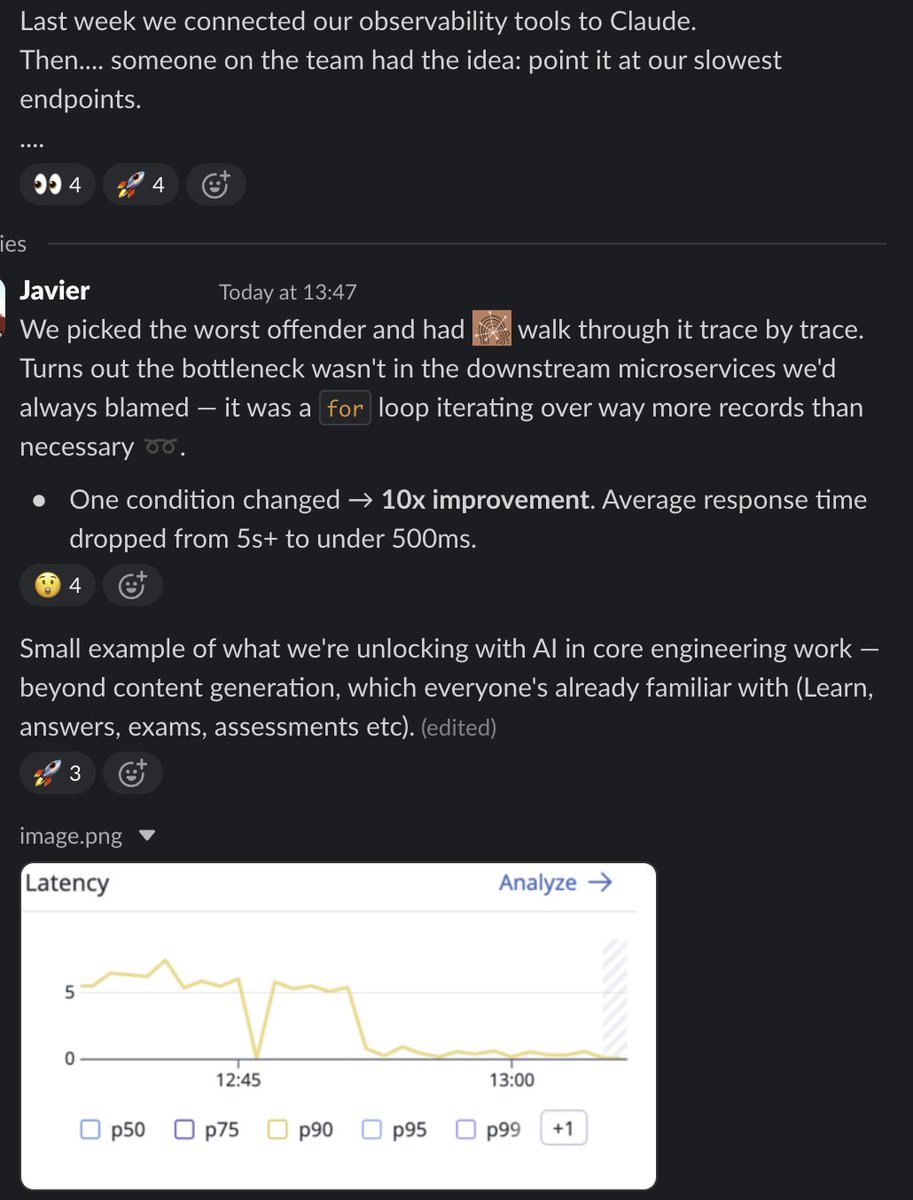
Claude made Platzi 10x faster.
Platzi's dev team connected Claude to our observability tools. It went, trace by trace, to all the bottlenecks in our code. It found a condition that took 5s to solve and transformed it into a 500ms process.
Senior developers are currently having a massive existential crisis because Claude writes "messy code"
A junior just used Claude to ship an entire feature in 2 hours.
Meanwhile, the Senior is still spending 3 days reviewing code.
When will y'all realize that literally nobody cares if the code is "messy"?
Today, we’re open-sourcing the draft specification for DESIGN.md, so it can be used across any tool or platform. We’re also adding new capabilities.
DESIGN.md lets you easily export and import your design rules from project to project. Instead of guessing intent, agents know exactly what a color is for and can even validate their choices against WCAG accessibility rules.
Watch David East break down this shared visual language in action👇. New capabilities and links in 🧵
New Anthropic research: Emotion concepts and their function in a large language model.
All LLMs sometimes act like they have emotions. But why? We found internal representations of emotion concepts that can drive Claude’s behavior, sometimes in surprising ways.