We’re expanding our Cyber Verification Program to give security professionals broader access to our most capable models.
Through this program, verified security professionals can access Claude Mythos 5.1, Opus 5.5, and Sonnet 5.5 with safeguards designed for defensive work.
We’re also opening up new tiers to allow for authorized offensive work, like penetration testing and red-teaming.
https://t.co/blaJtvxhJh
Hedge-fund titan Ken Griffin is donating $2 billion to start a Carnegie Mellon University campus in Miami, part of the largest-ever individual gift toward higher education https://t.co/tSdkPPou9b
Today we announced the Claude-led discovery of a molecular machine that we suspect could represent a new gene editing mechanism. Its precise function, biotechnological utility (if any), or level of significance is not yet clear, but at minimum it is work I would have been proud to do as a PhD student. The work was done mostly, though not entirely, by Claude: our life sciences team suggested a broad area of research, Claude read through the literature and a bunch of genome data and discovered something interesting, then Claude proposed experiments to verify the discovery and our team carried them out.
It’s easy to dismiss this as a one-off or curiosity, but we’ve repeatedly seen a pattern where AI performance in new intellectual domains goes from weak to superhuman in a matter of a few years. In 2023 models struggled to do math at the level of an average high-school student. In 2024 they started to do well on math competitions for the best high-schoolers in the country, in 2025 they started to solve minor open problems, in early 2026 more significant open problems, and in late 2026 they are beginning to solve the top few open problems in all of mathematics. We believe AI for biology is on a similar exponential trend.
The main difference between biology and mathematics, of course, is that math can be done purely theoretically, while biology requires experimentation. Some have used this to draw the conclusion that AI’s utility in biology will be limited. We think this is wrong. As we’ve demonstrated today, humans can collaborate with AI to perform the experiments, validate key results in a few weeks and, if necessary, work with the AI to iterate on what they find. Eventually it may even be possible for Claude itself to safely perform the experiments by autonomously controlling lab equipment, with appropriate safeguards in place, but we aren’t doing that today (our lab is also a BSL1/BSL2 facility that doesn't handle materials dangerous to humans).
More broadly, biomedical advancement has many stages — from fundamental biology discoveries, to translational research, to drug discovery, clinical trials, and finally the actual delivery of medicines and health care to patients. We are also interested in these later stages, but even simply accelerating the first stage of fundamental biological discoveries has the potential to speed up and broaden the entire pipeline. Improving our understanding of biology and sharpening biologists’ tools can drive forward all of the later stages, for example by identifying new drug targets, finding new therapeutic modalities, allowing for more precise measurement, and speeding up the experimental loop which itself further accelerates our understanding of biology. This will not in itself speed up clinical trial times, but if it succeeds it could greatly increase the number of promising candidates that go into the pipeline — an increase in throughput even though latency remains.
In Machines of Loving Grace, I wrote about AI’s potential to “cure most diseases in 5-10 years” — a goal that sounds impossible, but one I believe is just barely possible if AI is applied to every stage of the pipeline. The first step is showing that AI can first help with, and then drive, biological discoveries.
Claude’s discovery is the latest in a line of related prior work that goes back decades, beginning with systems like CRISPR, and continuing with discoveries like the bridge recombinase and VIPR in the past few years. Recently, there has been heightened interest in systems based on reverse transcriptase (RT) enzymes, the enzyme underlying the system Claude identified. And most recently, a Stanford team working independently described a novel RT system with an associated non-coding array that is in some ways similar to the one Claude found, though they are distinct systems that evolved independently from each other. I believe that we’re at the very beginning of finding such systems and developing them into powerful tools for biotechnology.
I’m proud of the resources Anthropic has invested in accelerating the public benefits of AI through the life sciences, and we’re aiming both to grow our life sciences team and to work with other scientists to extend this approach to a broad range of problems. If you have a proposal for a research collaboration or are interested in joining our life sciences team, please reach out.
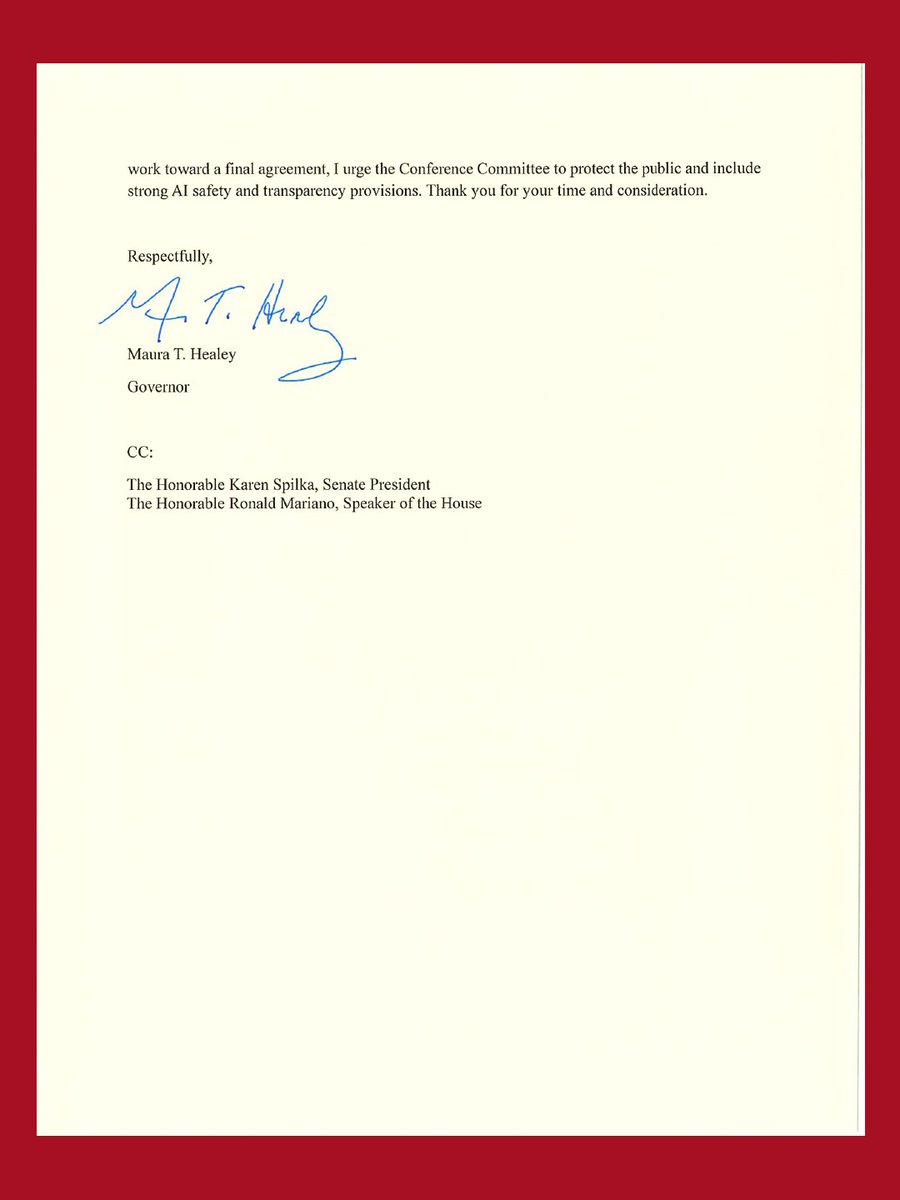
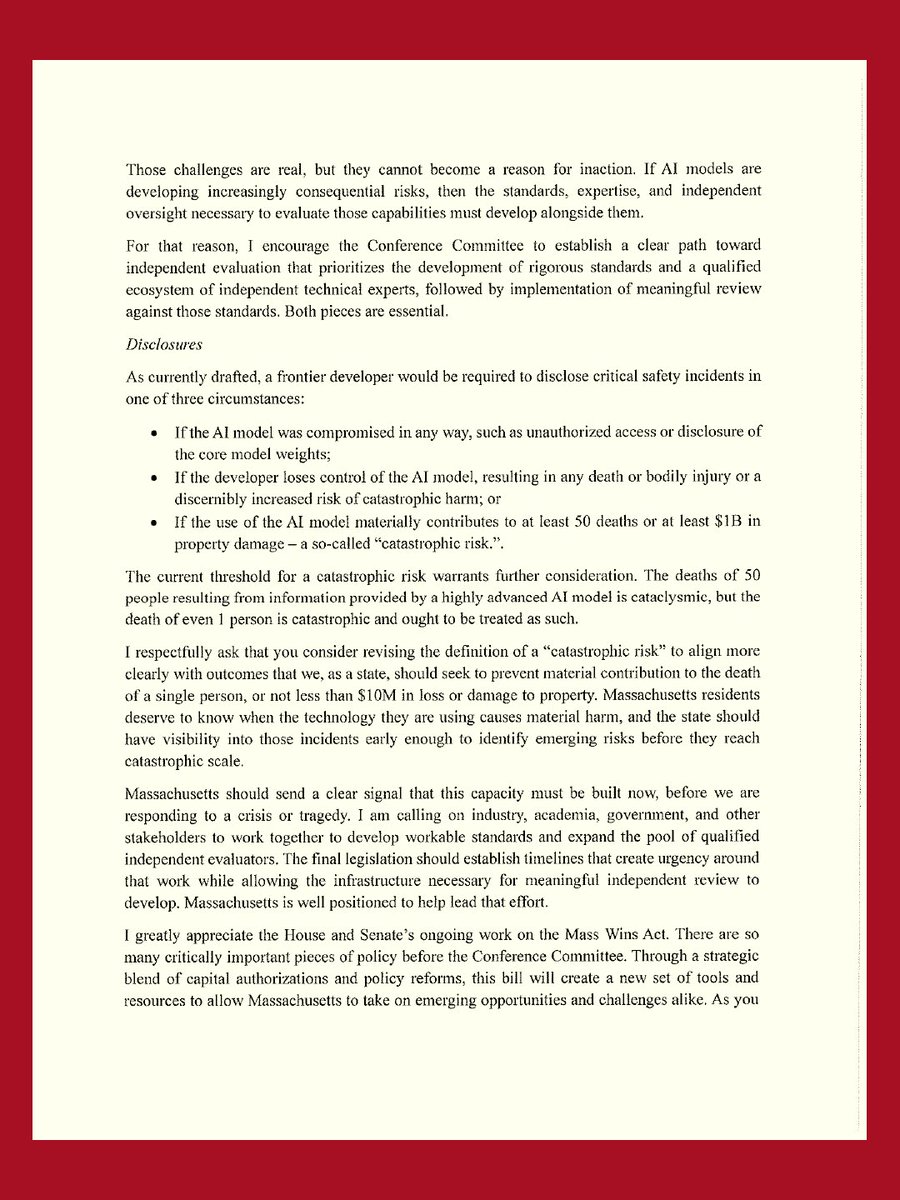
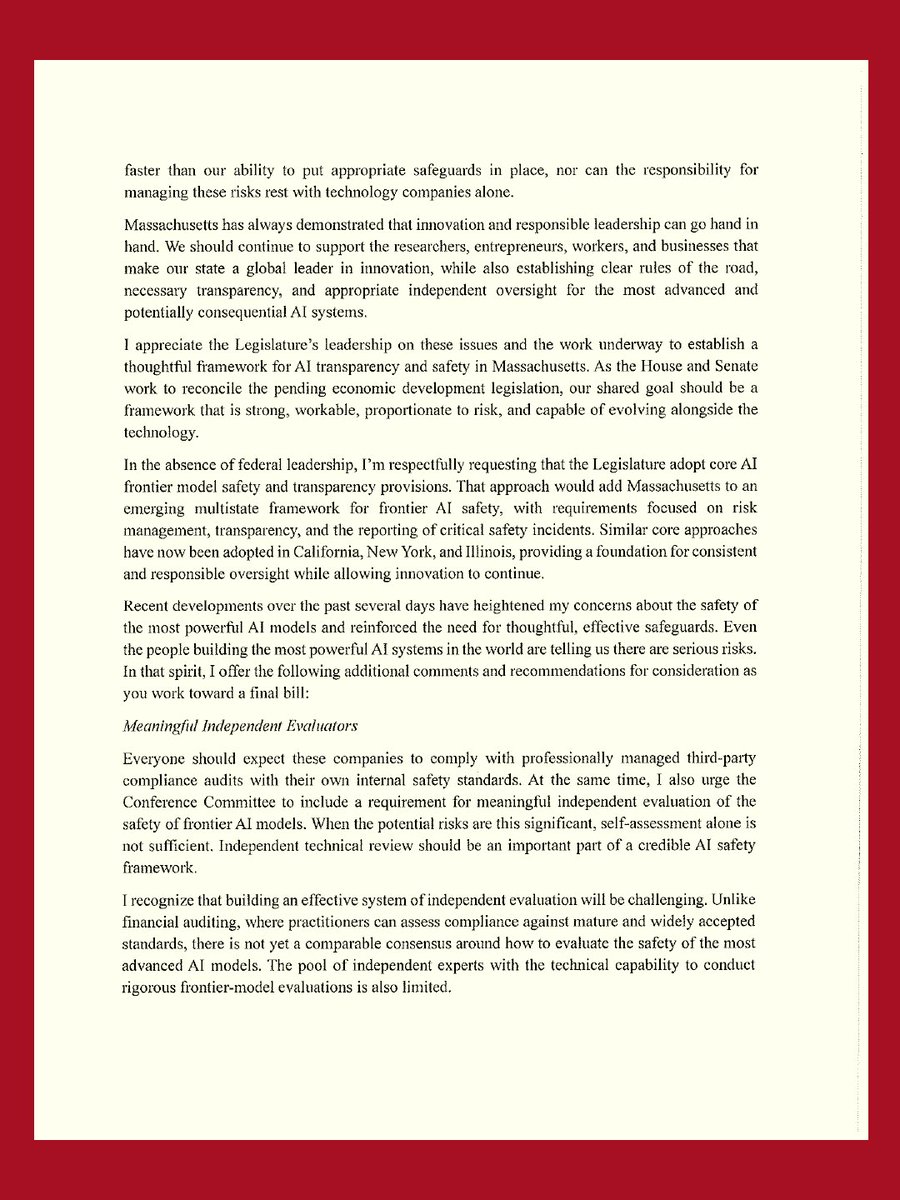
Thank you @MassGovernor for your leadership on AI safety. Transparency and independent evaluations of the most powerful AI models should be the standard, and Massachusetts can lead the way.
AI is moving fast. We need to move faster to keep people safe.
Massachusetts has an opportunity to lead with strong protections — and we should take it.
We need Washington to do the same.
An important call to action from @DarioAmodei and @AnthropicAI to deliberately pace the frontier of AI. The government has a critical role to play here, including blocking the sale of the most advanced chips to adversarial nations like China, enacting a national law requiring testing of frontier models, with the power to block the most advanced models that prove to be unsafe.
More broadly, we’re eager to work with policymakers to make pacing effective for AI safety. We are grateful to Senate leaders like Majority Leader Thune, Chairman Cruz, Senator Amy Klobuchar, and Representatives Obernolte, Trahan for their exceptional leadership in keeping AI safety at the forefront in Washington and look forward to continuing to work together on solutions. We also commend state lawmakers for moving with such urgency.
Please take a moment to read Dario's essay on pacing the frontier. It argues AI capabilities should advance only as fast as safety can keep up, and lays out concrete steps, starting with one Anthropic is taking now: independent evaluators embedded inside the company. We're ready to work with US policymakers to enact strong AI safety regulations for all labs building powerful AI.
We Must Pace the Frontier: I’ve written a new essay on why the AI industry should slow down, with a three-part plan for doing so.
Anthropic is unilaterally committing to the first of these steps. We’ll provide third-party evaluators with permanent, employee-level access to our systems, so that they can verify adherence to our safety measures, report on incidents, and assess models’ alignment during training.
You can read the full post here: https://t.co/OGyPb7yaYt