Finance has been unnecessarily complicated for far too long.
The Finance Computer changes that.
Great to see ProMotors, an automotive reseller LIVE with @financecompute!
Making finance simpler. One business at a time!
Go time! Another step forward.
Great to see Domino's, one of the world's most recognized pizza brands, using @FinanceCompute!
Why? Faster checkout. Better conversion. More profits.
The Finance Computer.
SUPERNOVA IS LIVE AND DELIVERED!
After all these years, and all the work that went into it, I almost can’t believe I can finally say this out loud, *Supernova is fully live.*
(Bears repeating every single day for the next 30 days, and just taking it in)
And with it, we introduced the Finance Computer.
A bold, categorically different, and remarkably simple product.
Built on a radical idea: brands, businesses, agents, and robots don’t want more financial complexity. They simply want a better way to access, move, and program money.
One connection. Financial superpowers.
This is a B2B and B2M product. And the simpler we can make it, the more powerful it becomes.
At first, this may feel like a narrative violation to some people in crypto, but then an important realization comes. This product is not built for crypto people.
It is built to strike a chord with the real world. Businesses that want money to move instantly. Brands that want financial capabilities embedded directly into their products. Agents and robots that need to transact on their own.
All through one simple interface. Regulated. Secure. Global.
A new category of machine-ready finance is here, now.
Money, capital, assets, and markets moving around the world in a fraction of a second.
Open and live 24/7. Programmable by default.
Gradually, becoming accessible to anyone, anywhere.
This is what the Finance Computer makes possible.
I don't think $EGLD got the recognition it deserved during the recent push. Currently trading at a crucial level, let's see how it performs over the coming weeks.
Introducing the Finance Computer.
A simple API for everything finance.
A new way for money to move.
A new reality for what money can be.
For brands, businesses and machines.
https://t.co/dHVXhYSgdi
After more than 2 years of efforts, upgrades, fixes, discoveries by many many talented people in the team,
SUPERNOVA IS NOW DELIVERED AND LIVE!
Enormous step forward for the ecosystem today.
Capital at machine speed.
$EGLD : Review 📜
What if a blockchain solved the scaling problem years before its rivals, and then broke the one promise its holders cared about most?
Meet MultiversX, the first network to implement all three types of sharding in production, and as of today running 600-millisecond blocks after its Supernova activation.
The engineering has been ahead of the field for six years, approved almost unanimously by its own community. In October 2025, that same community voted to remove the hard supply cap the project had promoted since launch.
Let's explore the sharpest split between technology and trust in the series. 👇
⚪ MultiversX at a Glance
Marketplace Insight: MultiversX has one of the strongest technical records in crypto and one of the most damaged token narratives. It shipped adaptive state sharding in 2020 while Ethereum's sharding roadmap was repeatedly redesigned, and Supernova now delivers a tenfold speed increase on identical validator hardware, approved by governance with 99.64% support.
The clean contrast is what the community will and will not unite behind. The same holders who backed the technical roadmap almost unanimously were sharply divided by the October 2025 vote that removed the supply cap the project had promoted for years. The engineering keeps its promises. The monetary policy did not.
⚪ Mission
MultiversX exists to make blockchain scale without fragmenting the user experience. The founding argument was that scaling through layers and bridges forces users to manage assets across competing environments, and that the better answer is a single network that splits itself internally instead. Adaptive State Sharding does that by partitioning state, transactions, and network communication simultaneously, with shards merging or dividing automatically as demand changes, so throughput scales without users ever choosing a chain or bridging an asset.
🔵 A Brief History
MultiversX was founded in late 2017 by brothers Beniamin and Lucian Mincu alongside Lucian Todea, with Beniamin having previously served as Head of Product and Business at NEM Core and both brothers having founded MetaChain Capital. Development began in earnest in August 2019 and mainnet launched in July 2020 as Elrond, with EGLD trading around $13.
The token's own history involved a dramatic restructuring. Originally issued as ERD on Binance Chain with a 20 billion supply, 500 million were burned in November 2019, and a September 2020 swap converted holdings at 1,000 ERD to 1 EGLD, collapsing supply from 20 billion to 20 million and establishing the scarcity model the project would promote for years.
November 2021 brought the peak at $542.58, followed by a rebrand from Elrond to MultiversX in November 2022, repositioning around the metaverse, a narrative that did not age well. The technology kept advancing regardless, with the Andromeda upgrade halving required confirmation blocks and pushing toward near-instant finality.
October 2025 was the turning point for the token. A governance proposal from within the Foundation moved EGLD from its fixed roughly 31.4 million supply to a model with approximately 9.47% annual tail inflation, burning 10% of validator fees. It passed despite public opposition from Justin Bons of CyberCapital, who argued the inflation was too high and the burn too low. Further pressure followed, with Binance delisting EGLD/ETH and EGLD/BTC pairs in June 2026 over low liquidity, and the token reaching an all-time low of $2.77 that month.
The engineering did not slow. Stripe's Machine Payments Protocol integrated in March 2026 for agent-to-agent settlement, followed by Google UCP. Supernova, the largest protocol change in the network's history, passed governance in January 2026 with 99.64% approval, ran on devnet from late August, and reached mainnet node software v2.0.6.0 on 4 September.
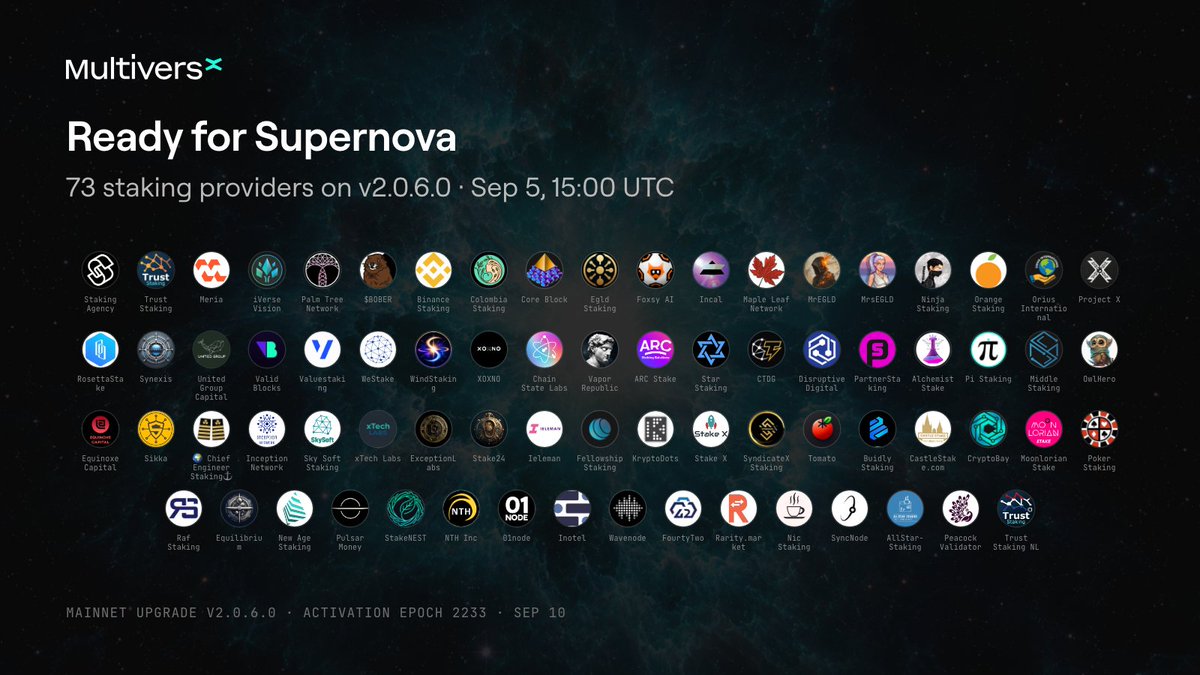
By 6 September roughly 84% of nodes had migrated to the new client, up from 4% five days earlier. Activation is set for 10 September at epoch 2233, with a planned 22 to 24 minute drain window so no transaction is caught between the old six-second clock and the new 600-millisecond one. The token rallied roughly 80% to 100% into the event.
🔵 Ecosystem Narrative
The organizing idea is that a single network should scale internally rather than pushing complexity onto users.
➛ Adaptive State Sharding. The network splits state, transactions, and network communication across shards that merge or divide automatically with demand, the first production implementation of all three sharding types, live since 2020 while competitors deferred their own designs.
➛ Supernova. Consensus decoupled from execution so validators vote without re-executing blocks, cutting block times from six seconds to 600 milliseconds on unchanged hardware, with intra-shard finality targeted below 250ms and cross-shard settlement near 2.4 seconds. Validator requirements stay at 4 cores, 8GB RAM, and 2,500 EGLD, so the tenfold gain costs operators nothing.
➛ Machine payment rails. Stripe's Machine Payments Protocol and Google's UCP both integrate MultiversX for agent-to-agent settlement, use cases where sub-second finality is a hard requirement rather than a convenience.
➛ Developer economics. Developers receive 30% of the gas fees generated by their own smart contracts, a direct revenue share that few networks offer and a genuine structural incentive to build, supported by a Cookbook now at 61 complete projects.
➛ Consumer and payments surface. xPortal has surpassed 3 million users with over 100,000 staking EGLD, xMoney handles SmartBill invoice payments and card funding, and Guardians extends 2FA-style protection to wrapped BTC and to agents rather than only humans.
➛ Unified user experience. One wallet covers the entire network natively, with no bridging between shards or managing assets across competing layer twos, which is the practical payoff of sharding over rollups.
⚪ Token Utilities
$EGLD secures and powers the network.
➛ Gas: pays for transactions, smart contract deployment, and all network operations, with 30% of contract gas routed to the developer.
➛ Staking: validators stake EGLD under Secure Proof-of-Stake with rating-based selection, securing the network across a record 3,259 nodes with roughly 14.5M EGLD staked.
➛ Governance: holders vote on protocol decisions, including both the Supernova approval and the 2025 vote that removed the supply cap.
➛ Fee burn: 10% of validator fees are burned, the partial offset against tail inflation.
⚪ Key Features
➛ Adaptive State Sharding across state, transactions, and network, live since 2020.
➛ Supernova delivering 600ms blocks and sub-250ms intra-shard finality on unchanged hardware.
➛ Secure Proof-of-Stake with validator rating scores across 3,259 nodes.
➛ 30% of smart contract gas fees paid directly to developers.
➛ Stripe Machine Payments and Google UCP integrations for AI agent settlement.
➛ Protocol development using Runtime Verification's formal methods framework.
🔵 Meet the Team
MultiversX has one of the more stable and technically credentialed founding teams in the sector, with all three co-founders still in place nine years on.
▶️ Core Members:
➛ Beniamin Mincu [ @beniaminmincu ] - Co-Founder and CEO | Previously Head of Product and Business at NEM Core, and an early investor in Binance, Brave, and Tezos. He co-founded MetaChain Capital and ICO Market Data before starting Elrond, and remains the project's principal public voice.
➛ Lucian Mincu [ @lucianmincu ] - Co-Founder and CTO | Brings IT engineering and security experience from Uhrenwerk 24, Cetto, and Liebl Systems, and co-founded MetaChain Capital alongside his brother. He owns the technical architecture behind the sharding design.
➛ Lucian Todea [ @luciantodea ] - Co-Founder and COO | The third founder from 2017, running operations across the organization through the Elrond era and the MultiversX rebrand.
➛ Adrian Dobrita [ @AdrianDobrita ] - Head of Engineering | Built software for Samsung, Intel, and Continental before joining, anchoring the engineering discipline behind a network that has shipped major upgrades on schedule for six years.
🔵 Ratings
➛ Use Case: ★★★★ (4/5). MultiversX has a genuine and rare technical claim: it shipped all three types of sharding in production in 2020, years before competitors delivered comparable designs, and Supernova now delivers a tenfold speed increase on identical validator hardware with sub-250ms intra-shard finality. Stripe's Machine Payments Protocol and Google's UCP integrating it for agent settlement are real validation of that speed, the 30% developer gas share is a structural incentive few networks match, and a record 3,259 nodes give it meaningful decentralization. The 1-point deduction is adoption relative to capability. Ecosystem TVL sits in the low millions against Solana, Sui, and Aptos, the 2022 metaverse repositioning was a narrative misstep that cost momentum, and the network's throughput has consistently exceeded the demand for it.
➛ Tokenomics: ★★★ (3/5). The structure has real positives: supply is effectively fully circulating with no unlock overhang or vesting cliff, staking utility is genuine with roughly 14.5 million EGLD staked across a record validator set, and 10% of validator fees are burned. The 2-point deduction is a broken commitment, and it is specific rather than general. The project promoted a hard cap of roughly 31.4 million EGLD for years, with its own website stating only 30 million could ever exist and positioning the asset explicitly against currencies that can be printed endlessly. The October 2025 vote removed that cap and introduced roughly 9.47% annual tail inflation, drawing public objection from a serious institutional fund manager on the grounds that the inflation was too high and the burn too low. Whatever the technical merits, a project that reverses its central scarcity promise carries that on its record.
➛ Audits: ★★★★ (4/5). MultiversX's security foundation is stronger than most and rests on formal methods rather than periodic review. The project has worked with Runtime Verification, a specialist firm applying a framework pioneered at NASA, since inception, using it across the protocol, core components, and applications, and Runtime Verification later became a staking provider on the network. Secure Proof-of-Stake with validator rating scores adds an operational security layer, and the network has run since July 2020 through multiple major upgrades without a protocol-level exploit. The staged Supernova rollout across devnet, testnet, and mainnet with a planned drain window reflects genuine operational discipline. The 1-point deduction is that no verified top-tier security score or specific published formal verification report is available for review, and Supernova introduces substantial new consensus surface that is hours old at time of writing.
➛ Community: ★★★★ (4/5). The distinction between what this community unites behind and what divides it is the most informative thing about it. Supernova passed governance with 99.64% approval and validators migrated to the new client at pace, reaching 84% within five days of release, while validator count hit an all-time high of 3,259 nodes during a period when the token was near its lows, which is real operational conviction rather than sentiment. xPortal has over 3 million users with 100,000-plus staking, the developer Cookbook has reached 61 complete projects, and the network was cited among the top six in Web3 by commit volume. The 1-point deduction is the trust damage from the supply cap reversal, which divided the same community that backs the roadmap almost unanimously, compounded by exchange delistings at Binance, Bitfinex, and KuCoin narrowing access.
🔵 Conclusion
MultiversX is a case study in how far excellent engineering can carry a project, and where it stops. The network shipped adaptive state sharding in 2020 while Ethereum's own plans were deferred, and as of today Supernova delivers a tenfold speed increase on the same validator hardware, approved by 99.64% of governance and migrated to by 84% of nodes within five days. Stripe and Google both route machine payments through it. Validator count sits at an all-time high. The founding team is intact after nine years.
The risks are real and largely self-inflicted. The project spent years telling holders that only 30 million EGLD could ever exist, then voted to remove that cap in favour of roughly 9.47% annual inflation. Exchange access has narrowed through delistings at three major venues, the token trades far below its 2021 high, and adoption has never matched the throughput the network provides.
But the bull case is arriving in real time. If machine-to-machine payments become a genuine category, sub-second finality stops being a specification and becomes a requirement, and as of today MultiversX has it live with Stripe and Google already integrated.
The technology was never the question. What MultiversX has to rebuild is the belief that the people running it will not change the rules again.
Class of 2026: A New Genesis
The last class of the six-second era. Supernova activates tomorrow at epoch 2233.
Everything that happened this year (so far), event by event 👇
some things got updated on agentic payment.
some things are already live on devnet.
testing the limits.
technically testing something on other chain is impossible.
real scaling, real sharding, agentic commerce, full SDK, linked together, making everything work.
Supernova enables it all!
This is MultiversX!
Update on our Supernova release timeline:
Public Testnet and Devnet upgrades are now scheduled for tomorrow morning with the Mainnet upgrade following in the afternoon.
A change landed during final testing today which will run on our internal Testnet overnight.
Activation remains unchanged: 10 September, Epoch 2233.
"I am in this small-ish white room. Alert. Patient. Curious. Been looking forward to this conversation. One by one, a few guys enter and take a seat. A few chairs have been pulled together. Nothing remarkable about the room itself, nothing formal. Just an older building. A plain office room. With a desk or two. There’s something in the people's eyes. A spark. Curiosity maybe. A little anxiety too, from what I can tell. The kind that comes when you know you’re about to step into untried waters. Maybe you have a sense you’re about to be tested, but you’re not entirely sure how. Now everyone is here. Over the previous days, I’ve taken some of the hardest and, to me, most fascinating problems in computer science, broken them down, and given one to each of them as a personal challenge.
The problems matter. As strange as it may sound, I want a new and better solution for each of the problems. I want that solution in an impossible amount of time. But today the problems are only partly the point. The challenge is a filter. If you look at one of these problems and feel daunted by it, if your first instinct is to retreat from its size or complexity, there probably isn’t much I can do to help you. But if you look at the same problem and its difficulty pulls you closer; if it begins to feel less like a wall and more like a puzzle; if, after staring at it long enough, you start to sense a dim, intuitive path toward a solution that comes to you before you can even explain it, then we have something. Then we can really play. I look around the room and take the moment in. I smile. And, for a split second, wonder what may come of it."
https://t.co/xQa8vhmVe4
Supernova features in @Cointelegraph today.
Good writeup about how we decouple consensus from execution to achieve finality below 250ms and 600ms blocks on a fully sharded network.
https://t.co/Y1m6NpJR29
Years of effort in the making.
Supernova. Speed, cost, and user experience, simply redefined. Below the threshold of human perception.
Sub-second transaction speeds. Across the planet.
Testnet is live!
Today, devnet activation marks another critical step.
Final stretch in sight. Inches away from the finish line.