@SEeckelaerts Bedankt voor het delen. De kernvraag lijkt me inderdaad te zijn wanneer persoonsrechten starten, waaronder art. 3 UVRM.
Daarover ook nog steeds missend in dit debat: hoe belangrijk vinden we biologisch noodzakelijke voorwaarden voor 'personhood'?
https://t.co/McBgR6NUyX
Wel moeten we het binnen CD&V eens hebben over de link tussen #personalisme en #abortus.
Zeker omdat personalisme een -uitdagende- stroming is binnen de bio-ethiek, en beschreven staat in dingen als de Journal of Medical Ethics.
https://t.co/AqlC9bqis2
Gelukkig zijn er nog filosofen die een platform krijgen om het verschil tussen beschrijving en voorschrijving uit te leggen.
Dat negeren is een zwakke manier om cd&v inzake abortus te bekritiseren, geen idee waarom een aantal partijen hierop inzetten.
https://t.co/VosGHiZxBG
@brentbellefroid Ik zou het veel interessanter vinden moesten andere partijen t.a.v. cd&v zeggen "Ja, het klopt dat wetenschap niet bepaalt wat we belangrijk horen te vinden. Maar waarom vinden jullie x belangrijk en niet y?"
@brentbellefroid Mensen kunnen correct zijn wat het is-oughtprobleem betreft en nog steeds argumenten aanvoeren waarover je kan discussiëren.
Daarover: ik mis van alle partijen in dit debat helderheid over wat men belangrijk vindt, en over hoe dit linkt naar feiten en afwegingen.
Ik merk vandaag nogmaals dat het abortusdebat in Vlaanderen bol staat van de non sequiturs en particuliere redeneringen.
Elke partij bezondigt zich er meer of minder aan.
The French hate air conditioning.
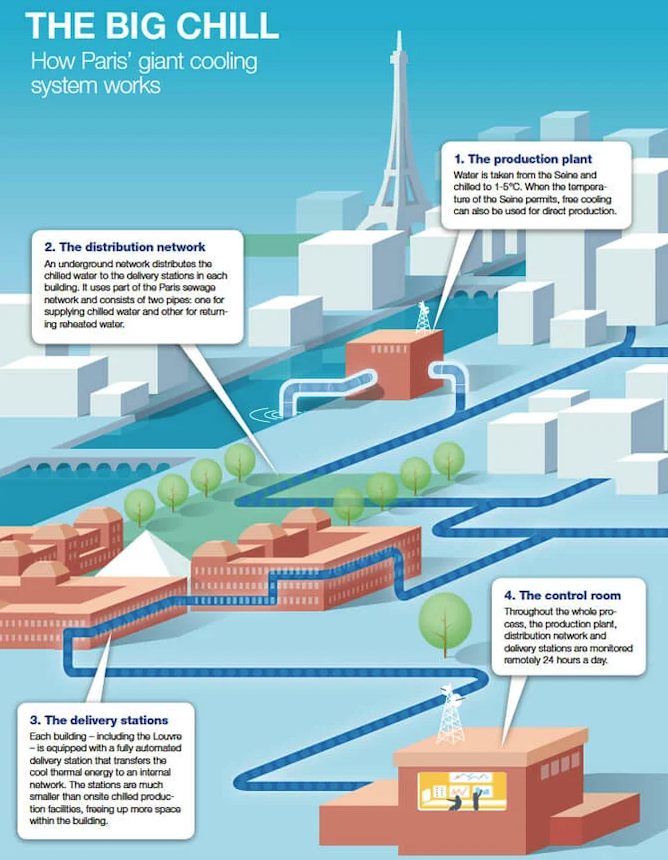
So Paris built a 120-kilometre machine under its streets for producing cold.
It’s called Fraîcheur de Paris, and it does for summer heat what district heating did for winter: centralise the problem.
Instead of every museum, office, hotel, hospital and shop bolting its own cooling plant onto the building, Paris moves cold through pipes.
The network sends water chilled to 2 to 4°C through buried supply lines. The water enters a connected building, absorbs heat through an exchange station, then returns at 12 to 14°C to be cooled again.
It essentially functions with two pipes. One carries the cold out, the other carries heat back.
The production plants cool the circuit from 12°C to 4°C. Some sites use the Seine as a heat sink. In colder periods, the system can use the river’s own temperature for free cooling, which means the machines work less and the electricity demand drops. The Seine water doesn’t become the building water. It stays separate, passing temperature across heat exchangers.
The scale is pretty strange when you see it written down though.
It's got 15 production sites, 4 storage sites, 120 km of underground network with 924 subscribers. This has resulted in 7 million square metres cooled, and 493 GWh of cooling sold.
A cold utility running beneath one of the densest cities in Europe.
The Forum des Halles has been cooled this way since 1979. The Louvre since 1986. Galeries Lafayette, Opéra Garnier, Hôtel de Ville, Station F, La Samaritaine and the National Assembly all sit on the same idea. Tourists stand in the Louvre looking at paintings while a municipal cold loop does part of the dull work below ground.
The boring part is the breakthrough.
Cold can be stored at night in chilled water or ice, then used during daytime peaks. The network is monitored from a control room with more than 125,000 control points. A delivery station inside a building takes 5 to 7 times less space than a standalone cooling installation and avoids the roof and façade clutter that turns cities into compressor farms.
That matters because conventional air conditioning solves heat by moving it somewhere nearby. In a dense city, thousands of private machines mean thousands of outdoor units rejecting heat into streets, courtyards and roofs, plus refrigerants, noise, vibration and maintenance spread across every building.
Paris’s public cooling network has a stated coefficient of performance of 4, against 3 for a wet standalone system and 2 for a dry standalone system. Against an equivalent set of autonomous installations, Fraîcheur de Paris says the network gives 100% higher energy efficiency, 35% less electricity use, 90% fewer refrigerant-fluid emissions and 50% lower CO2 emissions.
The climate backdrop is the real reason this exists.
Paris ran a full crisis exercise called “Paris at 50°C” in 2023. Météo-France’s 2050 reference trajectory for France points to heatwave days becoming five times more frequent, hot nights rising sharply in urban centres, and some local extremes around 48°C becoming possible.
The city signed a 20-year concession in 2022 with Fraîcheur de Paris, owned 85% by ENGIE and 15% by RATP. The contract is worth a projected €2.4 billion. The plan is to extend the network by 158 km by 2042, add 20 production plants and 10 storage sites, and reach more than 3,000 subscribers, including hospitals, nurseries, schools and care homes.
This is basically the infrastructure version of admitting that summer is becoming a public systems problem...
Most people, including really accomplished people, don't have an accurate mental model of how LLMs operate (and why would they?)
You see this in wide beliefs that AI is just copying from known sources, or that it only produces average answers, or that it can't generate new ideas
"Russia’s declining gains appear to be unrelated to the seasonal weather shifts that traditionally hinder advances, but is likely the result of more comprehensive battlefield shifts in 2026."
NEW: Ukrainian forces have largely halted the Russian Spring-Summer 2026 offensive so far, and Russian forces in May 2026 have gained a presence in only a fraction of the territory they did in May 2026.⬇️
ISW observed evidence to assess that Russian forces gained control of or infiltrated 40.64 square kilometers between December 2025 and May 2026. Russian forces, however, lost 281.1 square kilometers in the same time period when only considering territory that Russian forces control. (ISW’s infiltration layer shows areas in which Russian forces — sometimes very small groups of a few soldiers — have infiltrated and maintain a limited presence interspersed with Ukrainian positions but do not control.)
ISW calculations show that Russian forces lost control of about 281 square kilometers in part due to the fact that ISW recodes areas in the Russian advances layer to infiltrations when new evidence allows ISW to reassess the level of control Russian forces maintain over an area. ISW’s calculations that the Russian forces lost control of 281 square kilometers thus do not inherently mean that Ukrainian forces liberated that amount of territory.
Other sources with different methodologies are also recording a slow Russian rate of advance in May 2026.
Russia’s declining gains appear to be unrelated to the seasonal weather shifts that traditionally hinder advances, but is likely the result of more comprehensive battlefield shifts in 2026.
@GeertLangenus Ze blijven maar gaan :)
On topic: alleen al om geopolitiek zou ik zo'n concentraties vermijden. De vraag is hoe.
Voor mij: prioriteit is de onafgewerkte interne (kapitaal)markt, waarbij het idee van national champions moet wijken. Pas nadien komt reguleringsomvang op het menu.
The sum-product conjecture was just disproven - by humans! Last week the unit distance conjecture was disproven by AI, but the authors took some inspiration from the methods of that paper to apply it to this new result. My YouTube explainer on the conjecture in the reply:)
@UwDienstwillige@freekvdvelde Er lijkt me daarbij ook steeds het volgende patroon terug te keren:
1) een casus doet sommigen vragen naar perfecte ijking
2) bij nader inzien blijkt perfecte ijking niet altijd mogelijk
3) juridisch beoordelingsvermogen beperken tot perfect ijkbare concepten blijkt onwenselijk
Alsof @PBS ook op het Belgische publiek mikte, wanneer het deze week een stuk uitbracht over rechtspraak en interpretaties van woorden:
'The Problem with Judges Acting Like Linguists'
https://t.co/eksCY3EXis
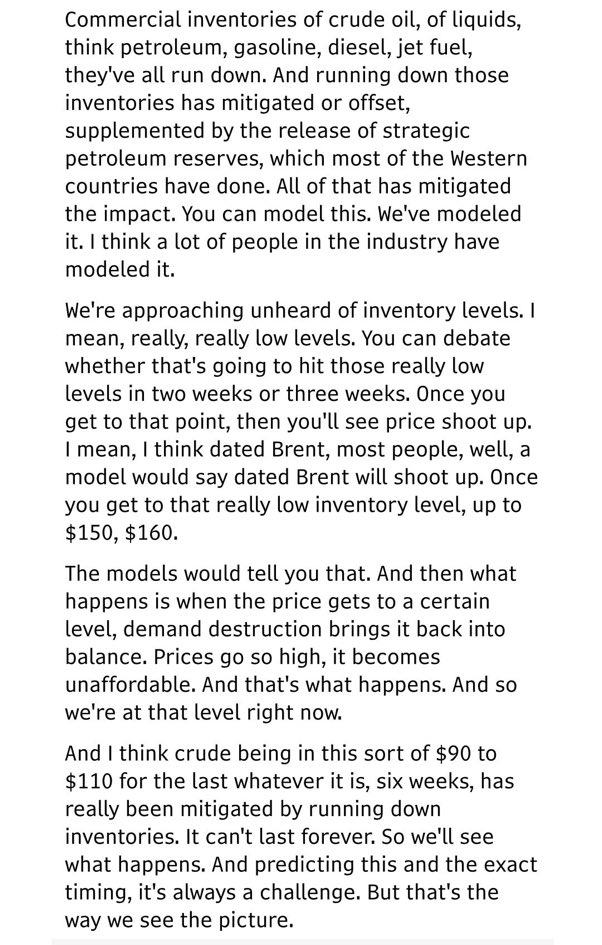
Everyone should read what Senior Vice President of Exxon Neil Chapman says about the oil price surge coming in 2-3 weeks
The next wave of the energy shock is approaching fast
@FrankVanmeenen@PLoobuyck Het lijkt me toch verdedigbaar om over ideeën te spreken met woorden als "mensen" en "wie nu". Want het zijn op het einde van de dag mensen die ideeën hebben.
Het lijkt me hier ook niet de functie te hebben v/e gezagsverhogend element.