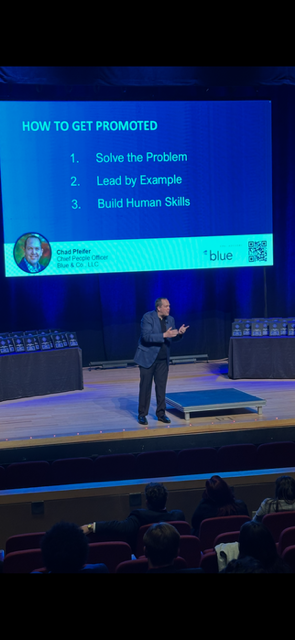
Culture is built in the rituals. The way you celebrate wins. The way you debrief losses. The weekly stand-up. The cadence of one-on-ones. These small, repeatable moments are where culture actually lives. If someone observed your team rituals for a week, what culture would they describe?
Courage is the one leadership skill that makes all the others work. Without courage, your vision stays a dream. Your feedback stays unspoken. Your strategy stays safe. Courage is not the absence of fear. It is the decision that your team deserves better than your comfort zone. What courageous conversation are you avoiding?
Have you seen this? One high-performer surrounded by average players does not lift the team. It burns out the high-performer. When every team member thinks like an owner, performance compounds. When they do not, your best people leave. Are you building a team of owners or a team of renters?
The leadership paradox is not making the big decision. It is having the small conversation. The coaching moment that takes five minutes but changes a trajectory. The feedback you give on Tuesday that prevents a disaster on Friday. Are you investing in the small conversations or just managing the big ones?
The most impactful mindset shift for someone's career is moving from thinking like an employee to thinking like an owner. What does that look like? For one, you stop outsourcing your growth to your employer. Your development plan is your responsibility. Your network is your responsibility. Your relevance in the market is your responsibility.
What skill are you building right now that no one assigned you?
Your managers are your people strategy. You can have the best benefits, the best HRIS, and the best talent acquisition team in the industry. But if your frontline managers cannot coach, develop, and retain talent, none of it matters.
Stop investing in programs. Start investing in manager capability. When was the last time you measured your managers on how many people they developed, not just how many they managed?
One mistake I notice in HR and People strategy is that most leaders treat it like a support function. The best operators treat it like their primary growth lever. Your hiring speed, retention rate, and manager capability are not HR metrics. They are business metrics. If your CFO can tell you revenue per client but nobody can tell you revenue per employee, you have a blind spot. What is the one people metric your leadership team should be obsessing over right now?
Authenticity is not weakness. It's really the ultimate power move. When a leader says I do not know or I was wrong, it does not erode trust. It builds it. The leaders who pretend to have it all figured out are the ones people stop following. What is the last thing you admitted to your team that you got wrong?
The most effective people I know protect their mornings like their career depends on it. Because it does. Before the emails. Before the meetings. Before the noise. That first hour sets the trajectory for everything. What does your first hour look like?
The greatest leader in history never held a title, never sought applause, and never put Himself first.
Jesus didn’t lead from a throne — He led with a towel and a basin, washing the feet of the people He served. His entire life was a masterclass in one truth: real leadership is sacrifice.
You don’t have to share my faith to recognize the power of that model. The leaders who change the world — at work, at home, in the community — are the ones who ask, “What do you need?” before “What do I get?”
Servant leadership isn’t weakness. It’s the hardest, most courageous way to lead. It costs you something. It’s supposed to.
Whether you follow Jesus or simply respect the example — lead like someone who came to serve, not to be served. The people around you will never forget it.
You can't build culture by committee. Someone has to own it. Someone has to be willing to have the uncomfortable conversation when values are violated. Culture requires a champion. Who owns culture on your team, or is everyone assuming someone else does? #culture#leadership #teamwork
Your energy is a strategic asset. The most effective professionals don't just manage their time. They manage their energy. They know when they do their best thinking, when they need recovery, and when to push through. Burnout isn't a badge of honor. It's a strategy failure.
Are you managing your energy as intentionally as you manage your calendar?
Are you on a team or lead one? Undoubtedly you've seen this play out. Trust is the foundation. Without it, every meeting takes longer. Every decision gets second-guessed. Every change meets resistance. With it, speed and execution become your competitive advantage. On a scale of 1-10, how much does your team trust each other?