AI × Web3 commercialization accelerator.
We help founders validate demand, win first customers & launch pilots — backed by research, media & industry networks.
Market Pulse + SecurityBitcoin reclaims $61,000 after a brutal weekend flush.
BTC briefly touched multi-month lows near $55k before a sharp relief bounce
~$1.8B in liquidations cleared leveraged positions
Fear & Greed remains in Extreme Fear territory
Meanwhile on the security front:
Chainflip’s $12M exploit deadline hits today (18:38 UTC). The team offered the attacker a 10% bounty to return 90% of the funds.Separately, Fusionist’s ACE bridge saw an exploit that snowballed into a ~$3.7M free-for-all as traders drained the remaining liquidity.Risk remains elevated. Capital is selective.#Bitcoin #Crypto #DeFi #ChainInsight
You scroll. Gemini does the busywork. 🖱️
Gemini’s Mac app can now click buttons, fill forms, and work across apps—from reading PDFs for shipping quotes to batch-editing photo colors.
It works in the background. Your mouse stays yours. Watch it live, pause anytime, and choose which apps it can access.
Rolling out to U.S. AI Plus, Pro, and Ultra users. Requires an Apple silicon Mac running macOS 15+.
With computer use in the Gemini app for Mac, you can now hand off tasks across your folders, apps, and the web, while your screen and cursor stay yours.
Watch Gemini click, scroll, and type in a live background window, turning a quick sketch into a rigged 3D model in Blender.
U.S. Approved 879,000 AI Chips for China, Including 272,000 for Tencent and Three Other Companies
November 20 — The U.S. Commerce Department approved licenses covering 879,000 AI chips for shipment to China between December 2025 and May 2026, according to House Foreign Affairs Committee data reported by Reuters. The chips included Nvidia’s H200 and AMD’s MI325X.
📊 Four Companies Received Approvals for 272,000 Chips
Tencent: 150,000
Alibaba: 75,000
Baidu: 43,000
BYD: 4,000
Companies applied to ship more than 3.4 million AI chips to China during the same period. These figures represent approved quantities. Actual deliveries require separate confirmation.
🏛 Export Licenses Face Congressional Scrutiny
The committee noted that some approved customers appeared on the Pentagon’s list of companies it identifies as having ties to China’s military. Bloomberg reported that some companies were added to the list after receiving approval.
💬 Nvidia and AMD Respond
Nvidia said the licenses covered limited quantities and carried strict conditions. The company has since stopped shipping H200 chips to China. AMD said it complies with applicable U.S. export control laws and regulations. Reuters report
Nvidia and AMD received Commerce Department approval earlier this year to ship AI chips to Chinese customers, including companies that were later added to a Pentagon list of businesses accused of aiding China’s military, new documents find https://t.co/as58RAe41k
Microsoft has offered 60,000 employees a “voluntary exit program”: it’s not a layoff—it’s an invitation to choose to leave of your own accord.
It’s like a waiter asking you, “Would you like to pay the bill voluntarily, or wait for me to slap it in your face?”
The most striking part is that case: an 11-person team that doesn’t develop products, but focuses solely on using AI to build a “development process.” In plain English: their KPI is to build systems that can replace more people.
The most stable job in the AI era—teaching AI how to replace others.
Claude writes your code. Now Anthropic wants a spot in your portfolio. At $83 a share and a $1.5 trillion valuation, it’s investors’ turn to check the work. https://t.co/8M5vSzGEdm
Chinese President Xi Jinping met with U.S. President Donald Trump in Shenzhen at noon on November 19. Trump was in China to attend the APEC Economic Leaders’ Meeting.
Binance Secures $6.5B Worldwide Freezing Order, Tracks Around 26,000 Wallets
Binance says it has obtained a $6.5 billion worldwide freezing order from the Abu Dhabi Global Market Courts to help recover crypto stolen in the October 29 hack, The Block reported.
⚖️ Legal Grounds to Return Frozen Funds
The court also issued interim injunctions and asset delivery orders. Some apply to issuers, exchanges, and other parties already holding frozen assets. Binance has not accused those partners of wrongdoing.
Some institutions require a court order before they can return frozen funds.
🔍 Around 26,000 Wallets Under Tracking
The orders can be served via blockchain. Market participants will receive updates to a rolling list of wallets identified as holding stolen assets, helping partners identify and freeze funds as they move.
💰 Recovery Still Faces Technical Hurdles
The orders provide legal support for recovery, but progress depends on the assets involved and cooperation from those holding them. Elliptic co-founder Tom Robinson previously estimated that around $3.3 billion remained in BTC, ETH, and XRP, which lack the direct freezing controls available to stablecoin issuers.
Switch AI assistants, introduce yourself all over again? Second wants to fix that.
First Person Labs has launched Second, a personal memory tool, and announced a $10 million seed round led by a16z.
🧠 Help different AI agents pick up where you left off
Second reads activity on your Mac to build an evolving picture of your projects, work habits, and preferences, then makes that context available to AI agents you authorize.
The goal is simple—spend less time explaining who you are, what you’re working on, and where you left off whenever you switch assistants.
🔌 Make memory portable
Second provides context to different agents through APIs. Users control which applications and agents can access their personal memory.
According to a16z, the product runs on-device by default. Its founder also described private-cloud processing, so the product documentation will need to clarify what stays local and what gets uploaded.
Introducing Second, and a $10M seed led by @a16z.
Second builds a model of you that you own, and your agents can use as an API.
Truly personal software needs a deep understanding of you: not just your emails and messages, but how you work, what motivates you, your people, priorities, style, goals, and intent.
This requires a new kind of personal AI infrastructure. One that continuously aggregates your context, distills it into durable understanding with a ton of compute, and then serves it securely, ubiquitously, and up-to-the-minute. One that builds your *portable user model*.
Second is that infrastructure. It installs seamlessly on your Mac, and your context just comes out. Live APIs of your priorities, to-dos, wikis, writing samples, preferences. Or what you did minutes ago. Or context packs of anything, dynamically assembled in seconds.
Second is streaming-state from local to a private cloud, which means anything you connect to--whether Claude, Dot, Muse, Grok Bot, Instinct, or iMessage--shares the same, growing, continuous understanding of you.
Your portable user model is as powerful as it is sensitive. We founded @FirstPersonLabs on the principle that it should belong to you. This commitment means taking on hard systems and security problems and making sovereignty an invariant of Second from the beginning.
We've barely scratched the surface of what portable user models can unlock. Deep understanding of us, served at machine speeds, could drive the next leap in personal software, human-computer interaction, large-scale coordination of humans and agents, and more!
We're tremendously grateful to be supported by @a16z (@martin_casado, @YODELAGARZA), Mozilla Ventures, @JeffDean, Ram Shriram, Jeetu Patel (@jpatel41), @percyliang, J. Alex Halderman (@jhalderm), @sanmikoyejo, and many others.
Our vision is for a future where every person is more powerful, because they have the ultimate affordance: personal computers that fully understands them on their own terms.
If this excites you, we're hiring and come build with us!
AI+IP Growth Workshop · Shenzhen 🇨🇳 No lectures. 3 hours of hands-on work.
01|FDE engineers break down your business process live
02|Write shoot-ready short-video scripts on the spot
03|Take home a content SOP — from manual work to AI batch production
📍 Nov 24 (Tue) 14:30 · Nanshan, Shenzhen
🎫 ¥99/person · 30 seats only
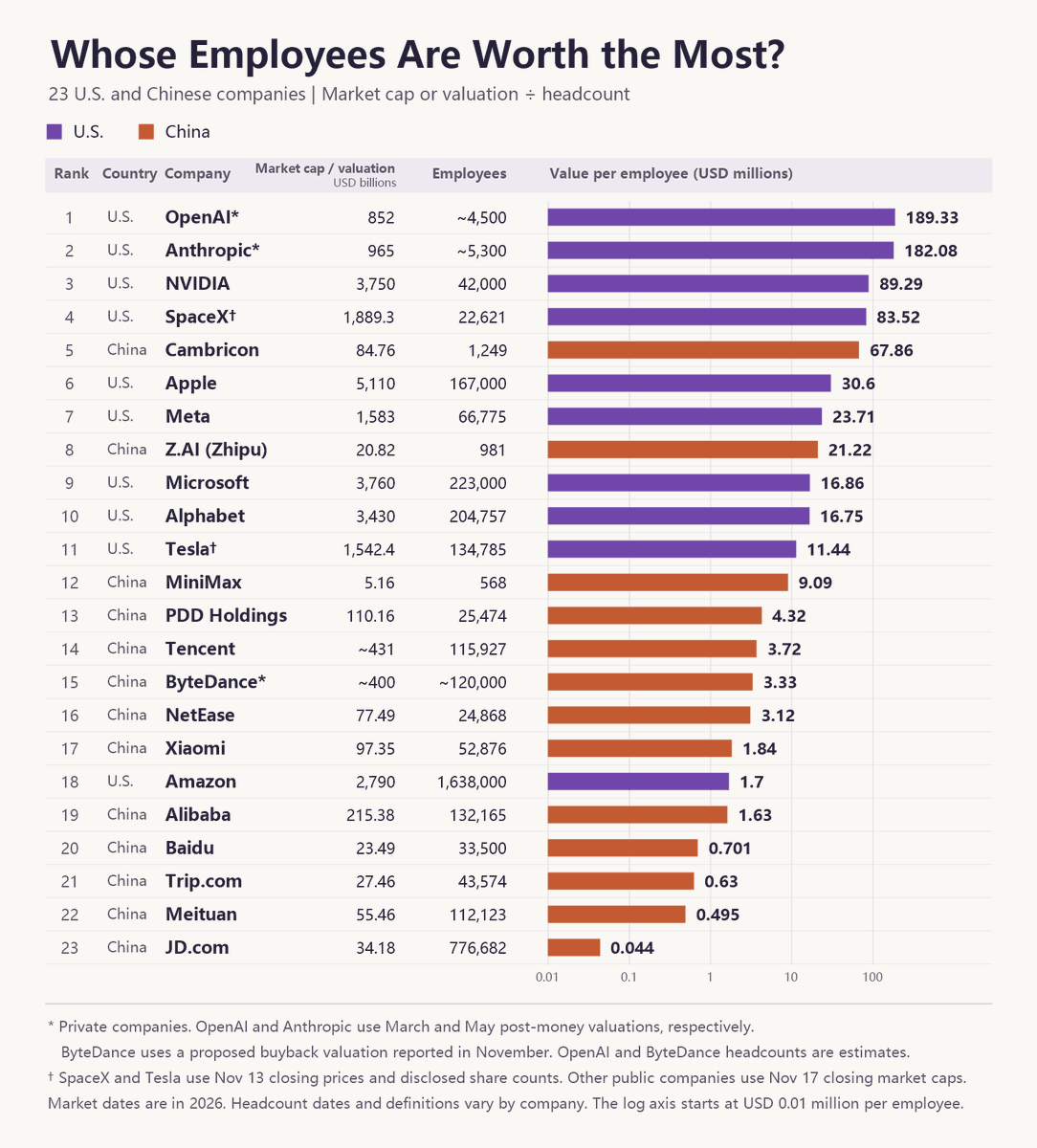
Whose employees are “worth” the most?
Across 23 U.S. and Chinese companies, market cap or valuation per employee ranges from $44K at https://t.co/2ITRTTKmlb to an estimated $189M at OpenAI.
Among listed companies, NVIDIA leads at $89M per employee, followed by SpaceX and Cambricon.
@wantlvm A little goodwill before the next negotiation never hurts 😄 Especially when you’re also trying to keep several chip suppliers competing for your business.
Sam Altman calls Jensen Huang his hero and says OpenAI will eventually go public. He also has a warning for chipmakers: When several suppliers are counting on the same big order, how many times does that demand get counted? https://t.co/rgnq1QgO2p
@vietzend That’s the funding question: how quickly can OpenAI turn all that capacity into revenue? The rollout timelines and payment terms matter as much as the headline gigawatts.
Nvidia’s Revenue More Than Doubles as Board Rules Out Jensen Huang’s Return
Nvidia released its first earnings report since Jensen Huang’s resignation. Revenue for fiscal Q3 2027 reached $115.8 billion, up 103% year over year and 20% quarter over quarter.
📊 Data Centers Account for Over 90% of Revenue
Data center revenue reached $107.6 billion, up 110% year over year, remaining the main growth driver. Adjusted earnings per share came in at $2.68. The company also announced that Vera Rubin NVL72 shipments had begun.
🔮 Further Growth Expected, With Margins Under Pressure
Nvidia forecast fiscal Q4 revenue of $130 billion, plus or minus 3%, excluding any data center compute revenue from China. It expects gross margins of 71%–72%, down from Q3’s adjusted gross margin of 74.9%. Alongside revenue growth, changes in profitability will also be worth watching.
👔 Board Gives a Clear Answer on Huang’s Return
Chairman Harvey Jones said on the earnings call that the board unanimously accepted Huang’s resignation and has no intention of reinstating him as CEO. Colette Kress remains interim CEO while the company searches for a permanent successor.
Claude just created a new $90K/year job in China: account babysitter.
Not coding. Not training models. Making sure the company can keep subscribing to Claude without getting banned. $3K-$6K/month, up to ~$90K/year at peak.
The job involves: overseas phone numbers, remote desktops, proxy registrations, account trading, and beating Anthropic's identity verification. One person reportedly rode a motorcycle 1,500 km to an Indonesian village to get locals who don't even know what Claude is to help with KYC — their names suddenly attached to multiple AI accounts.
Crypto natives know this playbook. Used to be for airdrops and token launches. Now it's for an AI subscription.
When a tool is so good that users hire full-time staff just to keep access, that's a market signal. But the flip side is absurd: we're shipping computers overseas, borrowing Indonesian villagers' identities, and spending $6K/month to not get banned from a chatbot.
When will domestic Chinese LLMs catch up? Not when they match parameters — when they make users feel "I don't need to take the back door."