🚨 Global Announcement
ChainX Officially Launches Post-Quantum Hardware Wallet Cracking Initiative
We extend an open invitation to the global security community to participate in cracking the ByteVault hardware wallet.
💰 Total Prize Pool: $1,000,000
🔐 Decryption Target: ByteVault Hardware Wallet
🌍 Open to All – Results Speak for Themselves
True security must withstand real-world attacks.
🌐 Official Challenge Portal:
👉 https://t.co/Sf2kpHvEJZ
📄 Challenge rules, technical specifications, and submission methods are fully disclosed on our official website.
🚀 ChainX Vault Multi-Signature Wallet Officially Launched
Digital asset security, taking it a step further.
ChainX Vault now officially supports Multi-Signature, combining with the ByteVault hardware wallet to build a comprehensive protection system integrating software wallet, multi-signature, and hardware security, providing individual users, teams, and institutions with a higher level of digital asset security solutions.
How to Use: Go to Wallet → Discover → Tools to enable the Multisig Wallet function.
Core Advantages:
🔹 Multi-signature mechanism effectively improves the security level of asset management.
🔹 ByteVault hardware wallet offline signing, with private keys isolated from the network throughout the process, further enhancing asset security.
🔹 Multi-device adaptation, seamless collaboration, balancing ultimate security with a convenient user experience.
🔹 Supports diverse scenarios such as personal asset management, family asset allocation, large-amount asset custody, and team collaboration.
True security is not just about protecting private keys, but about building a trustworthy security system. ChainX Vault and ByteVault are jointly building a new generation of digital asset security infrastructure, establishing trust for every signature and safeguarding every asset.
[ByteVault Security Sharing]
The recent COLDCARD hardware wallet vulnerability has drawn industry-wide attention.
Many people believe Bitcoin has been hacked, but that's not the case.
The real problem lies in a vulnerability in the random number generation logic for the hardware wallet's private key (mnemonic phrase). This vulnerability allowed some private keys to be predictable, and attackers exploited it to recover the private key and transfer approximately 594 BTC.
This incident once again illustrates that:
What truly determines the security of a hardware wallet is not just offline storage, but whether the private key is truly secure from the moment it is created.
This is also one of ByteVault's core strengths.
ByteVault focuses on ensuring the security of the private key generation process from the underlying security architecture. It employs multiple security mechanisms to reduce single points of failure and integrates a post-quantum cryptography (PQC) algorithm. While ensuring the security of current assets, it provides a higher level of security protection for the future quantum computing era, rather than relying solely on "offline" or "secure chips" as marketing points.
True security is not just about protecting today's assets, but also about safeguarding the security of digital assets for the next ten or twenty years. Security is not just a slogan, but the accumulation of every detail. This is also the design philosophy that ByteVault has always adhered to.
Official purchase
https://t.co/p74AifOVEw
🧧 The Red Packet feature is officially live!
Let digital red packets become a new way to interact within the community.
Whether it’s holiday giveaways, community events, or sharing with friends, you can send red packets with a single tap via BTX Link, making every interaction more meaningful.
BTX Link isn’t just a chat app—it’s a constantly evolving Web3 social platform.
🚀 More features are coming soon:
🎥 Live Meetings
🎁 Meeting Tips
📸 Moments
👍 Likes
🎬 Video Sharing
✨ More community ecosystem features coming soon…
In the future, we hope to truly integrate communication, socializing, content, and digital assets to create a freer, more open Web3 social experience.
Download BTX Link now to try it out 👇
🌐 https://t.co/O5Tqipc7aO
#BTXLink #Web3 #Crypto #CryptoRedPacket #Decentralized #SocialFi
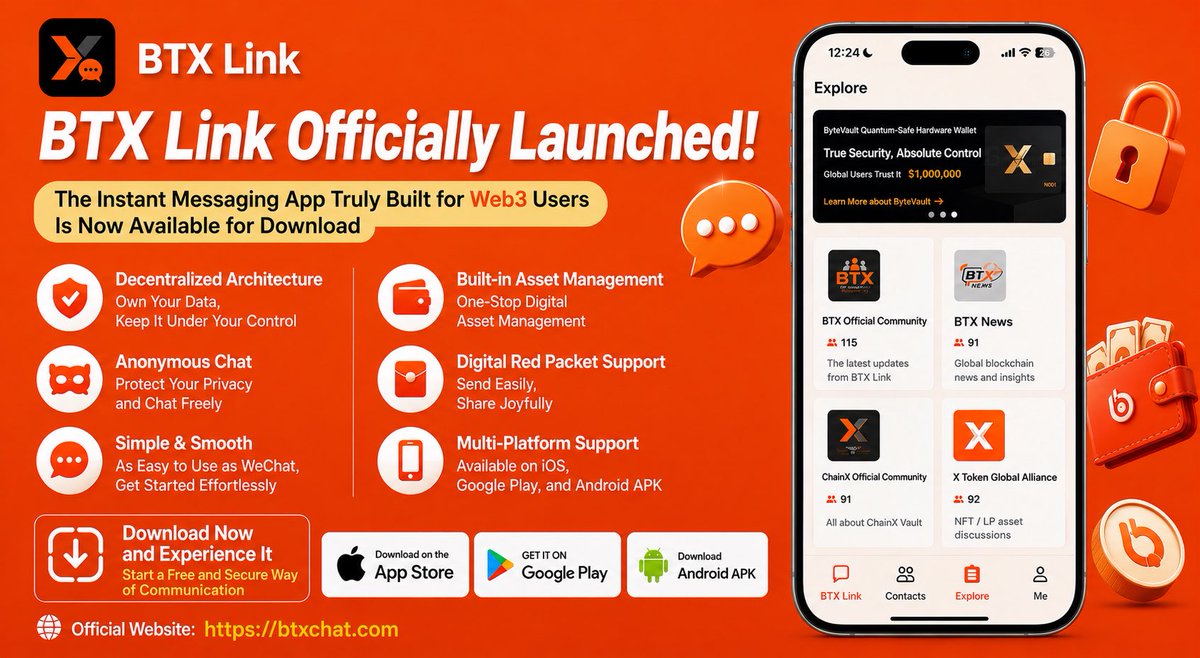
🚀 BTX Link is officially live!
The instant messaging app truly designed for Web3 users is now available for download.
Why choose BTX Link?
🔒 Decentralized architecture for greater data autonomy
👤 Anonymous chats to protect your privacy
💬 Simple and smooth—as easy to use as WeChat
💰 Built-in asset management
🧧 Supports digital red envelopes
📱 Available on iOS, Google Play, and Android APK
Download it now to experience it for yourself, join the BTX Link community, and start communicating with users worldwide in a freer and more secure way.
🌐 Official Website: https://t.co/O5Tqipbzlg
#BTXLink #Web3 #Crypto #Decentralized #Privacy #Blockchain
🍎 BTX Link is now officially available on the App Store! 🎉
iPhone users can now download BTX Link directly from the Apple App Store!
🔐 End-to-end encryption
🛡 Privacy first
🌍 Global instant messaging
⚡️ Secure and reliable
Now fully supported on Android (Google Play) and iOS (App Store)!
📲 Download now to enjoy a safer, more free communication experience.
🌐 Official Website: https://t.co/2VCqwMx4kf
BTX Link — Connect Securely. Communicate Freely. 🚀
Still worried about your chat privacy?
🔐 BTXchat — PQC-secured messaging app
Making socializing freer and communication safer.
Security shouldn’t be a trade-off.
#BTXchat#SecureSocial#EncryptedChat#PrivacyFirst
Everyone is building AI.
But only a few are building AI + Crypto communities correctly.
BTXChat is creating a new way to connect, trade ideas, and grow together in Web3.
📈 Alpha talks
🤖 AI-powered interaction
🌐 Borderless crypto community
This is just the beginning
The ByteVault post-quantum hardware wallet implements Post-Quantum Cryptography (PQC) algorithm standards and combines NFC post-quantum communication with an on-chip signing architecture, thereby truly embedding post-quantum security into the transaction chain of the hardware wallet.
Post-quantum cryptography is becoming an increasingly important area of research across the industry.
Our latest report explores what a post-quantum migration path for BSC could look like, including:
• ML-DSA-44 transaction signatures
• pqSTARK aggregation
• Throughput and block propagation trade-offs
One important takeaway:
The biggest challenge wasn’t consensus. It was the increase in transaction and block sizes once quantum-resistant signatures were introduced.
Full report 👇
https://t.co/IC6dd5To0U
The ByteVault post-quantum hardware wallet implements Post-Quantum Cryptography (PQC) algorithm standards and combines NFC post-quantum communication with an on-chip signing architecture, thereby truly embedding post-quantum security into the transaction chain of the hardware wallet.
LATEST: ⚡ Zcash plans to roll out quantum-recoverable wallets within a month and reach full post-quantum status within 12 to 18 months, says Zcash Open Development Lab CEO Josh Swihart.
As the development of quantum computing continues to accelerate, an increasing number of mainstream projects are beginning to address the issue of “post-quantum security.” Now, Zcash has officially proposed a quantum-recoverable wallet and a comprehensive post-quantum upgrade roadmap, signaling that the industry is moving from the “discussion phase” to the “actual deployment phase.”
The U.S. technology company ChainX Global Technology LTD has taken the lead in R&D: its ByteVault post-quantum hardware wallet has implemented Post-Quantum Cryptography (PQC) algorithm standards and, by combining NFC post-quantum communication with an on-chip signing architecture, has truly embedded post-quantum security into the transaction chain of hardware wallets.
Meanwhile, ChainX Vault, as the application layer, synergizes with the ByteVault hardware system based on user scenarios, further establishing a closed-loop post-quantum security ecosystem spanning asset storage, transaction signing, and on-chain interactions.
Unlike traditional solutions that “only support upgrades” or remain at the theoretical level, ByteVault has chosen to directly integrate PQC mechanisms into the hardware wallet signing process:
• Enables secure interaction between the device and the application through an NFC communication architecture
• Ensures private keys remain isolated within a secure hardware environment via on-chip signing
• Applies Post-Quantum Cryptography (PQC) directly to the actual transaction signing process
Future competition will not merely be about features, but about who can be the first to establish a truly usable quantum-secure infrastructure.
As the development of quantum computing continues to accelerate, an increasing number of mainstream projects are beginning to address the issue of “post-quantum security.” Now, Zcash has officially proposed a quantum-recoverable wallet and a comprehensive post-quantum upgrade roadmap, signaling that the industry is moving from the “discussion phase” to the “actual deployment phase.”
The U.S. technology company ChainX Global Technology LTD has taken the lead in R&D: its ByteVault post-quantum hardware wallet has implemented Post-Quantum Cryptography (PQC) algorithm standards and, by combining NFC post-quantum communication with an on-chip signing architecture, has truly embedded post-quantum security into the transaction chain of hardware wallets.
Meanwhile, ChainX Vault, as the application layer, synergizes with the ByteVault hardware system based on user scenarios, further establishing a closed-loop post-quantum security ecosystem spanning asset storage, transaction signing, and on-chain interactions.
Unlike traditional solutions that “only support upgrades” or remain at the theoretical level, ByteVault has chosen to directly integrate PQC mechanisms into the hardware wallet signing process:
• Enables secure interaction between the device and the application through an NFC communication architecture
• Ensures private keys remain isolated within a secure hardware environment via on-chip signing
• Applies Post-Quantum Cryptography (PQC) directly to the actual transaction signing process
Future competition will not merely be about features, but about who can be the first to establish a truly usable quantum-secure infrastructure.


![ChainXGlobal's tweet photo. [ByteVault Security Sharing]
The recent COLDCARD hardware wallet vulnerability has drawn industry-wide attention.
Many people believe Bitcoin has been hacked, but that's not the case.
The real problem lies in a vulnerability in the random number generation logic for the hardware wallet's private key (mnemonic phrase). This vulnerability allowed some private keys to be predictable, and attackers exploited it to recover the private key and transfer approximately 594 BTC.
This incident once again illustrates that:
What truly determines the security of a hardware wallet is not just offline storage, but whether the private key is truly secure from the moment it is created.
This is also one of ByteVault's core strengths.
ByteVault focuses on ensuring the security of the private key generation process from the underlying security architecture. It employs multiple security mechanisms to reduce single points of failure and integrates a post-quantum cryptography (PQC) algorithm. While ensuring the security of current assets, it provides a higher level of security protection for the future quantum computing era, rather than relying solely on "offline" or "secure chips" as marketing points.
True security is not just about protecting today's assets, but also about safeguarding the security of digital assets for the next ten or twenty years. Security is not just a slogan, but the accumulation of every detail. This is also the design philosophy that ByteVault has always adhered to.
Official purchase
https://t.co/p74AifOVEw](https://pbs.twimg.com/media/HOyVvV6aIAAL70T.jpg)