Building trust in blockchains among people, businesses, and governments. Our crypto compliance and investigation software powers hundreds of top institutions.
Introducing Chain, Chainalysis’ AI-native workspace for exploring intelligence, conducting analysis, creating outputs and building repeatable automations.
What used to take days, now takes minutes.
Everything we know about how money moves. Ask Chain.
We’ve seen similar connections between other criminal groups and terrorist financing networks recently, including a group of sanctioned Canadian OTCs that helped move millions for Iranian financial networks.
https://t.co/BdBBlxW8NN
Biker gangs and terrorists sometimes use the same financial rails on-chain.
Today, OFAC sanctioned a crypto address linked to Alexandre Varela Villar, a senior leader of the Comancheros motorcycle gang.
Chainalysis investigators found that Villar’s listed address and a Hamas-related address used the same intermediary.
Villar’s listed address sent $15,000 to the intermediary in September 2023. Starting in October, that intermediary sent $881,000 to a Hamas-related address from a U.S. Department of Justice forfeiture case, and $1,000 to Buy Cash, a money service business associated with terror financing.
We will continue to monitor sanctions lists and update labels in our products as new information becomes available.
Introducing Chain, Chainalysis’ AI-native workspace for exploring intelligence, conducting analysis, creating outputs and building repeatable automations.
What used to take days, now takes minutes.
Everything we know about how money moves. Ask Chain.
Money moves in seconds. Answering “where did it go?” still takes days, even weeks.
Tracing activity across chains and services. Checking what it finds. Documenting results. That's a lot of manual work.
We’re changing that tomorrow...
This week’s Optimizely supply chain attack failed to use fresh wallets, providing critical leads investigators can follow.
Chainalysis traced transactions going back months before the attack, involving merchants, gambling services, and blockchain bridges.
The malicious code loaded on sites including CNN, Fox News, the BBC, and Salesforce. Researchers estimate it could have reached 34 million page visits.
So far, wallets linked to the attacks have received ~$7,000 in crypto.
The malware included a crypto clipper, which monitors webpages for crypto wallet addresses and replaces them with attacker-controlled ones to steal funds.
We have flagged the associated wallets as stolen funds, enabling customers to take action to prevent withdrawals.
Eastern Europe has the highest retail share of crypto service flows of any region.
Retail transfers (under $10,000) made up 13.1% of the value Eastern Europeans sent to crypto services. That’s ahead of Sub-Saharan Africa at 12% and well above the global average of 10.1%.
The retail share rose because larger transfers fell. Smaller transfers grew 8.3% in value, while transfers for $10,000+ dropped from $591.5B to $488.6B.
Eastern Europe’s crypto market is becoming more retail-weighted, even as its overall size shrinks.
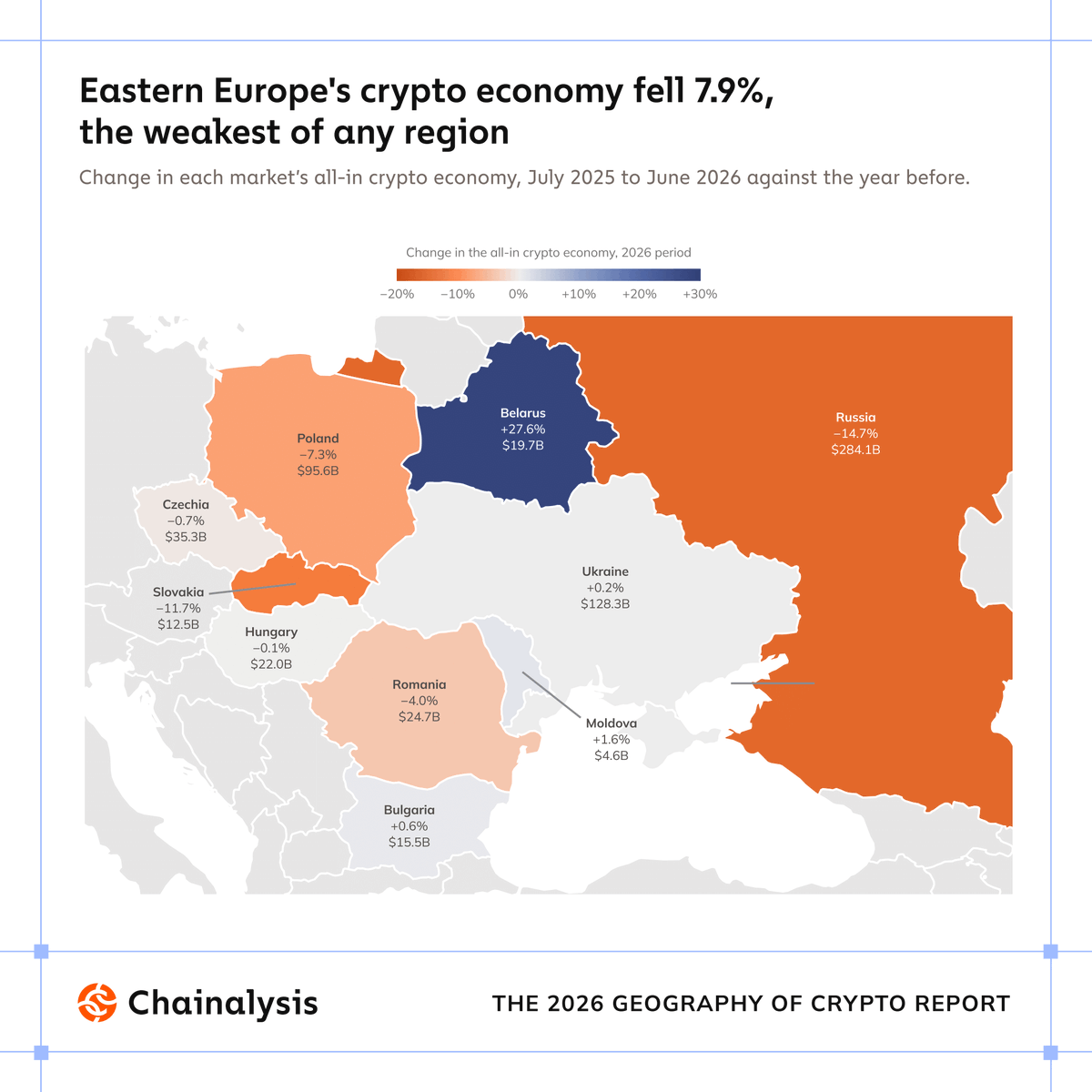
Eastern Europe’s crypto economy fell 7.9% to $642.1B in 2026, the weakest performance of any region we studied. Globally, the decline was 1.6%.
Domestic peer-to-peer volume moved in the opposite direction, rising 330% over the same period.
Across the region, users are adapting:
• Ukrainians abroad are using stablecoins to maintain financial ties with home.
• Poland emerged as the region’s crypto ATM leader.
• In Romania, instant and decentralized exchanges saw temporary surges after a tax increase on crypto gains was announced in July 2025.
War, cross-border financial needs and tax changes are shaping how people use and access crypto.
The global crypto economy declined 1.6% in 2026.
That global figure masks regional growth and shifts in how people use and access crypto, including the growing role of stablecoins.
Sub-Saharan Africa grew 13.4%, the fastest of any region. Eastern Europe declined 7.9%, the steepest regional decline.
Our 2026 Geography of Cryptocurrency Report explores crypto adoption around the world. Some of the findings even surprised our own researchers.
Following illicit funds across blockchains is how the industry makes crypto safer.
Chainalysis is a proud founding partner for the @FASEFoundation, and we look forward to supporting its work.
More than $234M in cash and crypto was seized in Operation TorNado, the DoJ and Europol announced today.
The operation led to dozens of federal prosecutions, including the arrest of two brothers in Florida accused of operating “BarbaraWhite,” a darknet vendor that distributed counterfeit pills containing highly potent nitazenes.
In this case, blockchain intelligence helped link a darknet drug operation to its alleged operators, a network associated with at least 12 overdoses and three deaths across the U.S.
Our Reactor graph below illustrates how funds moved between certain wallets linked to BarbaraWhite and other addresses associated with potential buyers and fellow vendors.
Chainalysis is proud to be a founding member of the Digital Crime Task Force.
Through our subject matter experts, blockchain intelligence and AI-powered investigative capabilities, the DCTF will aim to catch illicit activity involving USDT and TRON sooner, and help law enforcement act before criminals move funds.
.@Trondao, @Tether and @Chainalysis today announced the founding of the Digital Crime Task Force (DCTF), a new initiative designed to proactively identify and disrupt illicit activity involving Tether’s USD₮ stablecoin on the TRON blockchain.
DCTF brings together three industry leaders — a blockchain network, a stablecoin issuer and a blockchain intelligence company — in a next-level collaboration built around proactive defense.
Read more on @Trondao 👇
https://t.co/fP80o9KtBL
We are grateful to all Veterans, and we're proud of the many who we get to call colleagues and customers. Today we pause to honor their service and sacrifice.
Thank you, Veterans, and Happy Veterans Day! 🇺🇸
@MarshallHayner@ChiefVader6@MrAQUAMAN33 Compliance products are back online now, thanks for your patience. We’ve restored it with enhanced security measures, and we’re asking customers to reconnect in a specific way to keep accounts and data protected. If you’re having trouble, please contact support.
The $6.4B Binance theft by North Korean actors began with a fake job interview, per Binance's initial findings.
We have attributed more than $14.3M in losses over the past 18 months to similar DPRK-linked faked interview and malware schemes.
These schemes have spanned a wide range of targets, from individual crypto holders and private wallets to organizations, protocols, and DAOs.
Our analysis suggests these earlier compromises allowed North Korean actors to refine their methods on small targets before deploying them against higher-value targets.
Per Binance, attackers spent weeks building trust with an employee, first approaching the employee through a legitimate job platform with a fake job opportunity.
After two rounds of interviews with a fictitious company, the Binance employee was asked to download an interview assignment that contained malicious code.
From there, they deployed malware and exploited access to an internal AI tool to move deeper into Binance's system.
We have observed multiple similar cases in which victims had wallet private keys stolen from cloud storage following a malicious interview.
Our research also indicates that North Korean actors have used fake employment schemes for other cyber attacks.
For instance, they have used such schemes to conceal malware in public blockchains. We’ve found a fivefold surge in these blockchain-assisted cyberattacks over the past year
The same actors can exploit recruitment platforms, compromise corporate infrastructure, infiltrate legitimate businesses and use crypto to move the resulting proceeds.
Chainalysis closely monitors how DPRK actors use crypto to generate revenue, move and consolidate funds, and launder illicit proceeds.
Combined with traditional cybersecurity measures and threat intelligence, blockchain analysis can help organizations and investigators identify and freeze stolen funds.
It can also map DPRK's expanding financial networks and uncover procurement and payment patterns that can support sanctions investigations and enforcement.
The Binance investigation remains ongoing and we expect stolen funds to continue moving in the coming days.
North Korean hackers stole at least $2.02B in crypto in all of 2025, bringing their all-time total to at least $6.75B.
The Binance hack alone moved ~$6.4B, 95% of that all-time total.
The DPRK continues to undertake significantly higher-value attacks than other threat actors reinforcing that when North Korean hackers strike, they target large services and aim for maximum impact.
“Around 40 to 50% of the total amount that was stolen has already been frozen.”
Eric Jardine of @chainalysis on the response to the Binance hack:
• About $3B is frozen and set to be returned to Binance.
• Exchanges, analytics firms, law enforcement, and stablecoin issuers worked together to trace and freeze the funds.
• More could be frozen as long as the rest stays onchain and isn’t cashed out to fiat.
TODAY ON THE STARTING BLOCK:
We're joined by @chainalysis head of research Eric Jardine to discuss the latest details of the Binance hack.
Join us live on @TheBlockCo 🔽
https://t.co/9aFv2YiZnY