GM CT
Finding a new token is easy. Finding the right token to research before entering a trade is where things get interesting.
That's one reason I'm paying attention to what @Hypesium is building on Elysium.
Its token discovery approach gives traders a way to identify assets using their contract addresses and understand which launchpad they originated from.
I think this is an important detail because the crypto market is full of tokens with similar names, and buying the wrong contract can be an expensive mistake.
But discovering a token is only the first step.
Before making any trading decision, I would still:
➠ Verify the contract address.
➠ Check liquidity and holder distribution.
➠ Understand the token's launchpad.
➠ Review potential risks.
➠ Plan my entry instead of chasing momentum.
What I find interesting about Hypesium is the focus on making token discovery more informed and connected to the trading process.
In a market where opportunities move quickly, having the right information before clicking buy can make a difference.
Keeping an eye on @Hypesium as its ecosystem develops on Elysium.
Explore @starlisting for creator opportunity
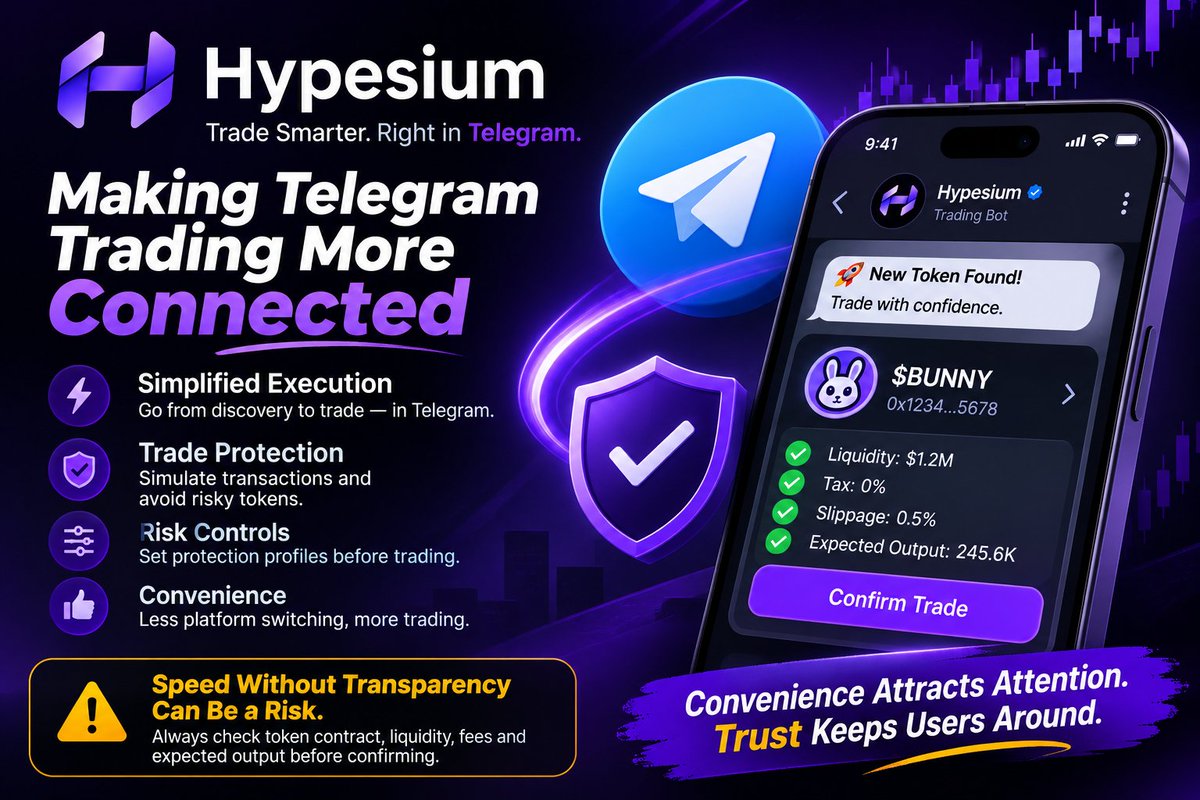
Hypesium: Making Telegram Trading More Connected
One frustrating part of crypto trading is the gap between discovering an opportunity and executing it.
You find a token, check the details, switch platforms, connect your wallet, and finally place your trade.
@Hypesium is approaching this problem with a Telegram first trading experience designed to make that journey more direct.
What makes its approach interesting:
➜ Simplified execution: Move from discovering a trading opportunity to executing through Telegram.
➜ Trade protection: Simulate transactions before execution to check important conditions and reduce exposure to potentially dangerous tokens.
➜ Risk controls: Protection profiles help users define trading conditions before entering the market.
➜ Convenience: Reduce unnecessary platform switching while keeping trading activities accessible.
However, there's one thing I believe should never be overlooked.
Speed without transparency can become another risk.
Traders still need clear information about token contracts, liquidity, taxes, slippage, fees, and expected execution before approving transactions.
A Telegram-based interface can make trading more convenient, but it doesn't eliminate market risks.
My perspective:
Hypesium is interesting because it focuses on a real problem in crypto: fragmented trading workflows.
The goal shouldn't just be to execute trades with fewer clicks.
It should be to help traders make better informed decisions before every transaction.
Convenience attracts attention. Trust keeps users around.
Everyone talks about trading speed, but speed means very little if you end up buying a token you cannot sell.
That's one reason @Hypesium's approach to trade protection deserves attention.
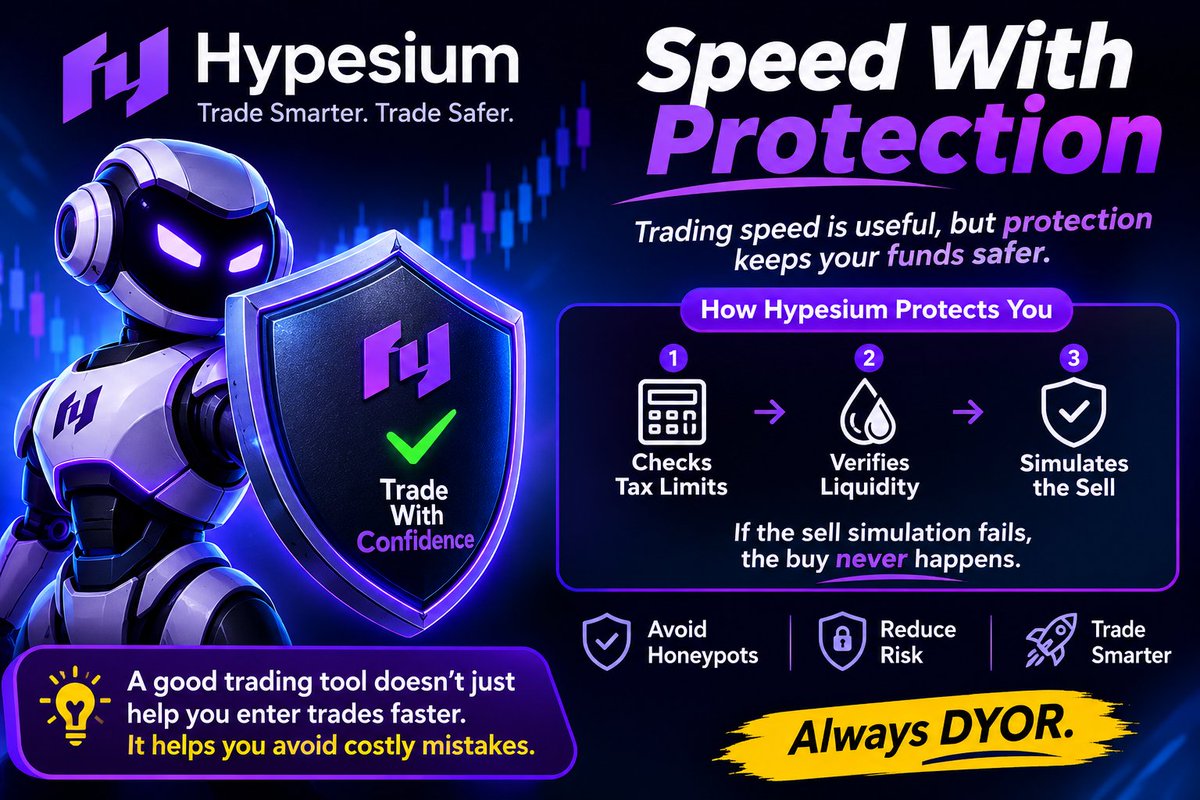
Before executing a buy, Hypesium simulates the exact transaction using the safety profile selected by the user.
It checks important conditions, including:
➜ Tax limits
➜ Minimum liquidity requirements
➜ Whether the token can actually be sold
The interesting part is the sell simulation.
Instead of only checking whether a purchase can go through, Hypesium immediately tests the sell transaction. If that simulation fails, the bot can skip the buy.
This changes the way I look at automated trading.
A good trading tool shouldn't only help you enter positions faster. It should also help you avoid entering positions that could trap your capital.
Of course, simulation is not a guarantee against every honeypot. Delayed restrictions, conditional taxes and changing liquidity can still create risks.
But having an additional safety check before execution is a meaningful step.
For me, the real value of @Hypesium isn't just faster execution. It's making risk checks part of the trading process.
Speed gets you into the market. Protection might keep you from making an expensive mistake.
Always DYOR.
One thing I've learned from following newly launched tokens is that speed means very little if you're looking at the wrong asset.
That's why I find @Hypesium token discovery approach on Elysium interesting.
Being able to identify a token through its address and understand which launchpad it originated from adds useful context before entering a trade.
This matters because similar token names don't necessarily mean the same project, and different launch platforms can have completely different trading conditions.
Before considering an entry, I'd still look beyond the discovery process:
➠ Check the contract and its permissions.
➠ Understand the available liquidity.
➠ Examine holder distribution.
➠ Identify the launchpad and trading mechanism.
➠ Evaluate whether the entry makes sense.
For me, useful trading infrastructure isn't just about helping users find tokens faster.
It's about making the research process less fragmented so decisions can be made with better information.
Hypesium is an interesting project to watch as token discovery and trading continue developing on Elysium.
Explore @starlisting for more creator campaign opportunities.
I've been thinking about what actually makes a trading bot competitive on a fast-moving network like Elysium.
It's not necessarily about how quickly it reacts when a new liquidity pool appears.
A lot of the advantage can come from the work completed before that moment.
This is one technical aspect of @Hypesium that I find interesting.
Instead of waiting for an opportunity and starting every process from scratch, its architecture focuses on preparing important transaction components in advance.
This includes:
→ Preparing transaction routes.
→ Building the required calldata.
→ Keeping gas information updated.
→ Maintaining persistent network connections.
Why does this matter?
When a new pool becomes available, unnecessary preparation can introduce delays.
Having important components ready beforehand can reduce the amount of work required before broadcasting a transaction.
But speed alone doesn't guarantee a successful trade.
Liquidity, execution conditions, slippage and network responses still matter.
My takeaway is that competitive trading infrastructure isn't just about reacting quickly.
It's also about reducing unnecessary work before an opportunity appears.
That's the engineering approach I'm interested in watching as Hypesium develops on Elysium.
Something interesting is happening with the referral side of @Hypesium and I think it deserves attention beyond the reward numbers.
Hypesium recently announced a weekly $1,850 reward pool for its top three referrers.
The distribution is:
→ 1st place: $925
→ 2nd place: $555
→ 3rd place: $370
Rewards are paid in HYPE, with rankings based on the trading fees generated by referred users.
But what interests me more is the underlying model.
Hypesium isn't simply rewarding people for collecting referral clicks. Its structure connects creator growth with actual platform activity.
There are also five referral levels, with direct referral commissions reaching up to 45%, depending on rank.
I find this interesting because Web3 growth shouldn't end when someone clicks a link.
The real question is whether the people joining actually find value in the product and continue using it.
For creators, that means building trust, explaining the product properly and attracting users who understand what they're joining.
Numbers can bring attention.
A useful product is what gives people a reason to stay.
That's the difference I'm watching as Hypesium grows within the Elysium ecosystem.
Good evening, everyone.
In fast-moving markets, execution speed matters, but preparation before execution can make an even bigger difference.
One technical approach I find interesting about @Hypesium is how it prepares transactions before a new liquidity pool appears on Elysium.
Most trading systems begin processing several transaction requirements after detecting a launch.
Hypesium takes a different approach by preparing important components ahead of time.
This includes:
➠ Selecting the transaction route in advance.
➠ Building the required calldata.
➠ Keeping gas information updated.
➠ Preparing the transaction nonce.
When a new pool creation event is detected, much of the preparation is already complete.
This reduces the amount of work remaining before transaction submission.
There's another interesting layer to its architecture.
Hypesium uses multiple communication connections to broadcast transactions simultaneously instead of depending on a single route.
I think this is an important design choice, especially in an environment where timing can influence execution quality.
However, having an optimized architecture doesn't automatically guarantee successful trades.
Actual latency, transaction inclusion, slippage and execution reliability are still important metrics to evaluate.
What stands out to me is the philosophy behind the system.
Instead of waiting for an opportunity before starting the preparation, Hypesium moves important work ahead of time.
In fast trading, being ready before the opportunity appears can be just as important as reacting quickly when it arrives.
That's the kind of infrastructure worth paying attention to.
@Hypesium@starlisting
Always DYOR.
The Hypesium referral competition adds another reason to pay attention.
$1,850 is distributed weekly among the top 3 referrers, with rewards paid in $HYPE.
What makes it interesting is that your ranking depends on the trading fees generated by your referrals, not just the number of people you invite.
Round 1 is already running. If you have an active community, this is worth exploring.
Speed is important when trading newly launched tokens, but entering a trade quickly means very little if the token cannot be sold afterward.
One feature I find particularly interesting about @Hypesium is its transaction simulation and protection profiles on Elysium.
Before executing a buy, Hypesium simulates the exact transaction and checks important conditions such as:
→ Buy and sell taxes.
→ Available liquidity.
→ Expected price impact.
→ Whether the token passes its sell test.
It also offers four protection profiles: Safe, Risky, Moon and Off.
The idea is to let traders choose how much risk they are willing to accept instead of applying the same restrictions to every trade.
For example, under the Safe profile, a token must meet the configured tax and liquidity limits and pass the sell simulation before the transaction is sent.
I think this matters because newly launched tokens can look attractive on a chart while hiding problems that only become obvious when someone tries to sell.
However, simulation is not a guarantee of safety. Liquidity can disappear, token behavior can change, and passing a check does not eliminate market risk.
My takeaway is simple:
A good trading tool should not only help you enter early. It should also help you identify situations where entering might not be worth the risk.
That's an important part of what I'm watching as Hypesium develops on Elysium.
Trading fees are one part of a platform's economy. What happens around those fees can be just as interesting.
That's something worth examining with @Hypesium
Its model combines a 1% standard trading fee with incentives designed to reward users who bring others into the ecosystem.
The interesting part is the lifetime benefit for referred users, who reportedly receive a 10% fee discount.
There's also a referral commission structure extending beyond direct invitations, with additional levels of 6%, 3%, 2% and 1%.
But I think the bigger question is sustainability.
Can a referral system create genuine community growth while keeping trading costs competitive?
For me, the real test isn't how attractive the percentages look on paper. It's whether the system delivers transparent calculations, fair distributions and lasting value for active users.
A good fee model should benefit the platform and its users without making the numbers difficult to understand.
In fast moving markets, finding a token is easy. Knowing exactly what you're looking at is a different challenge.
One thing I find useful about @Hypesium is its approach to token discovery across Elysium.
Instead of relying only on token names or searching through multiple launch platforms, users can work with a token address to identify where the asset originated.
I think this is an important detail because newly launched tokens can have similar names, competing listings and different launch conditions.
Knowing the platform behind a token gives you another layer of context before making a decision.
But discovery should never be confused with verification.
I would still want to investigate:
➠ Contract permissions and potential restrictions.
➠ Liquidity depth and distribution.
➠ Holder concentration.
➠ Whether the trading conditions make sense.
For me, the real value of Hypesium isn't simply making token discovery faster.
It's reducing the friction involved in gathering information before taking a trading risk.
Better discovery is useful. Better judgment is still essential.
Explore @starlisting for campaign opportunities
Buying a newly launched token is only half the decision. Knowing whether you can sell it is just as important.
One feature I find particularly interesting about @Hypesium is its transaction simulation before execution.
According to its documentation, Hypesium simulates the exact buy transaction and then tests the sell immediately afterward.
If the sell simulation fails under the selected protection profile, the bot can skip the trade instead of sending a potentially trapped buy.
There are also four protection profiles:
➠ Safe
➠ Risky
➠ Moon
➠ Off
Each profile comes with different tax limits, liquidity requirements and protection settings.
I think this is a practical approach to one of the biggest problems traders face when exploring newly launched tokens.
A token might look attractive, have an active chart and still contain conditions that make exiting difficult.
However, simulation isn't a guarantee against every malicious contract or future change in trading conditions. Hypesium also documents that Turbo mode skips this simulation.
My takeaway is simple:
Finding an early entry is useful, but understanding the exit conditions before entering is even more important.
Sometimes the best trade is the one your trading tool helps you avoid.
Not every trading opportunity deserves the same execution settings.
That's something worth considering when trading newly launched tokens on Elysium.
One feature I find interesting about @Hypesium is the level of control it gives users over individual trading parameters.
Instead of relying on one fixed configuration, traders can adjust settings such as:
➠ Buy and sell slippage.
➠ Transaction priority through snipeGwei.
➠ Buy amounts.
➠ Protection profiles.
➠ Automatic sell behavior.
Why does this matter?
A trade involving a deep liquidity pool doesn't necessarily require the same settings as an early entry into a newly created pool.
Having configurable parameters gives traders more flexibility to adapt their execution approach to different market conditions.
But flexibility also comes with responsibility.
Higher slippage tolerance doesn't mean a better trade, and increasing transaction priority doesn't guarantee a successful entry.
My perspective is that a good trading bot should provide control without encouraging unnecessary risk.
That's the difference between having more trading options and actually knowing how to use them.
Sending a transaction is one thing. Making sure it gets through when network conditions change is another.
One technical detail I find interesting about @Hypesium is its multi-lane transaction broadcasting approach on Elysium.
According to its technical description, Hypesium sends transactions through four connections simultaneously:
➠ Two persistent WebSocket connections.
➠ Two keep-alive HTTP connections.
The interesting part is that these connections don't simply wait for one another to fail before trying the next.
They broadcast simultaneously, giving the transaction multiple paths to reach the network.
Why does this matter?
Elysium operates with approximately 100ms block intervals, so unnecessary delays during transaction submission can make a difference when competing for early entries.
I like the thinking behind this architecture because it focuses on reducing dependence on a single communication path.
However, multiple connections don't automatically guarantee inclusion, successful execution or better pricing.
Actual results still depend on network conditions, liquidity and transaction competition.
For me, good trading infrastructure isn't just about speed. It's about building systems that remain responsive when timing matters most.
The biggest advantage in fast trading might not be how quickly a bot reacts. It might be how much work it has already completed before an opportunity appears.
That's an interesting part of @Hypesium approach to trading on Elysium.
Instead of waiting for a new liquidity pool and then beginning the entire transaction process, Hypesium describes a system that prepares important components in advance.
This includes:
➠ Selecting the transaction route.
➠ Building the required calldata.
➠ Updating gas information.
➠ Preparing the transaction nonce.
Once the pool creation event arrives, the remaining work is reduced before the transaction is broadcast.
Another interesting detail is its use of multiple communication connections to submit transactions simultaneously rather than relying on a single connection.
I find this approach interesting because it changes where the optimization happens.
Rather than trying to make every individual step faster after a launch, the system moves much of the preparation ahead of time.
Of course, technical architecture and real world execution results are two different things. Actual latency, successful fills and transaction reliability still deserve independent verification.
But the underlying idea is worth understanding.
Sometimes, winning a race isn't about running faster when it starts. It's about being better prepared before the starting signal.
Speed is useful in trading, but knowing when not to execute is just as important.
That's one thing I've been thinking about while exploring @Hypesium on Elysium.
A specialized trading bot can reduce the steps between identifying an opportunity and placing a trade. Having buy and sell actions in one place also makes the workflow more convenient.
But convenience shouldn't come at the expense of decision-making.
A fast entry into a low-liquidity token can still result in significant price impact. Quick execution doesn't guarantee a good fill, and being early doesn't automatically make a trade profitable.
I believe the real value of a trading tool should come from balancing execution with control.
Clear transaction previews, sensible slippage settings, transparent fees and reliable failure handling matter just as much as speed.
My approach is simple: I want tools that help me execute better, not tools that encourage me to trade faster without thinking.
With Hypesium, execution quality is what I'll be watching beyond the speed.